Online video, online video publishing, streaming media, OVP, OTT, web television, video advertising, marketing, startups, gadgets, social media, videoconferencing, collaboration and related topics are discussed here. Thanks for stopping by the "Klessblog."
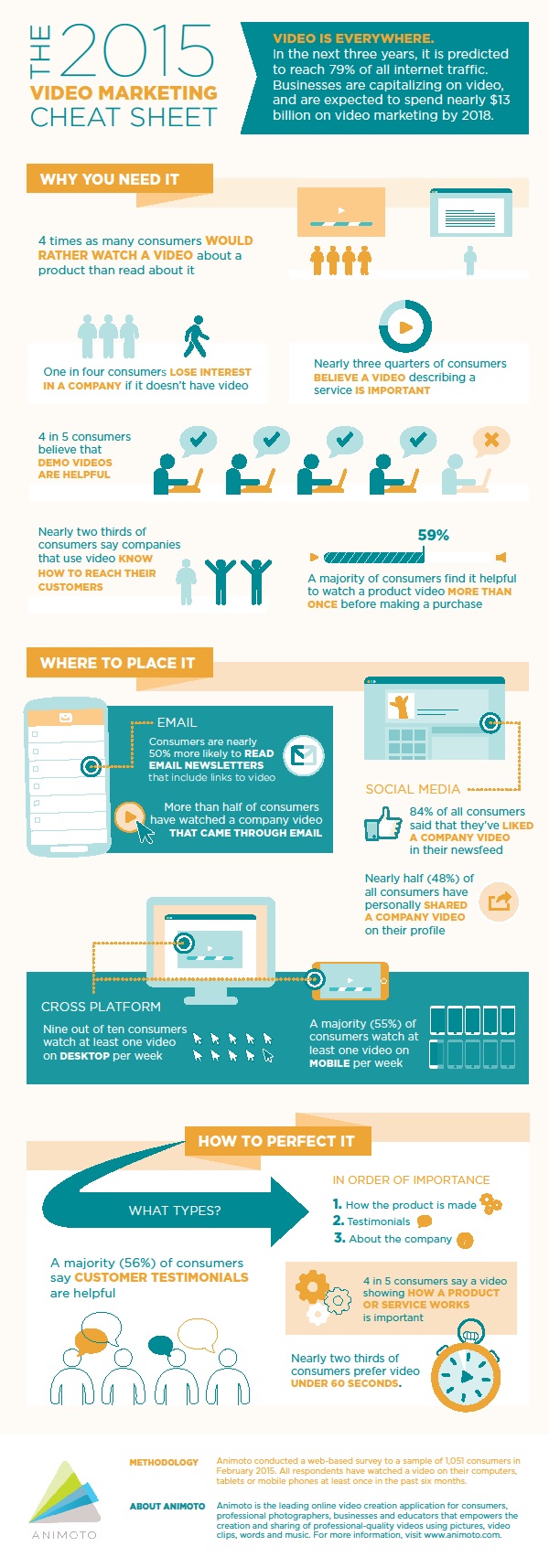
According to a new survey released today by Animoto, the leading cloud-based online video creation service, consumers are hungry for video and four times as many of them would rather watch a product video than read about it. In fact, of the 1,051 U.S. consumers surveyed, 1 in 4 actually lose interest in a company if it doesn’t have product video. The company issued a press release and infographic detailing the findings of its 2015 Video Marketing Cheat Sheet.
eMarketer estimates that US video advertising will climb to $7.8 billion this year and social media platforms like YouTube, Facebook and Twitter continue to attract and build content partnerships. Animoto CEO Brad Jefferson sees video as a huge opportunity for businesses to engage with consumers:
"The growth of online video marketing in recent years has been tremendous," said Jefferson. "Today, there are more than 7 billion videos watched every day on Facebook and YouTube. Historically, in order to create and distribute high-quality video to your customers it was cost-prohibitive for all but the largest brands. However, today's tools and platforms ensure that small and medium businesses can reach their audiences where they hang out online. This represents one of the biggest marketing opportunities for small businesses in a long time."
1. Video Marketing Resonates With Consumers (Video drives brand lift)
63 percent of consumers say companies that use video know how to reach their customers
One quarter of consumers lose interest in a company if it doesn't use video
56 percent of consumers believe that if a company has a website, it should have video
2. Video Boosts Email Marketing and Social Media Engagement (Connect with consumers)
84 percent of all consumers said that they have liked a company video that has appeared in their newsfeed
43 percent of consumers are more likely to read email newsletters that include links to video
56 percent of consumers have watched a company video that came through email
Nearly half of all consumers have shared a company video on their own social media profile
3. Video Boosts Email Marketing and Social Media Engagement (Tell your story)
80 percent of consumers say a video showing how a product or service works is important when learning about the company
56 percent of consumers says customer testimonials are helpful when purchasing a product/service
About half of customers say that 'about the company' videos are the most helpful when purchasing a product/service
About Animoto:
Animoto makes it easy for businesses to create effective, professional videos within minutes with no video editing experience. Businesses use Animoto to enhance and promote their brands, drive website traffic, increase sales, and create dynamic email, social and online marketing campaigns.Founded in 2006, Animoto is based in New York City with an office in San Francisco. For more information go to: http://animoto.com/business.
In a recent white paper, 7 Online Video Trends to Watch in 2012, online video management analytics company Skytide outlined the emerging trends in the online video industry and the content delivery supply chain that serves it. If the last few years were any indicator of the hockey stick affect of rapid change within the video sector, 2012 promises to be full of twists and turns and major and disruptions. While predictions are a dime a dozen, they have much more relevance when coming from an industry expert and authority on the subject. I caught up with Patrick Hurley, VP of Marketing of the Oakland, California-based Skytide, and author of the white paper, to get an insider perspective on their online traffic projections, federated CDNs and why Telco CDNs will dramatically change the content delivery market. The white paper has been very well received, as Hurley noted, since it was first posted on Slideshare late last year where it's currently accumulated over 8,000 views to date and was featured among their 12 best presentations with predictions for 2012. It is also the number one search result on Google for video trends.
1. Online video traffic will continue to soar
Skytide says the first trend to watch in 2012 is that online via traffic will continue to soar. Hurley admits that while this is no big surprise, they have data to back that up, including Cisco's Visual Networking Index (VNI) that forecasts online video will account for 90% of all consumer IP traffic by 2013 and a compound annual growth of 32% from 2010-2015. Skytide's own large Tier 1 customers are very bullish on this and have seen growth rates exceed all industry expectations. Skytide is even more bullish and believes that it's possible for the coming years that online video traffic will grow 50% or more annually.
"The implications for that are really significant, for the Telcos and Communications Service Providers (CSPs)," explains Hurley. "Because that could compound an already serious problem that they have. They're caught in a vicious cycle."
The cycle starts with the fact that their legacy businesses (landline, telephony, etc.) which used to be their cash cows are really declining quickly and they can't count on them anymore. At the same time, consumers continue to have this insatiable appetite for online video, but that demand requires that the big Telcos, ISPs and CDNs invest heavily in capital expenditures to support their infrastructure. That would be great, if they could recoup those costs, but the problem is, the only thing their getting from online video consumers is a very modest monthly fee, which is your ISP bill, so they aren't able to monetize their capital expenditures.
Hurley says that CSPs need to extricate themselves from this vicious cycle and pursue new strategies. One of the trends we saw in 2011 will continue into 2012, says Hurley, and that is that the Telcos and cable companies are going to get into the content delivery business, which is an inherent strengths they can leverage as owners of the network infrastructure with direct relationships with end users and content owners. That helps them on both sides of the ledger and create new revenue streams.
2. Telco CDNs will make big waves
Owning the network is the biggest advantage that the Telcos have because they control the Quality of Service (QoS) over the last mile, and more importantly, there's a cost savings component there as well. In particular, CDNs like Akamai and Limelight have to lease the bandwidth from the network operator, and network operators don't have that issue.
Based on those advantages, we'll be seeing more of that in the next year, which leads to Skytide's next prediction, that Telco CDNs will make big waves in 2012. Over the last several years the Telcos have waded in the CDN waters slowly, but now they're diving in head first. Some of the world’s largest telcos have now deployed their own CDNs, which is diminishing the dominance of pure-play CDNs. Companies from outside the space (Amazon, Google) are getting into the CDN business and the trend by major content providers (Yahoo, Microsoft, Google) to operate their own in-house CDNs. Dan Rayburn lists many of them on his blog here: Updated List Of Carriers, Telcos and Pure-Play Companies In The CDN Business | StreamingMediaBlog.com.
3. Federated CDNs will finally shift from concept to reality
The third prediction is that Federated CDNs will finally shift from concept to reality in 2012. This has been a hot topic of discussion at content delivery conferences over the last year, and Hurley says that's for good reason. As Federated CDNs move from concept to reality, it will cause a seismic shift in the CDN market.
"CDN Federation stands to be very disruptive, giving service providers an unprecedented opportunity to compete directly with market leaders like Akamai and Limelight in the global CDN arena."
In June of 2011, Dan Rayburn announced on his blog that a group of telcos had founded an Operator Carrier Exchange (OCX) to formalize the process and standards of interconnecting their content delivery networks. Just a few months later, Cisco announced at the CDN World Summit that it had completed a CDN interconnection pilot with several tier 1 telco providers (BT, KDDI, Orange, SFR and Telecom Italia).
In my conversation with Hurley, he skipped over the following three trends, but encouraged people to download the white paper to read more about how they'll be taking greater shape in 2012:
4. Adoption of Adaptive Bitrate protocols will grow 5. IPTV providers & MSOs will extend reach into OTT models 6. Multi-screen viewing will become the norm
7. Online video advertising budgets will soar
And, finally the last trend is that online video advertising budgets will soar. Hurley says that it's created a virtuous cycle based on a confluence of factors that plays in its favor. First, technology is finally at a point where online video resolution and reliability is to the advertisers liking.
"Advertisers buy an audience," says Hurley. "They also buy adjacency to content and they have to have that in a quality experience, and that's what they're able to get now."
They're also able to to tap into new technologies like adaptive bitrate streaming which holds the promise of ad insertion into a live stream, and that mirrors the model of traditional TV advertising. But most importantly, advertisers go where the audience and the audience is increasingly going to tablets, mobile phones and laptops to watch online video. So that confluence of virtuous events is really poised make online video advertising budgets grow 27% in 2012.
About Skytide
Skytide, the leader in Online Video Management Analytics, provides content delivery providers and digital media companies with the most complete operational view of their streaming video businesses, delivering the information necessary to make better-informed business decisions. Only Skytide's out-of-the-box analytics and reporting solutions can process massive amounts of disparate data sources and turn it into detailed reports in near real-time. Skytide is venture-backed and works with leading digital media and technology companies including: British Telecom, Broadpeak, Cisco, Clear Channel Communications, HP, Juniper Networks, Telecom Argentina, Telecom Italia, Telefonica and Telstra.
Earlier this year at OTTcon, I caught up with Suranga Chandratillake, CEO and Founder of blinkx, which describes as "the world's largest and most advanced video search engine." Chandratillake founded blinkx in 2004 and has helped pioneer video search on the Internet. Unlike other search engines that focus on text web, titles and metadata, blinkx uses a unique combination of patented conceptual search, speech recognition and visual analysis to find and qualify online video. The company has an index of over 35 million hours of searchable video and more than 720 media partnerships, including national broadcasters, commercial media giants, and private video libraries.
Chandratillake says blinkx has positioned itself as a premier destination for online video.
"When you come to blinkx.com, and search for any topic you're interested in right now, we can find videos for you that match that topic, that are highly relevant to that topic of interest and we bring those back to you. So you can click on them and watch them, and that's our core business. But we also power video search behind the scenes for other people too."
In particular, if you go to Ask.com, blinkx powers the video search experience for that site, which in turn helps power blinkx's ad business with its tens of millions of unique views each month that it sells advertising against.
"One of the really nice things about the advertising is that we use our search technology to try and target the ads. So if you're watching a video about a particular topic, you will likely see ads that are highly relevant to that video."
From a user perspective, Chandratillake says, that's great because you're not getting irrelevant ads that waste your time.
"It's also great from an advertiser's perspective because it means you're being able to engage people or consumers who may actually care about your product."
In April of 2011, blinkx acquired online video media company Burst Media for $30 million in stock and cash in a move to integrate its premium video content with Burst’s 150 million monthly uniques 35 billion page views (according to comScore Media Metrix, September 2011). Just last week, Burst Media introduced 12 new Internet video channels premium video from a host of blinkx's direct play partners, including Reuters, Howcast, CelebTV, GeoBeats and TVGuide, offering TV-style programming on a wide range of subjects, from food to fashion, celebrity gossip to gardening, health to How To.
blinkx also also made two strategic partnership announcements last week, that it is powering video for Aurasma, and it is partnering with Orb Networks to bring its vast video catalog to Orb BR and Orb TV Users. Aurasma is the world's first visual browser for smartphones and tablets that recognizes physical objects and delivers related online content - videos, animations, audio or web pages - in real time.
Orb TV is a hockey puck-sized OTT device that plugs into any TV, enables consumers to stream online video, photos and music to a TV. In addition to blinkx content, Orb TV provides consumers with easy access to services such as Netflix, Amazon Video on Demand, Hulu and Comedy Central. Orb BR is a software solution that leverages the power of PS3s and connected Blu-ray players to bring users the same content as Orb TV - without any additional hardware purchase. With the announcement, Orb BR brings blinkx content to the millions of PS3s and connected Blu-ray players in the market.
Chandratillake noted that the the online video and OTT space has come of age after so many years of video on the Internet. What's different, he says, is the momentum at which the idea is gaining. The reason for that is because the reality of that connected television universe is just getting ever close. More and more of us are watching Internet video on our television sets or contemplating the purchase of a set-top box or game system to watch OTT video.
"From a blinkx perspective, we look at the TV as the screen or one of the screens of the future. Today, the vast majority of our business, and most our audience is accessing our system through a computer screen. But in the future, I don't know if it's either two years or five years, I think a lot of people will actually access it straight through a television screen. So we've got be there and offer a very relevant service, but it's very important that we make the right partnerships to make sure our services are available though all these different devices."
Just as OTT video is gaining speed, so is social video, with video discovery and recommendation becoming more relevant than video search, which almost seems antiquated in comparison.
"Search and discovery are two sides of the coin," Chandratillake noted. "So on the one hands they never see each other , or on the other hand they're on the same coin. It's one of these classic cases where things can be so closely inter-related, yet so far apart. But its all down to the nature of what the user or consumer is doing at a given point in time."
Search is more of a lean-in experience, where you're doing investigative work finding specific information in a search engine like Google, Yahoo or Bing. You tend to add, subtract and play around with words to find the right combination to get the best search results. That, of course, is also the case with online video search.
But there are many other cases on television when actually it's about relaxation. It's about leaning back. It's about turning the box on and leaning back on the sofa and having entertainment come to you. Whether that piece of video is recommended to you by a friend or from personalized recommendations like blinkx's system.
"That's where discovery comes in," says Chandratillake, "discovery is about knowing enough about you, and knowing enough about the content to figure out what you want to watch right now."
About blinkx
blinkx plc (lse aim:BLNX) is the world's largest and most advanced video search engine. Today, blinkx has indexed more than 35 million hours of audio, video, viral and TV content, and made it fully searchable and available on demand. blinkx's founders set out to solve a significant challenge - the growing amount of TV and user-generated content on the Web means keyword-based search technologies only scratch the surface. blinkx's patented search technologies listen to--and even see--video on the Web, helping users enjoy a breadth and accuracy of search results not available elsewhere. In addition, blinkx powers the video search for many of the world's most frequented sites. blinkx is based in San Francisco and London. More information is available at www.blinkx.com.
2010 was massive year of growth for online video, throughout the industry and the way consumers accessed video content. Analysts are seeing a sharp rise in online video viewing compared to traditional television, which has huge implications for online video advertising and marketing. Digital media measurement firm comScore noted in its “The 2010 U.S. Digital Year in Review” that eCommerce spending in 2010 grew 9% to $227 billion in sales. Social networking site continue to drive views as audiences build, share and engage on sites like YouTube, Facebook, Twitter, LinkedIn and Tumblr. For businesses, there's no other tool more important than online video analytics to capture how your video content is consumed on the web.
Dan Piech, Senior Product Management Analyst with comScore says, the best way online video publishers and marketers create and sustain value is through differentiation, and the way you do that is through your data.
"It's not just about understanding your audience," Piech says, "but then putting together a pitch that sells that audience to advertisers."
Piech says that online publishers will not have the reach of a television audience, and for small publishers it will be even harder. So he suggests that publishers find that niche audience, develop it and sell that niche based on what you've learned about it from your metrics, because the agencies are not going to do that for you. He says that digital market intelligence services like comScore help you better understand your audience.
comScore believes that they have the most accurate methodology for measuring digital media. Each month, the digital media measurement firm comScore releases its Online Video Rankings from its Video Metrix service, with the most recent comScore May 2011 U.S. Online Video Rankings, that showed 83.3 percent of the U.S. Internet audience (176 million) watched online video content in May for an average of 15.9 hours per viewer. Video ads accounted for 12.6 percent of all videos viewed and 1.2 percent of all minutes spent viewing video online.
How comScore gets at the data is a secret sauce merged from two sources. The first source is a panel of two million Internet users worldwide that they track their behavior. One aspect of that behavior is watching videos. So they're able to understand where they are watching videos, how long they're watching videos, get a good sense of unique viewers , and project that to the total populations. The second source is census-level data collection method, commonly referred to as unified digital measurement, and comScore works with all the top publishers in the video and media space to get that data. In the method, publishers send data every time a video is viewed.
"By that we're able to get a very census-level, total population look at the video activity on that site," Piech says. "and furthermore, break that video activity down to very granular levels."
As an example, for clients like NBC, CBS or MTV, comScore is able to break down how people are engaging with those shows on a a census level from that unified digital measurement, as well as on the panel. Like Nielsen, comScore tracks that activity across all screens and as Piech notes
"Obviously we're paying close attention to the cross-media space and the three screen developments that are taking place. Because at the end of the day, content is king, as you always hear and to the extent that that's the case, we have to follow that content wherever it goes."
Piech says, currently that's mostly online but we're at a turning point in the space where mobile and OTT are growing very fast. So comScore is working on developing the indicators to know where the space will be in five years, mostly through surveys that help forecast audience perceptions. In a recent survey, comScore was working to understand the level of ad loads that users would be willing to watch, or rather willing to endure. What they found was that online viewers are perfectly willing to watch twice as many ads for their content. Piech says that when it comes down to it, the numbers are people, and by putting a face to the numbers puts an emphasis not just on numbers, but attitudinal changes happening in the space which helps publishers better understand how their content is consumed so they can best monetize it moving forward.
As the current trends in online video continue to show massive growth, so does the opportunities for online video publishers and marketers. Many analysts say that for the last several years we've reached a tipping point for online video.
"We've reached a state in the online video space now where almost everyone online is watching video at some point in the month," says Piech, "so we've now got that reach. But what's interesting that we're finding out is that now that everyone is watching online video, people are starting to watch a lot more."
He says it's more than doubled in the last year and is fascinated by the trend, because online video is still a small part of the overall activity of any individual day as compared to television, but what's happening is that's growing incredibly fast. Engagement levels are up, number of videos views are up and that's across all demographics and all across the board, and it's happening at a very high rate.
"So if you do a simple extrapolation that, in the very near future where online video is a major, major player out there," Piech notes, "and that's what makes me really excited about the space. We're not a dying industry, we're in our birth and really high growth state which makes this a very exciting space and a space that changes quickly."
This interview in this post was conducted at the Online Video Platform Summit where Piech was a panelist on the session, Online Video by the Numbers: Analytics, Reporting, and Metrics. He was joined by an all-star panel that examined what type of important data you should be collecting and how to use that data to improve the effectiveness of your video and increase your ROI.
Piech also spoke earlier this year at OMMA Video on, The State of Online Video, where he provided a picture of today’s online video consumer which can be viewed in the video below.
"Who is watching, how engaged are they and what has changed over time? Where are we seeing the biggest shifts – long-form or short-form videos? What impact is online video having on traditional TV viewing, and when it comes to online advertising how are consumers’ preferences shaping the market?"
Dan is a Senior Product Management Analyst at comScore, Inc. and President and Founder at evoxio. At comScore, Dan manages comScore’s online video measurement products and is responsible for ensuring that measurement insights support the growth and development of the online video industry. Previously, he was anInteractive Strategy Intern at McKinney, Project Manager at HG Media, Inc and Advertising Intern at Success Communications Group. comScore is a marketing research company that provides marketing data and services to many of the Internet's largest businesses. Follow Dan Piech (danpiech) on Twitter
Core to any good video content strategy is a blend of ingredients that compel and engage viewers to discover and share your content. You can have the most compelling content in the world, but if people aren't aware of it and can't find it easily, it won't make any difference. According to Patrick Starzan, Vice President of Marketing and Distribution for Funny or Die, its recipe for success is a combination great content, search engine optimization and social media. I caught up with Starzan at the Online Video Platform Summit where he discussed how Funny or Die developed its content strategy and some of the common mistakes publishers make with online video.
Funny or Die is both a video content site and brand focused on funny videos, and since its founding in 2007 by Will Ferrell, Adam McKay and Chris Hench, it has become one of the top destinations for comedy on the web. It's known for celebrity-driven comedy and has a steady stream of topical viral hits, including its most viewed video, The Landlord, with over 76 million views that features Ferrell, McKay and McKay's two-year-old daughter Pearl who plays the foul-mouthed landlord that berates Ferrell for overdue rent money. Other celebrities are featured regularly in Funny or Die exclusives, such as Zach Galifianakis' hilarious web series Between Two Ferns. The October/November 2010 issue of Streaming Media magazine features an in-depth cover story on Funny or Die, The Art and Science of Funny or Die - Streaming Media Magazine, that chronicles the rise and success of the popular comedy website, which Streaming Media editor Eric Schumacher-Rasmussen calls, "a shining example of marrying the best of Hollywood to the best of Silicon Valley."
Starzan says:
"For us, social media has been a core part of how we get our content discovered, and it's something we've working on for years."
How Funny or Die got there, Starzan says is that:
"Everything starts by defining your KPIs (Key Performance Indicators) and your metrics and what's important for your company's success. So we did that and we went out and developed a content strategy, separately for each of the platforms, understanding that the type of person on each platform is consuming and engaging in content in different ways. We really follow a strategy of building social capital, trying to give more than we get, trying to interact with the user, trying to give them a platform for access to Funny or Die, but also a platform where we can celebrate who they are."
Starzan says the Funny or Die team spends a lot of time working on their content strategy, about eight to nine hours a day on each of the platforms, because they feel that users are more engaged with content they want to watch.
"After your content strategy," Starzan suggests, "you start with your acquisition strategy and figure out how to target more people to come to join each of your platforms."
For many brands, the question of whether or not to drive traffic to its own site rather than establishing a presence on YouTube is quite common. For Funny or Die, its content strategy was to first establish its brand and then go to YouTube.
As Starzan explains:
"For us, coming out of the gate we really wanted to establish Funny or Die as a brand and we took a very walled garden approach. So we really wanted to control the experience and optimize the experience to out users, until we felt we had a brand that had a solid foundation. We didn't want to dilute it by actually going out and doing a lot of distribution, especially with YouTube. Once we felt we had that brand equity, that's when we went to YouTube and established a windowing strategy of our content over on YouTube, because obviously YouTube has a huge, huge audience."
Starzan says though that YouTube distribution hasn't cannibalized its brand or the video views on its own website and sees about the same amount of consumption on YouTube as on its our own site.
So for Funny or Die, it's now about exposing its brand to the largest audience. But as Starzan notes, a lot of Funny or Die's traffic comes from search and they've done a lot of work optimizing their video players and the specific type of keywords. Direct traffic though continues to grow as Funny or Die has become more of an established brand. But by far, social media has been one of its critical success factors for audience building and has a presence on Facebook, Twitter, Tumblr, StumbledUpon, Reddit, and so on, which are all places that people can search and discover Funny or Die's content.
By the numbers, Funny or Die's social media presence continues to prove successful by doubling its number of followers in the last six months, with 2.2 million Twitter followers and with 938,749 Facebook fans (but more than 3 million Facebook fans along with co-founder Will Ferrell), 40,000 followers on Tumblr and 468,306 subscribers to its YouTube channel. The website is also getting 2,000 “Likes” per day with an overall audience reach of 32 million through its social media channels.
"We make funny videos with celebrities in it," Starzan laughs, "and it lends itself well to the social media world."
The advice he offers to online video publishers and marketers to get their content discovered is that:
"It's about really having a comprehensive strategy. I don't think you should look at one, search over social media, as two different things, or two different variations of what's important. They're both just as important as the other. Because at the end of the day, you want to have your content discovered as quickly as possible by relevant audiences… So, put as much time into both of them as you can."
Starzan admits that they've learned a lot from trial and error, and for search, he recommends that you make all your content embeddable; that you have links coming back to your site; and that your tags are using the optimal keywords that you want to be discovered for, because it becomes a huge back linking strategy and you define what people are seeing when they back link to you. He says it's about making sure you do the simple things; like making sure your sitemaps are indexed with all the search engines and identifying the keywords that drive traffic to your site or to specific pages. If they'e driving a lot of traffic, go to that page and optimize that keyword for that page so you can rank better in search.
For publishers looking to build out their platforms using social media, Starzan says that it's not just about driving traffic to your site but about being a part of the community. While Funny or Die has an edge over other media properties through its celebrity power, he says it really comes down to the basics, which first and foremost, is to make great content.
"You have to have great content if you're ever going to survive on social media," he says, "and make a lot of it. Then just make sure you're in those communities. I think a mistake a lot of people make, and we made it in the beginning, is we just put up these pages and we'd put content up there and expect people to engage with it, share it and do everything we wanted them to do with it, but it just dies. You have to be there everyday – it's just like any other social interaction – you have to be there, you have to have that conversation, you have to listen as much as you talk. So take the time to learn all the nuances and definitely realize that, a lot of people say social and SEO are free, organic ways of driving traffic, but it take a lot of time in terms of resources to really develop these platforms and really optimize them."
Funny or Die recently introduced a new feature to its video player to help drive traffic from social media sharing by adding a clickable embedded Twitter hashtag. According to NewTeVee's Ryan Lawler, the latest episode of Between Two Ferns with Zach Galifinakis features the new social media element which is located in the bottom right corner of the video player.
"The embedded hashtag is a call to action that enables viewers of the video to share it with their friends," says Lawler, "Once clicked, it launches Twitter with a link back to the episode and the #btwn2ferns hashtag."
In an email to NewTeeVee, Starzan wrote:
“We are pretty excited about the potential of the in-video hashtag in driving usage and overall Twitter traffic. Since no one else is doing this it’s the first video we tested in, [but] I expect usage to increase as our users gain more exposure to it.”
About Funny or Die
Since its inception, three years ago, Funny Or Die has emerged as an award-winning, top destination for comedy on the web. With hundreds of exclusive celebrity videos and a steady stream of huge viral hits, Funny Or Die has become the "place to be seen" for comedic celebrities, and the obvious destination for a daily comedy fix. Funny Or Die's founders are Will Ferrell, Adam McKay and Chris Henchy. Judd Apatow is also a principal partner in Funny or Die. http://www.funnyordie.com
Follow Patrick Starzan, VP of Marketing, Funny or Die
Head of Marketing @FunnyOrDie. I tweet about the interweb, marketing stuff and the FOD. I like coffee, tobasco, punk music and you!
So, what constitutes a video view? Is it considered a view just when the stream is called up and served to the viewer, even though only a portion of the video is viewed? Does the entire video need to be viewed to be counted? After several years of inconsistencies, the online video industry has not yet adopted a standard definition for a view. So to get some insight on this subject I spoke with David Burch, Director of Marketing at TubeMogul, Inc. According to Burch, while the industry standard is to count a view once someone clicks play and the streams starts, there still is a lot of misconception among media buyers on constitutes a view.
Burch says the technology is definitely there and Tubemogul has been putting out benchmark data on video completion rates for some time. Back in 2008, Tubemogul put together a study on What Counts as a View? which identified the differences in view counting among popular video sites. Most of the sites counted any interaction with the video player (full view, 1/2 view, refresh, embed, embedded autoplay) a view and as the report states, "The implications are relevant for video advertisers, content publishers, and those that might seek to artificially inflate the popularity of a given video."
Jim Louderback
Jim Louberback, CEO of Revision3 Internet Television, has been very outspoken on the need for standardization and has railed against the industry practice of counting an autoplay-start, as a video view and the growing prevalence of "stream fraud". He cited Tubemogul's updated study from September 2010, which reported that the problem of counting views was getting worse and nearly all video sites, except YouTube, counted anything including embedded autoplays as a view. According to YouTube, "A view occurs when a person watches your video. In order to preserve accuracy in view counts, we identify irregular playbacks such as spam and remove these from the view count."
Burch suggested that for publishers and advertisers it becomes a tradeoff. Another Tubemogul research report looked at drop off rates for pre-roll ads, which found that for many viewers, sitting through a pre-roll just isn't worth it. In fact, the overall number of viewers that clicked away from a video during 10-30 second pre-roll ads was close to 16%, and that number varied with top magazines and newspapers, where 24.85% of viewers click away; large broadcasters, only 10.9% of viewers click away during an ad, and video sharing sites saw 38.4% viewers click away and never actually watch the video content they originally came to see.
For advertisers, it becomes a bit of quandary when it comes traditional CPMs (Cost-Per-Impressions). If an "impression" or "view" is logged at the beginning of the pre-roll, for instance, and not after the ad has been viewed in full, then it's quite possible advertisers could end up paying for viewers that never saw their ad. For publishers, they risk losing a quarter of their audience based if they run pre-roll ads.
Burch concluded that:
"There is consensus around the industry about when to count a view, that's just a stream. But I think there's also consensus that that's obviously not enough. The technology is there to track it but benchmarking is just the beginning."
About Tubemogul
TubeMogul is a video advertising and analytics platform that connects advertisers with highly targeted audiences. TubeMogul's advertising solution is powered by the company's unprecedented data platform that tracks billions of video streams every month from the Internet's top publishers. This unique technology enables TubeMogul to help advertisers find consumers who want to watch their videos - and watch them longer. Advertisers and marketers never again have to choose engagement and accountability over reach if they use TubeMogul's video advertising and analytics platform.
This week in a keynote address at the OTTCON Over-the-Top TV Conference 2011 in San Jose, Scott Puopolo, Vice President and Global Head of Cisco's Internet Business Solutions Group (IBSG), presented Cisco's predictions on what the future of television might look like in 20 years. Puopolo and his team developed the predictions based on interviews with more than 50 television industry and academic thought leaders who all agreed that almost every aspect of TV will be transformed – from how we interact with the TV; how channels will go away; how the remote control will disappear; how screens will do anything, anywhere and will become the nexus for all our connected, interactive and social video experiences – and move us away from the traditional linear "lean-back" TV viewing experience towards an immersive, collaborative experience in the future that goes beyond the Jetsons cartoon.
Many of the predictions are already evolving today with the explosion of connected devices, 3D viewing experiences, augmented reality, transmedia storytelling, advanced technology of touch screen and gesture driven control of screens that we've seen in futuristic sci-fi thrillers like Minority Report. As an example of what's in store for the future, Cisco says that TV will become a broader and more immersive sensory experience that will go beyond the visual and auditory senses to include the sense of smell and touch. But by far the biggest driver that propels innovation is the growth of online social communities and our need to be connected to them. Social interaction is embedded in many of the predictions of which could likely come to pass in the not-too-distant future.
I caught up with Puopolo following his keynote, where he presented 5 of the 10 predictions from the study, The Future of Television: Sweeping Change at Breakneck Speed, which he said, "offers the first holistic vision of the future across all key dimensions of the television industry and sheds new light on the likelihood and timing of innovation."
On the Cisco blog, Puopolo summarized the 5 predictions he presented to the OTTCON audience:
Is It Real or Is It TV? Sensory technology will enable new creative tools for producers and new experiences for consumers. So we’ll not only see Rachael Ray’s brownies -- we’ll smell them, and eventually taste them, too.
Screens Do Anything, Anywhere: Instead of buying TV sets per se, viewers will buy multipurpose screens. A screen in a bedroom could display your favorite painting or change into a teleconference monitor when you’re not watching TV.
Don’t Just Watch, Get Involved: Viewers will break the confines of the TV episode and interact with their favorite characters in everyday life. They could, for instance, collaborate with other fans to help key characters solve a crime or mystery.
Channels Go Away: Soon TV will be customized to your tastes. No more searching through menus to find a show -- the best streaming and on-demand TV will find you.
Viewers Kiss the Remote Goodbye: Consumers will use words, gestures, and devices such as smartphones and iPads to control their TVs. You might raise the volume or choose a different show with a simple flick of your wrist.
The 5 others predictions in the study are:
Ads Get Personal - you can interact with - In the future the majority of ads will be contextual, highly interactive, and laser-targeted to each viewer.
Watch Together, Virtually - TV will be an enabler of social interaction, encouraging group participation at home with remote friends and family. Viewers will experience a sense of community for the duration of the program.
Your TV Follows You - Content will be ubiquitous and available to you on any device wherever you are. Consumers will no longer be tethered to a particular device or network, and there will be limited ties to time itself.
“Regular Joes” Go Hollywood - Semiprofessional and amateur film and TV-making will flourish, and decentralized methods to create, fund, and deliver content to the mass market will thrive.
Creation Goes Viral - Content creators will invite consumers directly into the process.
CiscoIBSG produced this video to describe the 10 predictions for the future of television:
While the views among the experts varied on adoption rates of technology most did agreed that pay TV models will evolve and that consumers will have more control of their content experiences. Cisco IBSG believes that the combination of three key drivers—technology, consumer behavior, and business models – will accelerate our vision of the future and bring about enormous changes within the next 5-10 years that will permanently and dramatically alter our television experience.
For the evolving industry of PayTV operators, content producers, consumer electronics manufacturers, media aggregators and service providers, Puopolo said that competition for the consumer will also intensify dramatically.
So, what's the big message in all of this?
Puopolo summed it up in this way:
"The concept of consumer, controlled, increased, immersive, interactive experience is going to be the future of television and the consumption of our content is going to be ubiquitous. We'll be able to access it anywhere, anytime, from any device in any format."
Last week Ooyala issued a major announcement that it has signed a multi-year agreement strategic relationship with Yahoo! Japan which will open up its access to 80 million users – the world's second Internet economy. Ooyala CEO Jay Fulcher said that it's one of the largest, if not the largest industry deals at this point. Yahoo! Japan is the 12th most trafficked site in the world, and 1st for all Internet traffic in Japan – "about 60% of the Internet traffic in Japan today. The partnership paves the way for rapid evolution of the delivery, analysis and monetization of online video in the Japanese market." As far as video goes, Yahoo! Japan serves approximately 40% of its online video, about 200 million page views per day, and is growing 25% per year.
"Over time, Yahoo! Japan will standardize on Ooyala across all of its properties. They will leverage our advanced technologies for wide ranging video initiatives such as cross-platform video delivery, subscription, and advertising services. Yahoo! Japan will deliver rich video experiences on connected PCs, smartphones, tablets and ultimately TVs in the Japanese market."
Fulcher said that this deal is very complementary for both companies and Ooyala will help advance video delivery and monetization in Japan. Video is no longer just a business imperative, but a strategic imperative and the convergence is underway, as he says in this Ooyala video release:
"While it will take time to get Yahoo! Japan up to scale, I think this deal could bring in a substantial amount of revenue for Ooyala twelve months from now. By substantial I mean multi-millions, especially since Yahoo! Japan's stream count is in the billions each year."
Rayburn added that Ooyala is a "clearly a force to be reckoned with":
"In the online video platform space, the market is currently dominated by Brightcove, Ooyala and Kaltura in terms of market share. For some time I've thought that it would be very hard for any company to really give Brightcove a run for their money, but Ooyala seems to have really picked up a lot of momentum as of late and this deal is probably one of the largest seen in the OVP space."
Just a few months ago Ooyala raised a $22 million fourth round Series D funding which was used to build up its presence in Asia. Since its founding in 2007, Ooyala has raised $42 million and has 120 employees with corporate offices in Mountain View, California with offices in New York, London and a new office in Sydney and is working on Tokyo. Ooyala reaches over 50 million unique users a month via their player from their 500 media and non-media customers globally.
About Yahoo! Japan
Yahoo! Japan Corporation operates Yahoo! Japan, a search engine and online information portal. The company is based in Tokyo. Japanese telecommunications and web company SoftBank is Yahoo! Japan’s majority owner and the company is affiliated with US-based Yahoo!. Yahoo! Yahoo! Japan operates in a variety of divisions, including auction services, media development, Yahoo! BB broadband services, shopping and general business solutions. Users can also register for Yahoo! e-mail, personalized web pages, a social network (Yahoo! Days) and access to message boards.
About Ooyala
Ooyala is the leader in online video management, analytics and monetization. Our integrated suite of technologies and services give content owners the power to expand audiences and the deep insights that drive increased viewer engagement and revenue from video. Ooyala serves hundreds of global media companies and marketers including Telegraph Media group, Yahoo Japan, Fremantle Media, Vans, Endemol, Vice Magazine, and Glam Media. Visit Ooyala and follow @Ooyala on Twitter.
According to data in YuMe's new research report, “Online Video and Television Viewing Attitudes and Behaviors”, conducted with Frank N. Magid Associates, marketers not using online video advertising are missing out on reaching a growing audience of online viewers. The report is a random sample of 500 online video viewers across YuMe’s video ad network which found that video usage, users’ content preferences, and consumption patterns are shifting to online video and away from TV.
I spoke with Mike Vorhaus, President of Magid Advisors at consumer research firm Frank N. Magid Associates, at YuMe's roadshow event in San Francisco to get an overview of the report. Vorhaus says, some very fundamental discovery was found from the data collected among the YuMe audience shows that with online video, brands could reach viewers more easily, more often and with less expense than traditional TV. Overall, online video viewing showed a dramatic rise becoming a major platform for entertainment while TV viewing is on the decline.
Vorhaus notes that across the board online video viewing is up from last year and becoming part of most people's daily routine. Over the last 12 months 66% of respondents anticipated increases in online video viewing over the next 6 months and 48% in the next 12 months. This was not a generational shift either, as YuMe’s audience ranged from kids to grandparents, and compared to 12 months ago online video viewers skewed older, higher educated, single female.
"We found that the online video is growing, in terms of demographics, it's becoming more mass media. So you've got older women, younger women, older men, younger men, all now involved in the online video world. You have 75% of everybody using the Internet in the United States that uses online video."
YuMe believes that widespread adoption of online video for news and entertainment was brought on through the proliferation of connected devices. Online video viewing across all devices, from PCs to the iPad and smartphones, made it easy for viewers of all ages watch video content where they and wherever they wanted.
Vorhaus notes that a lot people are considering online video content to be as high quality as TV and short-from "snackable" video content reigned supreme. Online viewers were also more engaged with online video ads in contrast to the multi-tasking viewers do when watching television ads, which is twice as much for TV viewers.
Additionally, usage patterns indicate that consumers watch online video for the time-shifting benefits similar to how viewers use a DVR, and are not not worried about missing scheduled programs since they can watch them online whenever they want. For marketers this is a big issue because consumers skip more ads when watching TV than when watching online video. 49% of respondents skipped 75+% of ads on TV while only 29% of respondents skip 75+% of ads in online video.
Overall, Vorhaus says, the report paints a compelling picture that online video is powerful advertising medium:
"You put that all together and it's pretty clear that if you're a major brand advertising on TV, there are a group of people you're going to have to reach online because they're watching very little TV."
About Frank N. Magid Associates
Founded in 1957, Frank N. Magid Associates has provided strategic insight and direction for clients domestically and in 37 countries around the world. Magid has developed an international reputation
for excellence that spans multiple industries. Frank N. Magid Associates is a world leader in research-based strategy consultation. Its knowledge base is substantive, encompassing thousands |of research studies and consultation engagements. Its clients include Fortune 500 companies and leaders in their respective industries, as well as promising young companies looking to leverage the market knowledge Magid can provide to help them reach the top. Magid’s experienced professionals and operations staff serve clients around the world from offices in New York, Los Angeles, Minneapolis, Chicago, Dallas, Atlanta, San Francisco, and Marion, Iowa.
About YuMe
YuMe is a video advertising technology company that makes professional video profitable for publishers and effective for advertisers. Its robust ACETM technology powers both its premium ad network and its industry-leading advertising management solutions, ACE for Publishers and ACE for Advertisers. YuMe’s premium ad network aggregates the best video content, representing hundreds of premium publishers. As a result, YuMe gives publishers and advertisers unprecedented reach, brand safety, contextual relevance, controlled syndication, and consistent delivery across all digital media platforms–Web, downloads, mobile, and connected TV. YuMe is a privately held company headquartered in Redwood City, CA and backed by Accel Partners, BV Capital, DAG Ventures, Khosla Ventures, Menlo Ventures and Intel Capital. For more information, visit www.yume.com, follow @yumevideo on twitter, or become a fan of YuMe on Facebook at www.facebook.com/yumevideo.
According to eMarketer, online video ad spending increased by 40% in 2010 and is projected to increase 39% in 2011, as more advertisers incorporate online video into their overall media mix. However, even with the explosive growth, online video still represents only a small portion of marketers' overall ad spend compared to their traditional advertising channels of television, radio and print. But new data in a research report from YuMe conducted by the Nielsen Company intends to change that.
As part of its ongoing market research, YuMe set out to demonstrate that shifting a portion of a brand's ad spend, for example reallocating 5%, 10%, or 15% of a TV buy, to online video can not only improve reach, effective reach, and frequency, but can also lower the overall campaign CPM. YuMe suggests a holistic approach to media buying independent of which screen the ad appears and set out to demonstrate this in its latest market research, Online Video Share-shift Analysis, which incorporated Nielsen TV/Internet Data Fusion, to show that online video campaigns complement TV campaigns, and that the combined effect is yields even greater advertising effectiveness.
I caught up with Travis Hockersmith, Director of Market Analytics for YuMe, at the YuMe roadshow in San Francisco to discuss the key findings of the share-shift analysis based on the selection of a representative consumer packaged good (CPG) food brand that invested $4.5 million in National TV spots (Network, Cable and Syndication) during the month of January 2010. Hockersmith says that Nielsen's new data set, Fusion, statistically fuses the TV and online panels to create a complete, or as he says, holistic video plan – which is really what agencies and advertisers want. This approach offers a lot of benefits and least of which, answers the question, "What percentage of my budget should I spend in online video and what exactly does that buy me?"
Hockersmith notes that while TV continues to command the dominant share of viewers, as audiences continue to move online and to mobile devices, it becomes difficult to achieve a brand's desired reach and exposure in the fragmenting advertising landscape.
"As online video is added to the mix, there's a lot of different benefits that advertisers realize, the most important of which is cross-platform reach. By that I mean, how can you get people to see your ad across multiple screens? So we know there's a major performance lift if you can get your TV spot in front of someone on a television and a PC screen, even more and more on a mobile screen, iPad screen, you name it. So as you add online video to the mix you get a nice lift, in that effect, in the campaign with no additional spend just by making the right decisions about where to pull from TV to put into online video."
The share-shift data points out that when a viewer is exposed to a campaign across multiple screens, brand recall scores increase dramatically with multi-platform exposure and performance, from 62% for ads solely on TV to 82% for adds viewed on TV and online.
A common question Hockersmith is asked is, "Do I need online specific video creative to run in online video spots?"
His answer is, no:
"We have a lot of evidence that TV spots work great. TV spots have a high production value, they're very well tested, typically. They also can reinforce the message that you see on TV by having the same creative online. So we find that advertisers do quite well with TV creative in the online space. There's really not a need for online specific creative. We do see a need to sometimes cut back the length of a TV spot to run online. Fifteens typically work best. We can still run thirties in the online video space, but the attention span in online video space tends to be for fifteens."
As far as pre-roll ads, Hockersmith says, they are still king for a number of reasons:
"It's the king because you have this lean-forward engaged audience calling up a piece of content, and then getting an ad in front of that piece of content. In banner, it's wallpaper, it's off to the side, it's somewhat of a distraction. But in-stream, as we refer to it, is where you get the highest user attention."
Hockersmith summed up the take home message of the share-shift analysis in this way:
"We are all still trying to figure out what percentage of television budgets make sense to put into online video and we think that we've quantified the effect that 5, 10, 15% level – we really believe that there's a strong case and a lot of hard evidence that suggests that 15% of TV spend should be moving into the online video space."
YuMe is a video advertising technology company that makes professional video profitable for publishers and effective for advertisers. Its robust ACE™ technology powers both its premium ad network and its industry-leading advertising management solutions, ACE for Publishers and ACE for Advertisers. YuMe’s premium ad network aggregates the best video content, representing hundreds of premium publishers. As a result, YuMe gives publishers and advertisers unprecedented reach, brand safety, contextual relevance, controlled syndication, and consistent delivery across all digital media platforms–Web, downloads, mobile, and IPTV. YuMe is a privately held company headquartered in Redwood City, CA and backed by Accel Partners, BV Capital, DAG Ventures, Khosla Ventures, Menlo Ventures and Intel Capital. For more information, visit www.yume.com, follow @yumevideo on twitter, or become a fan of YuMe on Facebook at www.facebook.com/yumevideo.
I caught up with Scot McLernon, YuMe's Chief Revenue Officer, at the San Francisco event to get an overview of the two studies and hear how brands can benefit by adding online video to their advertising and marketing mix. McLernon has been in the digital media space for the past 15 years and noted that within that space online video is the single fastest growing segment of online advertising. He said that the last two years have been a test for online video and now that test is over and online video has received high marks with its growing adoption.
Despite these trends, online video advertising still remains just a fraction of most brands overall advertising spending. YuMe's clients now want to know how to make online video an integral part of their overall media mix, which includes television, radio, print, outdoor advertising, out-of-home solutions and connected devices, to reach the growing audience that has shifted from TV to online video.
It's on that premise, McLernon emphasized, that YuMe's roadshow is based and explained that TV ad dollars are now shifting to online video because consumption patterns are changing, online video, impression-per-impression, is more impactful than TV and, performance increases as online video is added to the media mix.
McLernon said:
"Online video is the fastest growing segment of online advertising but it's a confusing topic for many marketers and brand managers. We worked with both of these esteemed research companies to provide data that would help dispel the confusion around how to weave a cross-platform online video campaign into existing campaigns and future projects."
The first report, conducted with Frank Magid Associates, was a random study across the YuMe video ad network of over 600 top publishers. The data showed that with online video, brands could reach viewers more easily, more often and with less expense than traditional TV. Online video viewing showed a dramatic rise becoming a major platform for entertainment while TV viewing is on the decline. Over the last 12 months 66% of respondents anticipated increases in online video viewing over the next 6 months and 48% in the next 12 months. This was not a generational shift either, as YuMe’s audience ranged from kids to grandparents. In addition, short-from content reigned supreme and the viewers' perception of the quality of online video has improved and was viewed as on par with television. Online viewers were also more engaged with online video ads in contrast to the multi-tasking viewers do when watching television ads.
I also spoke with Mike Vorhaus, President of Magid Advisors at Frank N. Magid Associates, at the YuMe event and will feature him in an upcoming post with more in detail on this report. Vorhous noted that it's important to educate marketers on the major trends and available opportunities as video viewers move away from traditional TV to online.
The second report is based on research conducted with Nielsen set out to prove that shifting a portion of TV advertising dollars, in this case 5%, 10%, or 15%, to online video not only improves the campaign's reach, effective reach, and frequency, but also lowers the overall CPM. The CPM decrease was a real surprise for YuMe, as McLernon noted, since it was done without any increase in brand's advertising budget.
The take home message for brand advertisers, McLernon summarized is:
"This is not a generational shift. This is a shift that's taking place across all of the generations, from young to older and that shift is more of a technology shift than anything else. The second is don't be scared by the CPMs. Sure they might be a little but higher but the effective CPM, the return on investment is absolutely terrific. And the media mix, the effective reach and all the effective attributes that you would apply to your media buy, all of those go up as you sprinkle online video into the mix and shift it from television."
YuMe is a video advertising technology company that makes professional video profitable for publishers and effective for advertisers. Its robust ACE™ technology powers both its premium ad network and its industry-leading advertising management solutions, ACE for Publishers and ACE for Advertisers. YuMe’s premium ad network aggregates the best video content, representing hundreds of premium publishers. As a result, YuMe gives publishers and advertisers unprecedented reach, brand safety, contextual relevance, controlled syndication, and consistent delivery across all digital media platforms–Web, downloads, mobile, and IPTV. YuMe is a privately held company headquartered in Redwood City, CA and backed by Accel Partners, BV Capital, DAG Ventures, Khosla Ventures, Menlo Ventures and Intel Capital. For more information, visit www.yume.com, follow @yumevideo on twitter, or become a fan of YuMe on Facebook at www.facebook.com/yumevideo.