Online video, online video publishing, streaming media, OVP, OTT, web television, video advertising, marketing, startups, gadgets, social media, videoconferencing, collaboration and related topics are discussed here. Thanks for stopping by the "Klessblog."
Showing posts with label brand marketing. Show all posts
Showing posts with label brand marketing. Show all posts
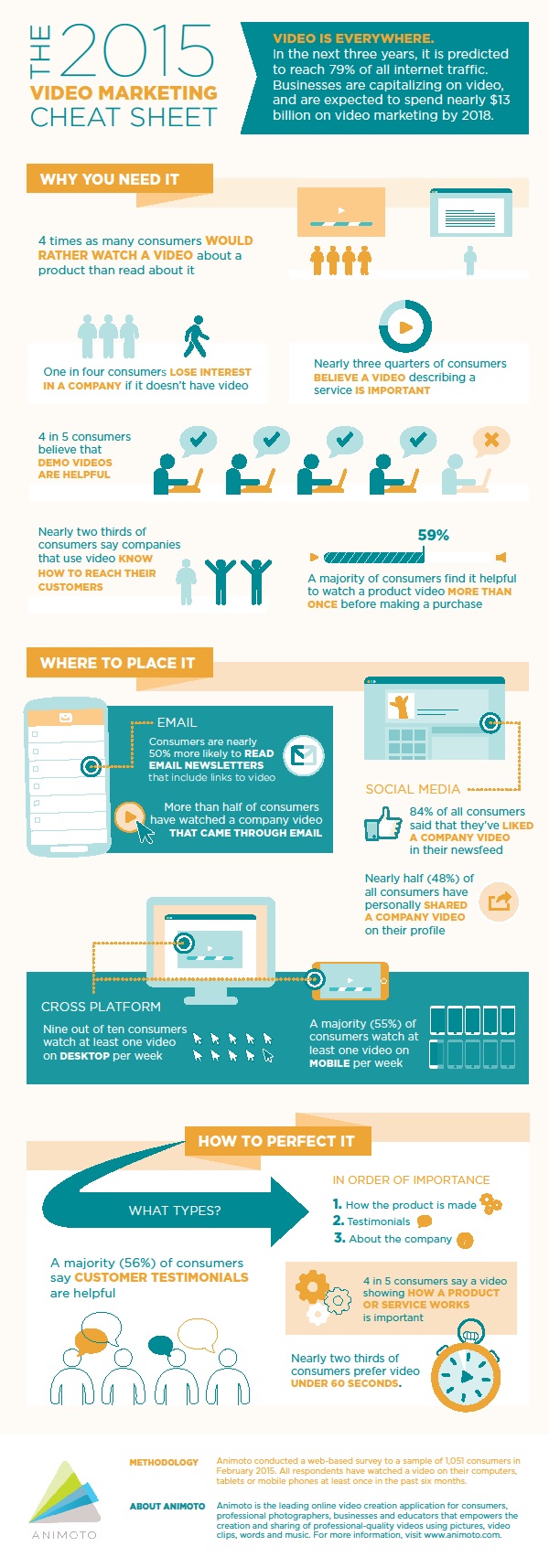
According to a new survey released today by Animoto, the leading cloud-based online video creation service, consumers are hungry for video and four times as many of them would rather watch a product video than read about it. In fact, of the 1,051 U.S. consumers surveyed, 1 in 4 actually lose interest in a company if it doesn’t have product video. The company issued a press release and infographic detailing the findings of its 2015 Video Marketing Cheat Sheet.
eMarketer estimates that US video advertising will climb to $7.8 billion this year and social media platforms like YouTube, Facebook and Twitter continue to attract and build content partnerships. Animoto CEO Brad Jefferson sees video as a huge opportunity for businesses to engage with consumers:
"The growth of online video marketing in recent years has been tremendous," said Jefferson. "Today, there are more than 7 billion videos watched every day on Facebook and YouTube. Historically, in order to create and distribute high-quality video to your customers it was cost-prohibitive for all but the largest brands. However, today's tools and platforms ensure that small and medium businesses can reach their audiences where they hang out online. This represents one of the biggest marketing opportunities for small businesses in a long time."
1. Video Marketing Resonates With Consumers (Video drives brand lift)
63 percent of consumers say companies that use video know how to reach their customers
One quarter of consumers lose interest in a company if it doesn't use video
56 percent of consumers believe that if a company has a website, it should have video
2. Video Boosts Email Marketing and Social Media Engagement (Connect with consumers)
84 percent of all consumers said that they have liked a company video that has appeared in their newsfeed
43 percent of consumers are more likely to read email newsletters that include links to video
56 percent of consumers have watched a company video that came through email
Nearly half of all consumers have shared a company video on their own social media profile
3. Video Boosts Email Marketing and Social Media Engagement (Tell your story)
80 percent of consumers say a video showing how a product or service works is important when learning about the company
56 percent of consumers says customer testimonials are helpful when purchasing a product/service
About half of customers say that 'about the company' videos are the most helpful when purchasing a product/service
About Animoto:
Animoto makes it easy for businesses to create effective, professional videos within minutes with no video editing experience. Businesses use Animoto to enhance and promote their brands, drive website traffic, increase sales, and create dynamic email, social and online marketing campaigns.Founded in 2006, Animoto is based in New York City with an office in San Francisco. For more information go to: http://animoto.com/business.
The 2013 Video Marketing Summit was held on July 25-26 in San Francisco and is the largest and only annual event devoted to all things video marketing and video commerce. The sold-out event drew over 300 attendees and was co-hosted by ReelSEO and Liveclicker, and was held in tandem with the Liveclicker's Video Commerce Summit. This year's combined summit was Liveclicker's 5th annual and an inaugural event for ReelSEO, and drew a cross section of over 300 retailers, brands, and agencies attending either summit.
Over the last few years, I've interviewed attendees and speakers at the Liveclicker video commerce summit, and this year the tables were turned, when Tim Schmoyer asked me to share a video marketing tip for his weekly ReelSEO Creator's tips. He included me in the following video, with video marketing tips from Suzie Reider (Marketing Director, YouTube), Jim Louderback (CEO, Revision3), Reed Lucas (Director of Channel Management, Channel Factory), Rob Sandie (CEO, vidIQ), Sofia Stefou (Video Strategist, Sofina Media), Jason Cesare (Account Executive, Unruly Media), Jay Nolan (Producer, Ecommerce), and Anthony Bucci (Founder, RevZilla).
See my tip is at 1:15, "Tell a story and capture your audience, whoever they may be--marketers, consumers, your customers." Don't sell the product, tell the story.
For a full look at the event, speakers, schedule and video summit links, visit reelsummit.com. For a preview of last year's conference, watch this video with interviews I conducted at Liveclicker's Fourth Annual Video Commerce Summit.
Over the last several years live video streaming has become a powerful marketing tool for artists and brands. For Max Haot, CEO and Co-founder of Livestream, it's been interesting to watch the growing trend of brands adopt live streaming to market their products. I caught up Haot at NewTeeVee Live 2010 where Livestream announced its new Livestream For Facebook application that allows anyone with Facebook pages to launch a live broadcast within Facebook. Livestream launched this service based on the demand they were seeing from the market and developed an easy way to integrate live streaming into Facebook. Livestream and its competitors had previously provided this service for a fee, but Livestream decided to launch it in a DIY way so that anyone could launch a Livestream channel and embed it in their Facebook page.
Facebook launched its own channel, Facebook Live, in August 2010 powered by Livestream, and has hosted numerous live video and chat with Hollywood celebrities, musicians other high profile Livestream events. Most notable is a recent Town Hall meeting with President Barack Obama that was streamed live from the Facebook headquarters.
comScore noted in a September 2010 study, that the amount of time American audiences spent watching video for the major live video publishers (USTREAM, Livestream, Justin.tv, LiveVideo, and Stickam) had grown 648% since 2009 to more than 1.4 billion minutes. While that's just a fraction of the amount of time Americans spent overall watching online video content, comScore said that the sharp growth indicates viewers’ growing comfort with watching live content. Additionally, the comScore report indicated that live video sites have not only been successful in building audience, but also keeping them more engaged, with the average live streamed video view is 7% longer than the average on demand video view.
"What's interesting for brands to realize," Haot notes, "is the engagement time is on average twenty to thirty minutes, versus if you post a trailer, it's only two or three minutes… and then they have a chance of really creating a viral buzz on Twitter and Facebook, and get a lot of eyeballs coming to the live stream because it's trended on Twitter."
Content brands like movie studios, use Livestream to market the release of a new movie within social networks like Facebook and Twitter through a live broadcast of the red carpet premiere. TV networks like HBO are taking advantage of the Livestream's ability to host live video Q&A sessions with celebrities and show exclusive behind the scene previews. Other brands like Ford used Livestream to launch its 2011 Ford Explorer and hosts regular live events on its Facebook pages with Q&A sessions with customers and fans. Restaurant chain PF Chang hosts a live cooking show to market its Pei Wei Asian Diner brand and takes questions from the audience.
Haot says that working with brands and content owners drives content quality and revenue and is core to Livestream's mission to build a next-generation live cable operator. But the bigger goal of Livestream is to unlock every event around the world, from major events like red carpet interviews at the Oscars or the Royal Wedding, to prosumer events from a church, a small baseball game, or even a smaller conference.
"If you look at the world of events today," Haot says, "a very small percent of these events are being live streamed, so we offer the technology, the tools and promotion to hopefully increase the amount events owners that realize that they can use Livestream to extend their event online and connect with audiences on Facebook and Twitter."
Another goal Haot says, is to increase the production quality and reach across the various platforms by offering HD quality and enhancing the mobile offering by live streaming to the popular mobile devices, and on the web by enhancing it with multi-bit rate encoding and HD. Haot says that connected TVs are another growing platform that event owners can reach and that 80% of all TVs sold today are "connected" TVs.
In a related post on Beet.TV today, Andy Plesser spoke with Kevin Delaney, Managing Editor of the WSJ.com, about the value of live video streaming at the Wall Street Journal. The news organization is creating value in process and audience by connecting with viewers through daily webcasts. This is yet more evidence that live streaming has become a mainstream tool for publishers to extend their reach beyond traditional outlets. As more content creators, publishers and broadcasters develop their mobile and OTT offerings, and with YouTube finally getting into the live streaming business with selected YouTube partners, it's clear that live video streaming has become an integral tool for artists and brands to connect with fans and that demand will continue to grow.
About Livestream
Livestream offers brands a complete solution for your live streaming project on Facebook - Including : Custom Facebook application development with integrated live streaming that gives you everything you need to launch your own 24/7 television station (including Like to watch), Live video platform (including CDN bandwidth from Akamai, social enabled chat and player) and on-side production/encoding services if needed. Livestream streams more than one billion video minutes each month to a growing community of 20 million monthly viewers (with some 50,000 watching at any given time) to audiences on the web, mobile devices, and connected TVs. Notable content partners include Facebook, The New York Times, ABC News, CBS News, Associated Press, HBO, AT&T, IBM, Burger King, Nike, The Academy Awards, The Foo Fighters, Maroon 5, Ralph Lauren, and Diesel.
Livestream was cofounded in 2007 by Max Haot, Dayananda Nanjundappa, Phil Worthington, and Mark Kornfilt, and has received $13 million in funding from private angel investors & Gannett Co. It now operates with over 50 full-time staff members in 3 offices - in New York, Los Angeles and Bangalore (in addition to a globally-available production team). The service is available for free (advertising-supported) or as a feature-rich, monetizable, premium subscription for business. In May 2009, Mogulus re-branded as Livestream. Become a fan of Livestream on Facebook and follow Livestream (livestream) on Twitter.
About Max Haot
Max Haot is CEO and co-founder of video streaming company Livestream. Max is an expert in user generated content, broadcast technologies and workflow. He previously founded ICF a media asset management platform which was sold to Verizon Business in 2005. He held positions as VP of Digital Media at Verizon Business and Senior Vice President at IMG Media - the television and interactive arm of the sport marketing giant (www.imgworld.com). Max is a recognized digital content industry pioneer and is regularly invited to speak and contribute at industry events/forums for the broadcast, broadband and mobile industry. Max is a Belgian national and lived in London, UK between 1995 and 2005 before moving to New York. Follow Max Haot (maxhaot) on Twitter.
Video is well on its way to becoming the dominant medium for communication. In the past, text had been the main vehicle for communicating within the business, entertainment and news and information worlds, but that has changed dramatically in recent years with the rise of low cost video production tools and distribution platforms. The explosive growth of user-generated content on YouTube has spawned a new generation of amateur video producers which has, in turn, made it more acceptable for lower quality productions. It's true that anyone with the right tools and know-how can shoot and edit video. And, to some degree we are all able to craft an interesting or even compelling story. But what about the art and craft of producing a professional video production? Does knowing how to use a Flip camera make you a video professional?
Bruce Alfred, Principal of Cobblestone Inc., is asked over and over, how important is it to create high quality video? Can I just use my consumer HD camera to make something and put it up on my business website? As professional video producer and web video consultant, Alfred's answered that question many times and his answer is no, that's not the best idea.
Alfred says,
"When you're putting your own video on your site you want it to increase and raise your image. You don't want it to join the YouTube, user-generated, quickly shot and thrown up on the web type of video because there's so much of that. You want to rise above the noise. So, in short, make sure that you hire a video producer or a video production company that knows how to tell stories, that knows how to connect with any audience, that can learn your goals quickly and be able to interpret those goals into a message that calls people to the action that you need."
Certain content requires high production value and other content may not. It all depends on your audience. But for brands, you want to make sure you're above the fray and not just another low quality YouTube video. While there could be places on your site where you have user-generated video, when it's your creation you want it to reflect well on your brand.
With text, anyone can write, but that doesn't make you a great writer. Alfred says that a professional video producer is an expert that every brand should hire.
"Any good producer will really be a visual storyteller. They are going to know how to build your story and your story is how we as humans connect to others. What you want to do with your video is build some kind of loyalty, bring people into whatever your organization is. A professional video producer will help you reach that type of goal by using storytelling, by building emotion, perhaps by humor – all things that draw the users in."
"Video is your public face to the world. Make sure you don’t have egg on it. The less cheeky answer is more nuanced: it depends on your goals and the expected shelf life of the video. If you’re producing video to build brand awareness, or generally promote your organization it makes sense to produce a high-quality professional video. In most cases, the same applies to any evergreen subject that you will highlight on your website for the foreseeable future. The video needs to not only convey information but your professional image as well.
If you are providing product details or how-to information to potential or existing customers, the production still needs to be professional. But in this case, viewers are looking for specifics, and don’t need bells and whistles. Here simplicity, clarity, and brevity are the elements that count most. When you want to create a community around your product, an event, or your business as a whole, it is worth asking your users to upload relevant videos. User generated content is an excellent way to deepen engagement, and allow users to inform others."
About Bruce Alfred
Bruce Alfred is an award-winning producer/director/writer, and web video consultant. During a career which has spanned 25 years, Alfred has produced non-fiction works for clients of nearly every size and stripe -- for broadcast, web, corporate, governmental, and non-profit. Alfred’s video projects have taken him from the operating room to the board room, from a Somali immigrant community to the south of France. Yet, all of his programs have one basic commonality: Alfred’s work speaks to his audiences in ways that are at once informative, understandable, and engaging.
One of his better-known documentary projects was a four-hour mini-series on the group of French impressionist artists. Alfred led all creative processes on The Other Revolution: The Impressionists, which became one of A&E Television’s most sophisticated and successful Biography programs. The series continues to sell well on DVD, and has been rebroadcast multiple times. Projects prior to his establishment of Cobblestone include his role as coordinating producer for Ken Burns' Baseball, the 18- hour series for PBS.
Alfred has long embraced emerging technologies when such technologies lower costs, increase efficiencies, or allow new opportunities. As streaming video on the web became practicable, Alfred saw the challenge and opportunity in delivering a highly satisfactory results-oriented web video experience. After in-depth web-video related research and much testing of software and hardware, Alfred now serves as a consultant to organizations interested in optimal video delivery to internet connected devices, as well as video SEO, monetization, and analytics. He also works with clients on instituting best practices for integrating video into websites, social media, and video sharing sites.