Showing posts with label Web video. Show all posts

Wednesday, February 17, 2010

Google Finally Acquires On2, What's Next for Online Video?

After many long months and several offers increasing their bid, Google has won over the On2 shareholders with an additional $26.5 million on top of their original $106.5 million to purchase On2 for $133 million, in a merger deal that should close the by end of day Friday. The saga of this acquisition dates back to August 2009, when Google announced that they would acquire New York-based video codec maker On2 Technologies f0r $106.5 million, but the search Goliath was met with their own modern-day version of David, in the form of defiant On2 shareholders who refused to agree to the terms of the sale.

An outspoken group of stockholders protested "the attempted theft of the company at $0.60 per share" and believed that On2 was worth more than 60 cents a share. They held out for many months as Google upped the offer several times, with the final offer last month of $133 million, that was approved by a majority of On2 stockholders today. On2 shareholders will receive 1/1000th of a share of Google stock, plus 15 cents per share. Google (GOOG) stocks are currently trading at $538 a share.

With all the recent debate on the future of web video, Flash vs. HTML5 and open video formats, H.264 licensing fee extension, and the coming mobile explosion of 2010 - now that Google has finalized this deal, how disruptive will it to the online video landscape?

In a previous post, I asked that same question:
"There's been a lot of speculation that Google is purchasing On2 to take advantage of the advanced V7 and V8 codecs for either open source the codecs and make them license-free. Such a move would create serious competition to the other major video compression technologies of H.264, Flash and Silverlight all of which are proprietary codecs. Could Google be looking to to avoid the licensing fees for H.264? Will Google open source On2's technology to disrupt HTML5? Is Google looking to bake the high quality video compression technology into YouTube to speed up videos and lower bandwidth costs?
This all sounds like a big deal that's going to give Google the edge to disrupt the fabric of the online video landscape and "win the online video format war" and with the acquisition Google acquires technology that it can embed within its Android and Chrome OS platforms. This may cause companies like Adobe, Microsoft and Apple to take a financial hit and force them to support whatever new video codec that Google brings to market. Also, with the situation regarding browser-based decoding for tag in HTML5 at a stalemate and undefined, Google could help change the tide by open sourcing On2 VP technology."
I also cited a number of sources in that post who shared their theories on the acquisition, such as Dan Rayburn who didn't think it would be a big deal, Om Malik who said to pay attention to what Google does with Android, and Brian Dipert who thought that it could be Google's latest move to wrest control from Adobe, Apple, Microsoft and Mozilla.

For now, we can only speculate what Google will do next with On2's video compression technology, but this could prove to be a major game-changer in online video landscape and the mobile frontier. 2010 is shaping up to be quite an interesting year so far.

Related:

Monday, October 26, 2009

Web Video Pick of the Week, "The Spark Series: Part 1, The New Dial Tone"

According to Trust Agents author Chris Brogan, “Social media… is the new dial tone,” a concept that is the subject and title of a new short documentary by Marc Ostrick, CEO and Co-founder of eGuiders and Michael Sean Wright, founder of nicefishfilms. The video, which documents their day at the Blog World Expo and the conversations with noted bloggers and reporters who describe the growing shift in media production and consumption through social media networks. This is the first in their Spark Series which explores the documentary style of filmmaking using consumer grade new media tools.

By shooting with Kodak Zi8 and Flip Ultra HD cameras they wanted to see how far they could push the limits of the technology by bringing a filmmaking sensibility to amateur event coverage video. They also used a few other accessories to increase the production value, like a Sennheiser ME 66 shotgun microphone and a Frezzi Micro-fill light, all of which all could fit into a bag. The soundtrack of the video was composed in Garageband.

The video discusses how the disrupters are becoming mainstream and as eGuider Brian Rothe says:
"The new dial tone is a dialog among media producers, technologists and bloggers who are looking to express their ideas in the stream of the real-time web."


Appearances in the new dial tone include:

Robert Scoble - Tech Blogger, @scobleizer
Don Lemon - CNN Anchor, @donlemoncnn
Hugh Hewitt - National Talk Radio Host, @hughhewit
Leo Laporte - Chief Twit, @leolaporte
Chris Brogan - Author, @chrisbrogan
Chris Morrow - CNN iReporter, @morrowchris
Ben Parr - Co-Editor, Mashable, @benparr

The next Spark Series will focus on Jeff Pulver's 140 Character Conference that will be taking place the next two days on October 27 and 28 in Los Angeles.

Follow the Filmmakers:

Tuesday, October 6, 2009

KIT Digital Acquires Online Video Pioneer The Feedroom for $9.8 Million

In yet another shake up within the online video space New York City-based web video and streaming pioneer, The FeedRoom, has been acquired by Czech Republic-based web company KIT Digital (KITD) for approximately $9.8 million worth of stock. A long-time player in the online video market, The FeedRoom remained at the forefront of online video communications for the last decade. Since launching in 1999 as a video aggregation site, The FeedRoom raised at least $66 million with $12 million just two years ago. According to Dan Rayburn, The Feedroom had agreed to the deal some time ago and changes have already taken place with the departure of top leaders, CEO Mark Portu and SVP Daniel Webster, and the pending closure of the San Francisco office. Many in the online video news space commented that it was not a good day for The Feedroom investors who ended up losing the majority of their investments. Dan Frommer called it a "Web Video Firesale", Ryan Lawler noted it "marks an inglorious end to The FeedRoom" and Dan Rayburn pointed out that being acquired was really their only option.

Dan said this about the deal:
"On paper, the services of KIT and FeedRoom fit nicely together and considering that KIT paid FeedRoom investors with all stock, it was an easy deal. While the deal makes sense on paper since it gives KIT a U.S. presence, enterprise and government customers, and all of The FeedRoom's technology, the success or failure of this acquisition will all come down to the integration of the two companies. KIT has a challenge ahead of them since they are doing multiple acquistions and integrations and can't yet know how much of The FeedRoom's revenue will remain come next year."

In 2004, The Feedroom transitioned to a SaaS (software-as-a-service) video platform for video management tools and went back to it's roots within the last year to power enterprise video with the FeedRoom 4.0 Enterprise Video Platform. The company has provided B2B video and digital asset management solutions for Marketing and Branding, Public Relations and Communications, Media and Publishing with a strong focus on ROI. As part of its end-to-end platform The Feedroom acquired digital asset management company Clearstory Systems late last year.

The Feedroom's $6 million annual revenue consisted of customers that includes Barnes & Noble, Best Buy, Hewlett-Packard, Intel, and both the U.S. Department of Defense and U.S. Department of Health and Human Services. A number of their customers were recognized for Excellence in Enterprise Video Awards by research firm Interactive Media Strategies.

Within the past few months The Feedroom announced a number of partnerships that extended their capabilities in social media with widget syndication service Clearspring and distribution and analytics with Tubemogul. I spoke with Matt DeLoca, SVP of Sales and Marketing earlier this year about The Feedroom's business objectives and refocus on enterprise video, some of the challenges in the marketplace and how The Feedroom differentiates itself from other video platforms. While it may seem ironic now given the acquisition, Matt was optimistic that The Feedroom would be remembered as one of the founders and leaders of the industry and be around to say that for a long time.


Update: Matt is now SVP, Sales and Marketing, KIT Digital and he'll be one of the featured speakers on the Best Practices Roundtable: Online Video Publishing Strategies and Tools, at the Online Video Platform Summit on November 18th in San Jose, California.

In addition to The Feedroom acquisition, KIT Digital also acquired German-based Nunet AG, mobile device video provider for about $11.5 million.

Gavin Campion, president of KIT digital told StreamingMediaGlobal:
“The acquisitions were a no brainer. Both come with their relative merits, both have great technology capability, and both come with immediate cross and upsale capability which strengthens our drive for organic growth. The synergies between our companies will be a lot easier to handle simultaneously. KIT CTO Andy Steward is working to integrate a one platform continuation of our current SAAS model.”
See Adrian Pennington's article KIT digital Acquires Nunet and The Feedroom for $21 Million to read more about how the two acquisitions expand KIT digital's presence in both the mobile and enterprise markets, while also giving the company a foothold in North America.

Expect to see more M&A activity continue to heat up in the online video space.

Related:

Updated10/6/09: Information on Matt DeLoca, Online Video Platform Summit and correcting KIT Digital's location as Prague, Czech Republic.

Sunday, September 6, 2009

Web Video Pick of the Week - The Onion 'Facebook, Twitter Revolutionizing How Parents Stalk Their College-Aged Kids'

This week's 'Web Video Pick of the Week' goes to fake news agency The Onion for their social media satire, Facebook, Twitter Revolutionizing How Parents Stalk Their College-Aged Kids. (Disclaimer: the video contains strong language and is not intended for viewers under 18 years of age.) 

In this episode of Today Now!, the Onion News Network's lively and informative morning program, 'E-Mom' Gloria Bianco shows co-hosts Jim Haggerty and  Tracy Gil how to use the Internet to monitor your child's every move. Geographical distance is no longer a roadblock to shamelessly interfere in the lives of your college-aged kids when you can stalk them through Facebook and Twitter.  This one scores high in creep factor.


One giant misstep for Bangladesh News 
Extra points for The Onion for duping two newspapers in Bangladesh this past week into believing their fake news story,  Conspiracy Theorist Convinces Neil Armstrong Moon Landing Was Faked | The Onion - America's Finest News Source, which said:
"Apollo 11 mission commander and famed astronaut Neil Armstrong shocked reporters at a press conference Monday, announcing he had been convinced that his historic first step on the moon was part of an elaborate hoax orchestrated by the United States government."
The two Bangladeshi newspapers, the Daily Manabzamin and The New Nation, published the story which appeared on The Onion website last week which they believed was a genuine news site. It was translated into Bengal and ran in both newspapers on Wednesday and Thursday and attributed to Onion News Network, Lebanon, Ohio. Both have since apologized to their readers for being so gullible. 

The associate editor Hasanuzzuman Khan of The New Nation told Agence France-Presse:
"We thought it was true so we printed it without checking. We didn't know The Onion was not a real news site." 
An embarrassed Manabzamin printed the following apology:
"The report has drawn a lot of attention. We've since learned that the fun site runs false and juicy reports based on a historic incident. The moon landing one was such a story, which received numerous hits on the internet. The truth is that Neil Armstrong never gave such an interview. It was made up. We are sorry for publishing the report without checking the information."
Chalk this week up to The Onion for the 'Web Video Pick of the Week' and possibly a new feature, 'Hoax of the Week'! ;-) 

Related:

Thursday, August 6, 2009

Google To Acquire On2 Technologies for $106.5M, How Disruptive Is It Really?

The big news yesterday was that Google announced they would acquire On2 Technologies for an all-stock deal valued at $106.5M. On2 is the developer of the high quality VP series of Truemotion video codecs, of which VP6 replaced the Sorenson Spark video codec for Adobe Flash player 8 and above and is the core of On2's video encoding software suite of Flix Standard, Pro, Exporter, Live, Engine and Directshow SDK. The VP6 is a proprietary codec and has been a direct competitor to H.264, the dominant compression standard for high-quality web video, IPTV and Blu-Ray disc also known as H.264/AVC/MPEG-4 Part 10. On2 also developed the earlier VP3 codec of which the open source codec Ogg Theora is derived. On2 customers include Adobe, Skype, Nokia, Infineon, Sun Microsystems, Mediatek, Sony, Brightcove, and Move Networks.

In a letter to on2 Flix customers, Frank Galligan, Vice President of Engineering said that they are thrilled to become part of the Google family and gave the rationale for why Google is acquiring On2. He said:
"Google has indicated to us that they are continually looking to improve video quality and delivery on the web, and that our video technologies will allow them to do even more with their products and initiatives. They have indicated that they are interested in all parts of our video technology. With Google Video, Google Talk and YouTube, among others, they have a substantial interest in developing tools and technology that will better support more high quality video on the Internet. Google has indicated that they believe that our team and technology will help Google make higher quality video available online."
While it's too early to discuss specific product plans until the deal closes, Mr. Galligan said that all existing agreements will remain in effect under their existing terms and that they expect that Google would honor its obligations under existing contracts.

So how "disruptive" will this be for the online video industry?

There's been a lot of speculation that Google is purchasing On2 to take advantage of the advanced V7 and V8 codecs for either open source the codecs and make them license-free. Such a move would create serious competition to the other major video compression technologies of H.264, Flash and Silverlight all of which are proprietary codecs. Could Google be looking to to avoid the licensing fees for H.264? Will Google open source On2's technology to disrupt HTML5? Is Google looking to bake the high quality video compression technology into YouTube to speed up videos and lower bandwidth costs?

This all sounds like a big deal that's going to give Google the edge to disrupt the fabric of the online video landscape and "win the online video format war" and with the acquisition Google acquires technology that it can embed within its Android and Chrome OS platforms. This may cause companies like Adobe, Microsoft and Apple to take a financial hit and force them to support whatever new video codec that Google brings to market. Also, with the situation regarding browser-based decoding for tag in HTML5 at a stalemate and undefined, Google could help change the tide by open sourcing On2 VP technology.


According to Dan Rayburn, who wrote in a two-part post that debunks many of the theories posed in the blogosphere, it's really not a big deal.

"While one could assume that Google will do something with VP8 and Chrome tying into the new HTML 5 standard, is that the reason to spend $100M to acquire a codec? I don't think so. While many want to automatically assume Google will always be successful in whatever they do, simply because they are Google, they have never done anything well outside of search and advertising, as far as generating revenue goes. If they want to challenge H.264, they'll lose. If they simply acquired On2 for their own use in YouTube and Chrome, ok, could work. But it won't have any major impact on the industry."
UPDATE 8/9/09: Check out Tim Siglin's new blog WORKFLOWED, which he launched following a discussion on Dan's post, Google's Acquisition of On2 Not a Big Deal, Here's Why. Tim says: 
"Dan listed off a series of reasons why Google may not have been interested in purchasing On2. A fascinating read, and a bit of a different take from the streamingmedia.com news article I'd written early this morning, which outlined the deal. In between writing mine and reading Dan's I had spent some time thinking through what Google might be up to, so I posted the following as a comment on Dan's blog: Google Purchases On2 - Additional Thoughts"
"I would pay special attention to what Google does with On2 on Android, because there is an opportunity for it to outshine rivals such as RIM and Apple. Just look at On2’s mobile video arsenal: It owns technologies for embedded video for mobile platforms (Hantro) and On2 TrueMobile System, a mobile video system designed to send video across the networks — including 2.5G, Edge, 3G and 4G networks — using On2’s VP7 technology."

"... my angle on this acquisition is one that no other commentator I've yet seen has taken: following in the footsteps of the Chrome web browser and the Android and Chrome O/S operating systems, Google's pending direct control over On2 is the company's latest move to wrest control of the Web from companies such as Adobe, Apple, Microsoft and Mozilla (specifically, the latter's under-siege Firefox web browser)
Also, with the current legal issues around Skype, Google could use On2's video technology could enhance its video communication suite of tools (Voice, Talk, Wave) to compete with Skype. With the open source movement gaining speed and online video growing at explosive rates it will interesting to see how disruptive this latest acquisition by Google will be for the web video. For now we can only speculate and since the deal won't close until the fourth quarter the effect of this merger won't be felt for months but the ripples within the online video landscape are already starting to appear.


Related:

Tuesday, July 7, 2009

Ooyala is Focused on Personalizing the New Media Experience

In part two of my interview with Ooyala CEO and Co-founder Bismarck Lepe, he talks in more detail about how his company is expanding their offering within the online video platform market with a key focus on personalizing the consumer experience and at the same time helping their content owners build a real business. In the previous post, he described that in the new media consumption world of today the consumer is the new brand manager and is in control of what they see when they want to see it. Ooyala has analyzed where the industry is headed, based on data collected by Quantcast, and believes that the current market for online video platform is roughly of 300,000 customers who are people who are willing to pay for an online video platform. For startups within the online video space, Lepe emphasizes that you need to know how to make your customers successful and help them build their businesses.


Larry Kless: When we spoke a few months back you talked about the subscription model and your plans to roll it out in Q2. Where is that now?

Bismarck Lepe: We've already started rolling it out with a couple of sports teams as a white-label and a pay-per-view model and one of the other monetization options that we're most likely going to be adding is licensing, and actually allowing content owners to license their content out to distributors. This has definitely been as evolution. When we look the majority of the dollars being made in the offline world the majority is actually made at the licensing phase. People who are taking digital rights and buying it for a certain window and a certain region and then figuring out how to target that content and sell that content to their market. There's so much content that's being created for online that the need for that marketplace is actually pretty rich, and I think it's also very rich for people who are taking their offline content and pushing it online and creating little clips for it. So I think it's going to be another monetization opportunity for content owners that will really start helping subsidize the creation of high quality content.

Larry Kless: What's next? What are you going to build on from there in terms of expanding throughout the following quarters? What's important?

Bismarck Lepe: I think what's really important for us right now is personalization and bundling of content. Really figuring out our audience either at the profile by profile level or if we're provided any individual log in and customizing the viewing experience for each one of those viewers. One of the problems with monetization today is that most people look at it on a title by title basis. But if you can actually create these dynamic and virtual networks around an audience then you can actually get bigger ticket prices. You can almost create a hybrid subscription and monetization model that mimics a lot of what the cable industry does today. So it's this hybrid of you pay your monthly cable subscription but then you also see advertising. And lot of what we're doing right now is being able to create these dynamic networks on the fly based on the content that's flowing through the system.

Larry Kless: Can you talk about the journey? Where you started and where you're at now. I understand that initially the tools were built because of the idea to be a destination site but the tools were just so great that changed.

Bismarck Lepe: I think we've taken advantage of the fact that content owners are putting more and more of their content online and we're realizing that the content owners want to be the masters of their future and they don't necessarily want to work with individual destination sites to power all of their video. Even today although Hulu has been successful in terms of getting mindshare, I don't necessarily know if that's going to be the model that's going to work for all content owners. Because again, it's very difficult for a destination site like that to get to profitability when they're only taking a fraction of a fraction of a dollar.

Larry Kless: Hulu is a good example too of the studios doubling down on two of the screens, computer and television and an iPhone app sometime soon.

Bismarck Lepe: I think that they're are going to be successful in gaining mindshare but ultimately I think what's going to be most successful is, a lot of these individual sites are built around a specific audience base as oppose to trying to aggregate as much viewership around all of the content that's out there. Because I think the economics are just not going to work for a lot of these property owners. But we'll see, I think what Hulu has done is actually get a certain level of adoption and acceptance at the studio level that is also helping raise all ships in the video space. You know people who are providing analytic solutions, people who are providing ad serving solutions, people who are providing CDN services.

Larry Kless: Finally from the distribution standpoint for content owners they're finally able to sink their teeth into real analytics with online video versus the Nielsen ratings. In looking at your list of customers on your web site it's pretty diverse. It must feel good to be able to provide this level of service to such a wide variety of customers.

Bismarck Lepe: Yes, and in June some of the customers we signed include Warner Media that owns Rolling Stone and US magazine, the Philadelphia Eagles and even Cesar Millan "The Dog Whisperer."

You know, I'm extremely bullish on this industry as is true with most sea changes in technology or ways of thinking. There are a lot of players, there are a lot companies that try to blaze a new trail. Some of them are successful and some of them are not and I think we're now starting to see some really good traction with the people that own the content and the people who are consuming the content online.

Larry Kless: So you've built in the API structure and extensible modules. How about the pricing structure?

Bismarck Lepe: So again, were focusing on the top 300,000 publishers that are out there and we have an enterprise solution that gives big companies multi-level access and multi-level access controls to the individual pieces of content, sophisticated analytics, live streaming and at the low-end a five figure annualized deal to six figures annualized deal and then we have our self-serve product that is available to anyone and everyone that wants to publish. Obviously they need to pay an hourly basis for the content that they use but we want to make sure that we enable the building of businesses all sizes with our platform and on our platform.

Larry Kless: So what drives you? What make the company tick? Being a long distance runner, what makes you put on those shoes and run everyday in this race?

Bismarck Lepe: For me, it's making sure that we are personalizing that media experience. I should never have to see a tampax ad I should only see content that's interesting to me and the Internet allows us to do that. And more and more of video is going to be delivered over IP which means across all screens we're going to be able to personalize that experience and that's our goal. Our goal is not just to build a publishing platform but to build a personal media platform.

Larry Kless: What sort of advise would you give a startup getting into this saturated market? What are the key differentiators?

Bismarck Lepe: I think you need to know how to make your customers successful. It's not just about taking their money but it's about helping them build businesses, and the way we think we're going to help our customers build businesses is by focusing on the consumer and continuing to drive the best possible experience with our platform. Now as a business owner and starting a company, at the end of the day, as long as if you're in a good industry and you have good people it's going to be sheer force of will. As a startup you either sink or swim and that's it, there's no middle ground.

Larry Kless: In terms of your company, it seems that anytime you see news now you almost can't see a sentence that says Brightcove without seeing Ooyala in the same sentence. You also mentioned having drinks with Jeremy Allaire recently. How is it within the online video platform space? Is it a community of innovation or cut-throat competition?

Bismarck Lepe
: I think that the people who are going to be successful in this space are going to realize that there's so much opportunity out there and that at this point everyone should be focused on helping make the pie as big as we can make it, and then we'll figure out it gets divvied up. But in the near term on the higher end there actually isn't that much competition and there isn't enough business out there for everyone who is approaching it the right way.

Larry Kless: So you never take a day off, do you?

Bismarck Lepe: You know, this really isn't a job so everyday is a day off. I love what I do.

Larry Kless: So overall it sounds like it's been a good journey so far with plenty of road left to cover.

Bismarck Lepe: I've been very lucky to have great team mates, great founders, great investors and a phenomenal industry. Back when I first got a taste of this when we were working on Google's first foray into the video space with Google Video, the studios and the broadcasters weren't as receptive to testing online video initiatives. But that has definitely changed, I think everybody understands that all video will eventually be delivered over IP, that the consumer is going to be in control and that they need to come to the table and talk to startups and they themselves need to push initiative in order to be relevant 5 years from now.

Saturday, July 4, 2009

Ooyala Sees Growth in the Crowded Online Video Platform Market

It was a bad news week for online video businesses with Maven Networks and Joost, but it's not all doom and gloom and when you look at the financials of nine of the leading companies, as Will Richmond pointed out, they have collectively raised $64M in funding in Q2 '09 and a total of $219M has been raised by 26 companies over the last three consecutive quarters. Other good news reported by Dan Rayburn is that Brightcove profitable and cash flow positive. Dan says, "While this is a big deal for Brightcove, it's an even bigger deal for the industry and is validation that companies in this market can in fact create scalable, profitable businesses." Techcrunch also noted, Joost, Meet The Competition. Magnify.Net Sees Growth In White Label Video Platform.

I spoke with Ooyala CEO and Co-founder Bismarck Lepe yesterday to get some insight on how his company is doing and his view of the market itself which has been overshadowed by the economic downturn. In a crowded field of online video platforms Mountain View, California-based online video technology company Ooyala sees growth. According to Ooyala, in June they signed more than 40 mid to large publishers 12-24 month agreements (of which 75% were taken from other platform providers) and self-serve product grew by another 1000+ publishers.

This video, actually recorded several months ago at the Ooyala headquarters, features Bismarck along with Ooyala CTO and Co-founder Sean Knapp who talk about the core value of their online video platform which is based on modularity and how Ooyala is innovating beyond a content management system.


The following is my interview with Bismarck Lepe from yesterday. This is not the transcript from the video.

Larry Kless: So Dan Rayburn just talked with Jeremy Allaire this past week and Brightcove is saying they're profitable and we spoke several months ago and you said you were getting towards profitability. How's that progress?

Bismarck Lepe: So we've also had months of profitability, being cash flow positive and we're investing in the business and continuing to grow it -- and you know again Jeremy is doing the smart thing -- with a startup the goal is never to really to just maintain profitability. The goal is to make sure you break even; that you're covering your expenses and your investments but this isn't a dividend business. Right now we're trying to grow the market and grow our businesses quickly as possible.

I think in general no one will argue with the fact that more and more people are watching more and more video every single day and more and more sites. So this transition from a completely analog push method of video delivery is changing with the web. The mid-tail and pro-tail has actually finally found a home where they can actually amass a large viewing audience. So I'm very excited and a couple of weeks ago I had drinks with Jeremy and he's also very bullish about his business and how much growth he's seen just in the last 6-12 months.

Larry Kless: Will Richmond's post, Video Companies Raised $64M in Q2 '09, Notching Another Stellar Quarter, was definitely some of the good news, can you talk about Ooyala's numbers? I understand you've had significant growth in your big publishers and individual publishers.

Bismarck Lepe: So, month over month growth from existing publishers that have been on our platform for at least three months they're actually seeing about 10 and 20 percent month over month viewership growth. The good news about viewership growth is that it directly drives more impressions and more ad revenue for them. So that's just the core base. In June, just from our mid to large publishers and these are customers that actually signed between 12 and 20 month deals we signed over 50 of them and we continue to see growth on our self-service product. In a monthly basis we're consistently signing between 900 and 1,000 new self-serve publishers. So we think that the momentum is actually increasing.

One of the things that we've seen from a platform company has been tremendous growth internationally because a lot of the media publishers and content publishers that have historically built their own solutions abroad their just now getting into the online video space and the idea that they would build technology when they're content producers doesn't even cross their mind, they're only going to outsource it. So today we're seeing about 50% of our new monthly recurring revenue that's coming in is actually coming from international markets.

Larry Kless: When we previously Sean and you talked about the core value that Ooyala brings in terms of the modularity of the platform and also that personalized experience. So what's important?

Bismarck Lepe: Again, one of the things that really excited me about online video back when I was still at Google and trying to figure out how to monetize YouTube, was the fact that in the new media consumption world the consumer is the new brand manager and the consumer is in control and they get to decide on what they see when they want to see. And that's pretty interesting because you're giving a lot of power to the mid-tail and pro-tail content providers because they can directly find the audience that's of interest, so a couple of our customers although they probably wouldn't have enough content to have their own TV network, they actually drive tens of thousands and in some cases hundreds of thousands of daily hourly viewership online. You know you have folks like Vice TV, people like FUNimation that have niche content that have actually found an audience base online.

Larry Kless: So back to the platform, what is the value? Why should a publisher consider an online video platform vs. a YouTube or other video sharing site vs. a do-it-yourself model?

Bismarck Lepe: When we talk about online video one of the first problems that needs to be solved is just getting your content online as quickly as possible and improving the experience. So the publishing piece is important but it's very difficult to differentiate and there are a lot of people offering basic publishing and you're seeing some of the key technology and infrastructure players actually getting involved to make it easier for content owners to publish their content. Akamia has OBP and Adobe is launching their Strobe initiative.

Larry Kless: I just saw the iPhone app that Akamai has. (Note: see Akamai Launches iPhone Video Streaming And Showcase Portal (iphone.akamai.com) | The Business Of Online Video)

Bismarck Lepe: Yes, it's brilliant.

Larry Kless: And I'd add Sorenson Media too with their video delivery network.

Bismarck Lepe: Yes, and I think it's extremely important that, we've gone through the top Quantcast one million sites and we've looked at kind of where the industry is headed and we look at our business and we think we can have up to 300,000 customers today. Like the current market for online video platforms is somewhere in the neighborhood of 300,000 customers. That's pretty neat, right? These aren't the self-serve free YouTube customers these are people who are willing to pay for platforms.

But again, the first barrier to entry is getting your content on the web and then once your content is on the web you start noticing that in order to increase viewership you really need to figure out how you can recommend the best content make your content more discoverable and improve the end-user experience. So that personalization piece becomes important and as you start to bring more and more content you realize,"Well, I've really need to cover my costs." Because it's not just about proving a better user-experience on my web site or making my site stickier, now I can start driving som e real revenue.

So where we think we've differentiated our offering is really been around the monetization tools that we offer our content owners. Being able to yield maximize across several ad networks and several 3rd party ad servers then also offering our own 3rd party ad server; for in-stream, pre-rolls, post-rolls, overlays; and then the analytics, figuring out how people are consuming the content and all of that has actually been built in house and is part of the platform when someone buys one of the licenses of any one of the packages and that where we think we're going to continue to differentiate our offering. Really helping personalize the consumer experience and at the same time helping our content owners actually build a real business.

End of Part One of Interview. Stay tuned for Part Two

About Ooyala
Ooyala is a video technology company that provides an integrated platform enabling the delivery, management, and monetization of high quality video content. Committed to providing the most accessible and comprehensive video solutions to companies worldwide, Ooyala's solution is easy to use, quick to deploy, and customizable. Ooyala's partner portfolio includes 1000s of media companies including Bebo, TV Guide, Glam, and Electronic Arts. Free trial Backlot accounts can be created by clicking here:http://www.ooyala.com/products/install. For more information please visit www.ooyala.com

Related:

Sunday, June 21, 2009

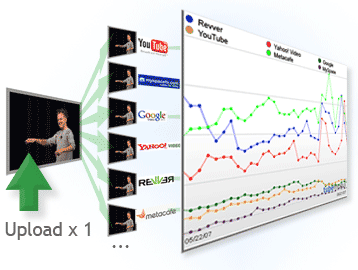
How to Upload Your Video to Multiple Sharing Sites

Hosting your videos on a free, video sharing website such as YouTube, Blip.tv, Vimeo, Dailymotion or even on a social networking site such as Facebook has many advantages for reach, higher visibility on search engine results (SEO) and of course, the fact that's it's free all the content delivery costs are paid for by the sharing site. This option for video hosting is one of three that Jan Ozer recently wrote about in his indepth article, Choosing an Online Video Platform. He referred to free video sharing sites as UGC sites and pointed out several pros and cons saying, "These UGC sites relieve you of the encoding and player-creation chores and assume the task of hosting and distributing the video for you. You can still embed the video on your own website, but by offering your video on a UGC site, you also expand the number of potential viewers, which can help from a marketing perspective. However, there are some negatives to consider, as well as some benefits..." (more)

For those interested in the "hyper-syndication" model of distributing your video to multiple video sharing sites there are a number of free and premium choices which are covered in two recent articles.

My friends at ReelSEO published this review, Upload Videos To Multiple Video-Sharing Sites - Tools & Software and highlighted the following services with short descriptions and pricing:
If you want to dig deeper you can also check out Best Tools To Upload Your Video To Multiple Video-Sharing Sites - Mini-Guide on MasterNewMedia with mini-reviews and a comparative table of 11 tools to automatically upload your clips to multiple video sharing sites.

Written by Robin Good, the guide used the following criteria to compare the services:

  • Distribution: Video-sharing sites where you can automatically upload your content
  • Analytics: Viewership information gathered from supported video-sharing sites
  • Upload: Publish to video-sharing sites accepting videos bigger than 300MB
  • Premium: Price and extra features of premium accounts for supported video-sharing sites
  • Migration: Export of your content from one video-sharing site to another site without download
Robin included this interactive map with links to all the services in the Mini-Guide. Full descriptions and comparative details on capabilities and cost are here.


The only service I use
to distribute my videos to multiple sharing sites is TubeMogul. You can read more about their new TubeMogul 2.0 capabilities which "democratizes video metrics" here. I haven't tried any of the other services but would be interested to hear from anyone who has.

A few other options that came up in the comments on these two articles worth checking out are:

Related:

Sunday, June 14, 2009

Streaming Media East: Live Broadcasts and HD Video - Can Web Video Ever Scale to TV-Sized Audiences?

In this video from Streaming Media East, Dan Rayburn moderates a panel discussion on live broadcasting in HD which as he notes has come a long way in the past 13 years when he first got into the streaming media business co-founding a live webcasting company. The panel discusses the scalability of HD content and the comparison of Internet video to broadcast TV, which is a great segue from Paul Sagan, CEO of Akamai who believes that online video is at a "tipping point" where it can finally compete with traditional broadcast TV. Is it a fair comparison? Will online video replace the broadcast TV or will they complement each other? 


Live Broadcasts and HD Video: Can Web Video Ever Scale to TV-Sized Audiences?
(B203)   1:45 PM - 2:45 PM

Last year we saw a big uptick in the number of high-profile, large-scale live events on the web. Most weren’t offered in HD, and the debate still remains whether the internet is even capable of supporting live events with the kind of traffic seen from TV broadcasts. We’ll explore this discussion from all angles—technology, infrastructure, and quality—to get a feel for what the barriers are and when we can expect to see more large-scale live events delivered in HD.

Moderator:
Dan Rayburn, Executive Vice President, StreamingMedia.com
Panel:
Mark Taylor, VP, CMG Product and Strategy, Level 3
John Edwards, CEO, Move Networks
Joe Inzerillo, SVP, MLB.com
Tony Fernandez, VP, Technology, CBSSports.com

Saturday, June 13, 2009

Streaming Media East Keynote: Paul Sagan, Akamai, "HD Online @ the Tipping Point"

This video features Paul Sagan, President and CEO of Akamai from his keynote at Streaming Media East last month. In his presentation, HD Online @ the Tipping Point, Sagan said that after more than 10 years of the evolution of online video delivery it's finally reached a "tipping point" where it can compete directly with traditional broadcast television. He traced the milestones of online video from the 1999 Victoria Secret Fashion Show to the present with the 2009 Presidential Inauguration (10 million streams) and NCAA Men's Basketball Tournament MMOD (March on March Madness) and pointed to the growth of HD and high quality video and adaptive streaming technology as key factors in the "tipping point" that will enable Internet video to reach a TV sized audience.

"We're on the cusp of many new businesses starting up," said Sagan, "and what the early days of broadband taught us is that, once consumers have access to fast bandwidth, that level of speed becomes the standard by which they judge all future online broadband experiences. Given full-motion video, gaming, and other high-quality online entertainment experiences, consumers will push every previous entertainment tool off the table and focus on consuming broadband-delivered content." 

Saturday, June 6, 2009

TubeMogul 2.0 Democratizes Online Video Analytics, Sets New Standard for Viewing Metrics

Leading web video distribution and analytics company TubeMogul recently launched TubeMogul 2.0 which "democratizes video metrics" by providing free video tracking capabilities that were once exclusive only to large media companies and advertisers. TubeMogul's powerful InPlay technology, incorporated into their platform from their acquisition of video analytics firm Illumenix, was previously only available to sites hosting their own video, but is now integrated on 15 of the Web's top video sharing sites, including Brightcove, DailyMotion, MetaCafe, blip.tv, Break.com, Howcast, eBaum’s World, Graspr, GrindTV, Sclipo, Webcastr, Viddler, 5min, Streetfire.net and Sevenload -- with more to come soon. TubeMogul says they are in talks with YouTube, who along with Hulu are not among the sites included.

So for the first time ever, video publishers can gain access to a single, standardized set of rich, census-based analytics that can be seen and compared in a single dashboard, aggregating data from the Web's top video sites, unlocking rich, standardized data measuring far beyond the metric of video “views,” including per-second audience dropoff, what sites and search terms are referring viewers, audience geography and much more. TubeMogul hopes that this public, census-based data will democratize viewing behavior online far more than the simple metric of video “views,” which are counted on most sites as soon as a video stream starts.

These metrics will be free to most of its 85,000 users but commercial sites and ad agencies will have to pay. As TubeMogul indicates, "In a world where panel-based data can yield such wildly divergent numbers, it’s important to have an independent, census-based standard, which we hope to become." 

Liz Gaines points out that a lack of standard measurement has led to conflicting reports and in light of the recent controversy surrounding the war of numbers between Nielsen and Hulu and the Nielsen-funded Council for Research Excellence's Video Consumer Mapping Study report this past week which stated that online video usage is "vastly overstated" it's clear that TubeMogul has taken a huge step to lead the effort towards standardization. 

I spoke with Mark Rotblat, VP of Sales and Marketing for TubeMogul back in March and he gave me the scoop on the upcoming release of TubeMogul 2.0. Mark said that TubeMogul 2.0 was always part of their plan and their acquisition on Illumenix helped them acheive their goal of providing a powerful analytics suite for their worldwide customer base. Mark also talked about TubeMogul Marketplace and said that more than anything TubeMogul is a promotion platform.

Tim Street shared his 3 reasons why he hates TubeMogul 2.0 and recorded a video with Brett Wilson, CEO and Co-Founder of TubeMogul who describes the exciting news and what it means for independent producers. "In the industry, this level of data was previously only available to large advertisers and top video destinations, and usually only for their own site," comments Brett. "We now track this type of data globally and are giving it away." 

Michael Greer, VP of Product Development at The Onion, which beta-tested the product says that TubeMogul 2.0, "has allowed us to understand our audience better, as well as to more precisely monitor our business needs."  Additionally, Jim Louderback, CEO of Revision3, who has been a strong advocate for honesty and transparency in online video metrics also beta-tested the product, echoed similar feedback, "Knowing which shows are the most engaging to viewers is helpful in selling advertising and devoting resources."

About TubeMogul 

TubeMogul is the first online video analytics and distribution company serving publishers 
large and small who need independent information about video performance on the Internet and automated upload to the Web's top video sharing sites. TubeMogul's analytic technology aggregates video-viewing data from multiple sources to give publishers improved understanding of when, where and how often videos are watched. TubeMogul offers tracking far beyond the traditional metric of video "views." TubeMogul InPlay, which can be activated within minutes, tracks rich viewership metrics such as audience engagement, attention span and site performance -- all in real-time. 

For more information about TubeMogul, contact: 

David Burch 
david@tubemogul.com 
+1 510 653 0501

Related:

Monday, June 1, 2009

Ooyala Releases Next Wave Video Player, "Swift"

Ooyala, an online video platform provider has launched version 2.0 of its advanced video player, code-named Swift. The player features improved video playback while incorporating a new, modular design. The modular framework appears to be part of the "next wave" in video player technology. Brightcove incorporates this in their player and Adobe recently announced an open source plugin framework.

The upgrades are intended to give content publishers the flexibility to add feature modules as needed, as well as to improve the overall viewing experience. The modularity is quite innovative. Ooyala says the new player can dynamically load code modules on the fly and that the player only loads modules that are required - resulting in more efficient video playback. A faster loading player offers a better user experience, and thus decreases the likelihood that viewers will abandon the video.

A few months back, I offered a preview of their soon-to-be released next generation player and met with their engineers and co-founders who were excited about the upcoming release. CTO and co-founder Sean Knapp told me that the player was completely rewritten from the ground up and is a fraction of the size of the other players with a plug-in architecture that allows for on-demand loading of modules and the seamless integration of new custom modules to extend the player's functionality with the ability to add surveys, polls or other extensible modules. I've republished the interview with Sean below.


The Swift player will also improve video delivery for their already popular adaptive bit rate video delivery feature. With the new player, it has refined the algorithms for bandwidth detection, resulting in a more accurate model of the user's bandwidth. The player dynamically and continuously checks the bandwidth and delivers the best video for the user at all times.

As a side note, Ooyala says it is the only company able to offer online video delivery in Flash using adaptive technology, without requiring Flash 10 or Flash Media Server 3.5. Their modular framework already includes live streaming and synchronized playback, support for many new ad networks, including VAST-based ad systems, integration of Visible Measures analytics.

Ooyala will likely incorporate Strobe, Adobe's open standard for media player creation says Will Richmond who spoke with Knapp last week about the new Swift player.

A few of the featured highlights introduced with Swift include:
  • Reduced player size resulting in faster load times and lower abandonment rates
  • Modular architecture enabling faster innovation and easier integration of new functionality
  • Higher quality playback driving greater video consumption and engagement
  • Enhanced UI and flexible controls producing a highly customized viewing experience
  • Improved bandwidth detection providing seamless playback


See their Swift FAQ page for an overview describing the new features and functionality of Swift.


About Ooyala

Ooyala is a video technology company that provides an integrated platform enabling the delivery, management, and monetization of high quality video content. Committed to providing the most accessible and comprehensive video solutions to companies worldwide, Ooyala's solution is easy to use, quick to deploy, and customizable. Ooyala's partner portfolio includes 1000s of media companies including Bebo, TV Guide, Glam, and Electronic Arts. Free trial Backlot accounts can be created by clicking here:http://www.ooyala.com/products/install. For more information please visit www.ooyala.com

Related:

Saturday, May 30, 2009

Streaming Media East: Content Production for the Web

This is the first of a number of Streaming Media East videos that I'll be featuring on the blog titled, "Content Production for the Web" from Tuesday, May 12th which was moderated by my friend Paul Kontonis co-founder and CEO of New York-based digital media studio For Your Imagination. The panel features Tim Shey, Co-Founder, Head of Entertainment, Next New Networks, Christine Beardsell, VP, Creative Director, Creative Director, Digitas/The Third Act and Austin Chang, VP, Strategy and Development, MTV Digital and focused on the types of online video, audience engagement, production and monetization amongst other topics important to developing and producing web video. 

Paul was also part of the panel discussion I moderated at Streaming Media West last year on Streaming Media West: Updating and Syndicating Your Channels for New Media Distribution which also featured Mark Rotblat of TubeMogul and Saidah Nash of Thomas Reuters.


Content Production for the Web
Track C (C103)   1:45 PM - 2:30 PM

If the sitcom and miniseries were the unique genres of broadcast TV, what will the new online TV look like? What will appeal to audiences and get them to come back again and again? What is the relationship between the audience and the new forms of online video? This session provides a showcase for the talent creating this new medium and showcases the evolution of original online programming and the tools available to help content creators engage their audiences.

Moderator:
Paul Kontonis, CEO, Co-Founder, For Your Imagination
Panel:
Tim Shey, Co-Founder, Head of Entertainment, Next New Networks
Christine Beardsell, VP, Creative Director, Digitas/The Third Act
Austin Chang, VP, Strategy and Development, MTV Digital

Follow these peeps and their companies on Twitter:
Related:
By Andrew LaVallee - May 13, 2009
When it comes to creating original material for the Web, Tim Shey, co-founder of Next New Networks, says it’s like sushi. “The fresher the better,” he said during a Streaming Media East panel session on digital content production, “and don’t leave it sitting around for too long.”

For Mr. Shey’s company, which makes Web shows such as “Barely Political” and “Nite Fite,” videos made in advance or with block shooting don’t do as well, he said. (more...)