Friday, May 8, 2015

Animoto Survey Says: Consumers Want More Video Marketing on Web, Social and Email [Infographic]

According to a new survey released today by Animoto, the leading cloud-based online video creation service, consumers are hungry for video and four times as many of them would rather watch a product video than read about it. In fact, of the 1,051 U.S. consumers surveyed, 1 in 4 actually lose interest in a company if it doesn’t have product video. The company issued a press release and infographic detailing the findings of its 2015 Video Marketing Cheat Sheet.

eMarketer estimates that US video advertising will climb to $7.8 billion this year and social media platforms like YouTube, Facebook and Twitter continue to attract and build content partnerships. Animoto CEO Brad Jefferson sees video as a huge opportunity for businesses to engage with consumers:
"The growth of online video marketing in recent years has been tremendous," said Jefferson. "Today, there are more than 7 billion videos watched every day on Facebook and YouTube. Historically, in order to create and distribute high-quality video to your customers it was cost-prohibitive for all but the largest brands. However, today's tools and platforms ensure that small and medium businesses can reach their audiences where they hang out online. This represents one of the biggest marketing opportunities for small businesses in a long time."
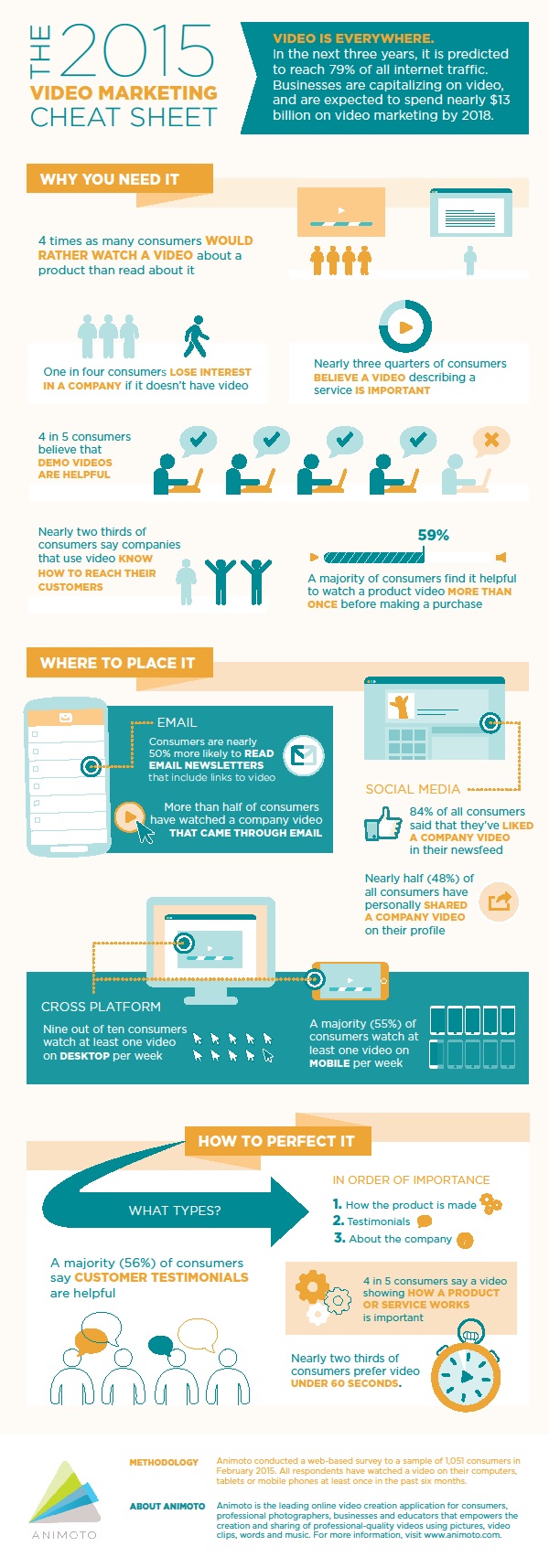
AnimotoSMBVideoInfographic
Three key themes emerged from the study, data presented below is directly from the press release:

1. Video Marketing Resonates With Consumers (Video drives brand lift)
  • 63 percent of consumers say companies that use video know how to reach their customers
  • One quarter of consumers lose interest in a company if it doesn't use video
  • 56 percent of consumers believe that if a company has a website, it should have video
2. Video Boosts Email Marketing and Social Media Engagement (Connect with consumers)
  • 84 percent of all consumers said that they have liked a company video that has appeared in their newsfeed
  • 43 percent of consumers are more likely to read email newsletters that include links to video
  • 56 percent of consumers have watched a company video that came through email
  • Nearly half of all consumers have shared a company video on their own social media profile
3. Video Boosts Email Marketing and Social Media Engagement (Tell your story)
  • 80 percent of consumers say a video showing how a product or service works is important when learning about the company
  • 56 percent of consumers says customer testimonials are helpful when purchasing a product/service
  • About half of customers say that 'about the company' videos are the most helpful when purchasing a product/service


About Animoto: Animoto makes it easy for businesses to create effective, professional videos within minutes with no video editing experience. Businesses use Animoto to enhance and promote their brands, drive website traffic, increase sales, and create dynamic email, social and online marketing campaigns.Founded in 2006, Animoto is based in New York City with an office in San Francisco.  For more information go to: http://animoto.com/business.

Monday, December 1, 2014

The Evolution of Video Marketing Part 2: An Illustrated History [Reel Summit]

This post is about five months old and goes back to the Reel Summit that was held at the Hotel Nikko in San Francisco on July 24-25, 2014. I meant to do a lot of blogging on this event, which was put on by good friend and ReelSEO rockstar and founder Mark Robertson and Dave Holland, ReelSEO Events and Commercial Director, but as you have noticed I've been way to busy to blog!

So, I share this video produced by BonFire Labs as the first post to wrap up the year, and the best of 2014!


Stay tuned for more to come... and visit ReelSEO to get everything you need to know about video marketing!

Thursday, July 24, 2014

The History of Video Marketing Part 1: Revolution [2014 ReelSummit] #reelsummit

The 2014 Reel Summit taking place today and tomorrow at the Hotel Nikko in San Francisco. This two-day conference is the only industry event devoted entirely to online video marketing for marketers and content creators who are serious about the (r)evolution of digital video marketing. The event is sponsored by ReelSEO and brings together inspiring brands, marketers and industry thought-leaders to share cutting-edge knowledge and advanced training and best practices on video production, online video advertising, brand management, e-Commerce and much more. ReelSEO welcomes video industry leaders YouTube, Vice, Vimeo, Cisco, Buzzfeed, Pixability, Brightcove, JW Player, Tubular, CinemaSins, and many others to learn from each other and celebrate the world of online video marketing.


As YouTube marketing expert Greg Jarboe says, this video, "An Illustrated History of Video Marketing Meet the Screens", produced by Bonfire Labs, illustrates that online video has grown, matured, and become mainstream.
"So has its audience", says Jarboe. "What was once the domain of the cutting-edge few has now become so common that it’s transformed how the world interacts with the web. Companies that never thought of using video now realize it’s the best way to communicate with their customers, build their brands, and educate and inform stakeholders both inside and outside of their organizations. With this new audience comes new challenges and new possibilities."
This year's keynotes include:

This Tubefilter article, 2014 Reel Video Summit Has A Stellar Lineup, Grilled Gurus, captures a great synopsis of the event and discusses a new and different format where attendees can "Grill the Gurus." Also, this Onlinevideo.net article written by YouTube marketing expert 


Several of the sessions will be streamed live on ReelSEO's YouTube, so stay tuned for updates.

More information - http://reelsummit.com

Wednesday, February 26, 2014

Online Video Conversations: Tom Morgan, Net2TV

At OTTCON 2013, I caught up with television industry veteran Tom Morgan, Founder and CEO of Net2TV, to discuss the evolution of traditional television programming and how it's changed with the rise of broadband Internet television. Net2TV is a free, advertising-supported long-form television programming platform for smart TVs and connected devices. Net2TV was established in May 2012 and launched its Portico TV service in December 2012, which delivers niche content channels in food, tech, news and entertainment and looks and feels like a normal "lean-back" TV viewing experience. Content partners included like Discovery's Revision 3, CBS Interactive's CHOW, Popular Science, CNET and other branded content.


Morgan is passionate about Net2TV because it provides him an opportunity to solve the '500 channels and there's nothing on' problem. It's an opportunity to create great TV based on a great business model for program developers and advertisers. Before founding Net2TV in 2012, Morgan spent the last 30 years in the digital media space on business development, focused on advertising models for DVRs, video on demand (VOD), and broadband TV.

According to Morgan, we're in the third phase in the evolution of television, with the two most important dates preceding on, August 28, 1948 and September 7, 1979. In 1948, CBS President Frank Stanton lured big name entertainers like, Lucille Ball, George Burns and Gracie Allen, Jack Benny and Milton Berle away from NBC radio and signed them to TV, which marked the beginning of a whole new medium of programming with "I Love Lucy" and other new shows defined the golden age of television.

On September 1979, a double header softball game was broadcast live for the first time on a little cable TV start-up called ESPN, and launched the first 24/7 Sports channel which brought niche content including live and recorded telecasts, sports talk shows, and other original programming. A year later in 1980, CNN would launch as the first channel to provide 24-hour television news coverage and other special-interest channels and niche content would follow.

"I think where most people talk about this being a new generation of television technology and everything else, what I think is the answer is, these were the emergence of the new networks of television," says Morgan. "So, like you had ESPN and MTV emerge in the 70's and early 80's, you're going to see whole new forms of programming here. Is it radically different? I don't think so. I think people in a television setting, which are sitting on a couch looking at a screen on the wall, regardless of the technology, want to be entertained, they want to be informed, be engrossed and engaged. That's our job in the industry."
Morgan says that we've reached the tipping point for original Internet television programming, with the plethora of original content available from  Netflix, Crackle, Machinima, Revision3, The Makers, Bedrocket, YouTube creators and more and more choices everyday. The greatest opportunity, he says, is that television is being reinvented by this whole new class of programming.
"That's the biggest upside, ever, and that's why I'm in this business. That's the fun part," Morgan acknowledges.

This interview was recorded at OTTCON May 19-20, 2013.

Saturday, January 18, 2014

Online Video Conversations: AJ McGowan, Unicorn Media (now Brightcove)

The online video platform leader Brightcove acquired Unicorn Media on January 6, 2014 for $49 million, consisting of approximately 2.9 million shares of Brightcove stock and approximately $9 million in cash. Unicorn Media is a leading video technology platform company specializing in dynamic ad insertion in the cloud. Unicorn Media's key technology is a product called Unicorn Once, that enables dynamic optimization of video content, either live or VOD, across any Internet-connected device through a single URL, and monetize video content by dynamically inserting and analyzing targeted ads through its patented video cloud technology. Unicorn Media was founded in 2007 and made a name for itself within the online video platform space with more than 50 customers in the broadcast TV sector and $5 million in revenue in 2013. Boston-based Brightcove established itself as the first online video platform (OVP), founded by Jeremy Allaire in June 2005, and went public (NASDAQ: BCOV) in February 2012.

I spoke with AJ McGowan, Chief Technical Officer of Unicorn Media at OTTCON 2013, where he discussed Unicorn's product roadmap and customer experience, its perspective on the state of the online video industry, the challenges within the fragmented market, and where Unicorn would be in 2014. With the acquisition,  McGowan will assume of the role of CTO at Brightcove, and Unicorn's video team and its Once technology joins Brightcove's Video Cloud and App Cloud platforms, and Zencoder, a cloud-based encoding platform and open-source HTML5 video player Video.js, acquired by Brightcove on July 26, 2012 for $30 million.


According to McGowan, the online video industry is at a tipping point. "If you were to compare this, for instance, to the conversion from terrestrial broadcast to cable broadcast, we're probably roughly 1978 or maybe the early 80's, so we're definitely in the early days," says McGowan. "There's massive opportunity that's still in front of us and people are experimenting. There's a lot of fragmentation in the marketplace. There's a lot of complex problems, and we solve a lot of those problems."

McGowan admits that all the complexity is actually great for business, and that throughout 2013 we'll continue to see growth. "Particularly now that we're allowing our customers to monetize their content effectively on all platforms," says McGowan. "That spurs those folks forward to actually putting that content on more platforms. I think we'll continue to see lots and lots of organic growth, and I think we're going to see a lot of different models being applied and we're really excited as a back-end technology vendor, because we make it a lot easier for people to experiment and try different things as they build those audiences."

Some of the challenges facing the industry as a whole, as McGowan points out, is in the friction of the monetization process on the business side. A lot of the hard technical problems have been solved, but one of the biggest problems yet to be solved is how to make an optimal experience, from the brands buying the ad all the way out to the consumer and all constituencies in that value chain. But a lot of smart people are working on solutions now that there's real money flowing into the space.

"I think that a big theme that you're going to see in the next 12-18 months, is as more dollars are being added to this business, as it starts to scale up, how do you make it dial tone? There's this expectation from users whether they're paying for content or whether they're consuming it in an ad-supported way, in either case when we're talking about premium content delivered out to massive audiences, it's go to just work," says McGowan.

So looking into the future, it's going to be all about scale. "Scale, scale, scale," McGowan emphasizes. "How do I get to more users in more places in a consistent high-quality broadcast experience."

This interview was recorded at OTTCON March 19-20, 2013.