Online video, online video publishing, streaming media, OVP, OTT, web television, video advertising, marketing, startups, gadgets, social media, videoconferencing, collaboration and related topics are discussed here. Thanks for stopping by the "Klessblog."
The coronavirus global pandemic of 2020 has had a worldwide affect on video communications and entertainment that harkens back to the early days of video blogging. Newsrooms, TV talk shows and other entertainment outlets have stayed on the air through makeshift DIY production sets outside their regular broadcast television studios using laptops with webcams, mobile devices and videoconferencing applications like Zoom , WebEx, Skype and other platforms that have powered business communications for years. The production quality mirrors the early days of video blogging with low-cost production tools and genuine and honest delivery on camera. Viewers have excepted lower quality audio visual standards for the immediacy and need for normalcy during these challenging times with millions ordered to stay at home to help reduce the spread of COVID-19.
"16 years ago I was one of the first video bloggers. I figured out how to combine the ease of use of blogging with the power of video, to help people easily share stories. Now, when many people are self-quarantined at home, to help flatten the spread of COVID-19, they are looking towards video to feel connected. It makes sense. Video has the power to help people connect through storytelling. A lot has changed since 2005, when I made my first videoblog post. Five years later, I wrote the book on videoblogging for Wiley, Get Seen. Now, a good portion of that book is history. It's a history book. ;-) Containing many cameras, video making tools, and software that aren't around any more."
For those of you who have followed this blog you've probably noticed that things have slowed here bit over the last year, due in part to my busy work schedule. But while things have slowed down here on Klessblog, it's been picking up on my other site, Online Video Publishing [dot] com, with a number of new posts by guest bloggers. I've been running Online Video Publishing [dot] com, as a companion site to my blog, and over the last few years it's become a resource for sharing strategies, best practices, news, tips and how to's for online video publishers.
So why am I spending time on my other site instead of producing new content here on this blog? Well, as a matter of fact, all the most recent articles on Online Video Publishing [dot] com have been written by guest authors. So, I've written this post as an open invitation to any guest blogger who would like to contribute an article or series to Online Video Publishing [dot] com.
The articles on the site are all focused on video publishing for multi-screen platforms. In the most recent post, Peter Smith provides some practical tips on How to start your own Videography Business. He says, one of the first things you have to consider when thinking about starting your own videography business, "is whether or not you are suited to owning your own business. As difficult as it may be to hear the truth is not everyone is capable of being in business for themselves. It takes discipline and dedication and owning a decent video camera does not automatically qualify you to be in business."Read more here.
In another guest post, Apple's Thunderbolt Display Port Dismays the AV Industry, Lorin Nelson, SF Bay Area-based Technical Panic Alleviation Technician, describes the current dismay within the AV industry resulting from HDCP encryption in Thunderbolt mini-DVI ports, and what current solutions are available. He sums up the challenges within the article in his sub-title, "AV Industry Challenges Brave Mac Techs Who Are Confined to Speaking In Terms of Re-Branding, With Little Success Given the Fact that They Are Unaware of Specs, Really want to Help, but Are Rendered Helpless by the Apple Core Design Team."Read more here.
Also, Joe Kukura, a writer for the RealPlayer video technology blog contributed an article on how music legend and recording artist, Neil Young rocks online music with a new high resolution audio format. Apparently, Neil Young had been working with the late Steve Jobs to bring this new HD audio format to future iPods and was quoted as saying, “Steve Jobs was a pioneer of digital music, but when he went home, he listened to vinyl. And you've gotta believe that if he'd lived long enough, he would eventually have done what I'm trying to do.” Read more here.
In addition to individual writers, video companies are also welcome to provide content, like UK-based Vidify, who shares 5 ways online video can increase your business revenue. The article points out that, "Video has been proven to be an effective tool in increasing conversion rates online. You should note however that a bad video is going to do just the opposite. When you decide that it is time to join the major brands in online video, ensure that you are providing your website visitors with a professionally produced video that explains your business message and presents you as an expert in your field." Read more here.
The posting guidelines for Online Video Publishing [dot] com are that articles be video topic related, and can be news, informational, analysis, observational, opinion, how to, production tips, best practices and can be any length. Articles can include videos, graphics, embed codes and can be in html format. Author and company will receive mention and backlinks within the post. Sponsored posts are also accepted, but posts that are just promotional, pure marketing, direct sales pitches or press releases are not accepted.
If you're interested, please feel free to submit any article or series, contact me at klessblog@gmail.com if have you any questions.
In an email to the community of 12seconds.tv users, called "12ers", co-founder Sol Lipman announced today that the 2-year old startup known as the "Twitter for Video," would officially end operations on October 22nd. What began as an idea over beers between two friends with "scrappy energy" ended up being a wild ride with many ups and downs, Lipman explained that 12seconds is in its twilight and had reached the end of its life cycle.
In speaking with Adam Ostrow of Mashable, Lipman pointed out a number reasons why they are pulling the plug on their once popular video service. Citing low traffic on the site which had not seen any real growth in the last two years since its launch, along the high cost of running the video site which had been self-funded are two main reasons. But essentially, 12seconds had been squeezed out of the Twitter app ecosystem as that market has narrowed with the richer experience of the New Twitter.
He told Mashable that:
“I don’t really see the growth in Twitter that we were seeing [back when we launched]. I don’t see it as an explosive growth opportunity right now for a third-party application builder. In any ecosystem eventually there are going to be winners and losers. I think that’s going to shake out more and more as time goes by."
Lipman told Janko Roettgers of NewTeeVee, that 12seconds “fell victim to Twitter’s growth." It was originally built to be its own video community but got swept up in the excitement of Twitter only to later see its users abandon the site for other services. While 12seconds said had moved on from being a Twitter utility, Roettgers pointed out that there was more to it than that, and actually most of the 12seconds team has been working on the location-based social networking startup Rally Up, that had just been acquired by AOL in August.
12seconds seems to have followed a similar path as Seesmic, which also started up as a video community but re-engineered itself as a Twitter client developer. Rather than shutting down the site, Seesmic deemphasized the video conversations to a new domain Seesmic.tv which is still up and running.
With 12seconds.tv users could record 12 second video messages with a web cam or mobile phone to share as status updates on Twitter, Facebook and embed them into blog or websites. While the site saw some success in gaining celebrity users, crowdsourcing commercials, launching iPhones apps, taking part in the first annual Streamy Awards and reaching 200,000 users – 12 seconds was self-funded and was unable to create a sustainable revenue model or attract VC money.
Lipman had this to say to the loyal 12ers:
"It is time to end 12seconds. However, if 12seconds had a bucket list it would have filled it up with amazing life experiences! We launched an innovative micro-vlogging system, built crazy mobile apps, created revenue with legit sponsors, we were nominated for awards and had the best users on the Internet - our beloved 12ers. 12seconds is not a failure - it is a life well-lived. It really is about the journey. I know this because I'm at the destination."
12seconds will be releasing a download tool later this week for 12ers to bulk download their videos. It will be available until they pull the plug on October 22nd.
Online video continues to explode and businesses now have the opportunity more than ever to promote their products and services and reach customers. It's become essential for businesses to incorporate social media marketing into their overall marketing plan, and video is one component that has become more crucial than ever. Also, with the development of affordable content creation tools and the solutions available from online video platforms, you don't need to be a high-end video producer to create and distribute professional-quality video.
What's in the book?
Steve says,
"In addition to everything I know about choosing a camera, lighting, sound, editing, hosting, conducting interviews, making videos without a camera and going live, I've included interviews with many successful online video creators. In the book I cover connecting with viewers, smart use of metadata, creating niche content, having passion for what you are doing, uploading everywhere, and understanding distribution and marketing."
In Get Seen, Steve Garfield offers a quick and complete toolkit to help businesses produce low-cost online video. If you're an online video marketer, small or medium-sized business owner, video producer or if you're just looking to get started producing video, then Get Seen is the resource you need.
From the Back Cover
"Use online video to Get Seen and drive your business to new heights. The new rules of social media are constantly changing. The world of online video is exploding. Hollywood is getting into the game, professional actors and writers are joining in, and independent producers are finding their niche. Now, companies are wide awake to the new opportunity that video presents for product and brand promotion, as well as long-term customer engagement."
"Are you paying attention? Are you getting your business seen?"
"Steve Garfield is hilariously awesome. He gave us timely advice when we started our videoblog, and now he's put that advice and more into this ridiculously thorough guide." — JIMMY FALLON, Late Night with Jimmy Fallon
About Steve Garfield A recognized video blogging expert, Garfield has been featured in Newsweek, Time, The Wall Street Journal, Rolling Stone, and Boston Globe and on CNN, BBC, and BusinessWeek.com. He blogs regularly at Off on a Tangent, which has received over 1 million visitors, posts videos at Steve Garfield’s Video Blog, (http://SteveGarfield.blogs.com), and can be found on twitter at http://twitter.com/stevegarfield where he has over 18,000 followers.
Steve is the founder of Boston Media Makers and has helped the group to spread to other cities including New York and Washington, DC. He was chosen as the Boston correspondent for the pioneering video podcast, Rocketboom, and he also provides citizen journalism reports for CNN iReport, The Uptake, and techPresident. Steve lectures at Boston University, Northeastern and Emerson College.
Just two weeks ago, Qik submitted their Qik Live app to the iPhone App store in hopes of finally getting the popular live mobile streaming application approved. Their wish came true just in time for the holidays when the app was finally approved and appeared in the App Store. Over the past few weeks, Apple has approved live video streaming apps on the iPhone in accordance to Apple’s screen capture API, with Knocking's Live mobile to mobile live video sharing application, Ustream's Live Broadcaster and Bambuser's iPhone app. Qik had been available on jailbroken iPhones for over a year, since but not as a legitimate iPhone app due to the structure of AT&T's terms of service which in fine print forbid live video streaming.
Then in July 2009, Apple launched HTTP Live Streaming standard in iPhone 3.0, which opened up the platform for streaming applications to iPhone or desktop computers, using an ordinary Web server. HTTP Live Streaming bundles RTSP (Real-Time Streaming Protocol) traffic into HTTP packets to get through most firewalls. Unlike progressive download, it streams live video by essentially breaking the overall stream into small HTTP-based file downloads, with alternate clips at various data rates to adjust to varying network bandwidth conditions. Earlier this month, Apple stated that HTTP Live Streaming is now required for for all applications which deliver streaming video. The current implementation supports H.264 Baseline Level 3.0 and AAC and MP3 stereo audio with data rates as low as 100 Kbps and as high as 1.6 Mbps to iPhone.
of Santa Clara, Calif.-based Visivo Communications. It became a popular live mobile streaming application for a growing list of 130+ supported handsets (including Android, iPhones (original, 3G, and 3GS - previously jailbroken only), BlackBerry, Nokia Symbian, many Windows Mobile devices, and J2ME devices. Qik launched into public beta on July 21, 2008 and now comes pre-loaded on the Nokia N97, Samsung Omnia II and other mobile devices. The new iPhone app, called Qik Live (version 4.40), works on all the iPhones (iPhone 2g, iPhone 3g, and iPhone 3gs) and on all networks (3G and WiFi) and is available from the App Store. Qik also just released a desktop app for live video sharing called, Qik-in-Touch, which is currently in private beta.
I conducted this "Qik" test of the new iPhone app on a iPhone 3G with a Nokia N95 using the newest version 1.0.25 of Qik in the following videos. While it's not a great testing environment, and may not be a fair comparison given the N95's Carl Zeiss lens and native video capability, I tried to match the subject matter and quality settings between the two devices. There is a significant difference in quality with the video frame rate and audio, with the Nokia handling both much better. There's a slight difference in color depth with the iPhone colors looking deeper. I listed the video profile below each video.
Nokia N95 video settings Video codec: H.264, 320 x 240, Million Audio: AAC, Mono, 44.100 kHz Frames per second: 30 FPS 14.88 FPS (average) Data rate: 333.45 kbits/s
iPhone 3G video settings Video codec: H.264, 320 x 240, Million Audio: AAC, Mono, 44.100 kHz Frames per second: 3-12 FPS (average) Data rate: 301.96 kbits/s
The iPhone frame rate is much lower and looks close to 3 frames per second. The audio has a narrowband quality and seems to be more compressed than the Nokia, and there's a considerable amount of latency between the audio and video, which causes a lip synch issue.
Now that Apple has opened up the floodgates to live streaming, expect to see a tremendous focus on mobile video applications over the next year. Both Qik and Ustream have already announced higher quality streams and recording capabilities, and continue to hone and integrate their products into other platforms as the currents of the live streaming grows stronger.
After a few weeks of Streaming Media West 2009 Red Carpet interviews, I'm breaking from the coverage to share news of my guest post on Kevin "Nalts" Nalty's blog, Will Video For Food. I want to thank Kevin for the opportunity to be a guest blogger on his blog and thanks as well to Jan Ischinger for the great editorial work on the post. I'd encourage everyone to visit Nalts' site and subscribe to his blog to read his daily posts and posts by other guest bloggers.
Last month, I had the pleasure of meeting Nalts at at the Online Video Platform Summit where he spoke on our Redefining Monetization panel session. It was a lively session that included Benjamin Wayne from Fliqz, Peter Csathy of Sorenson Media and Teg Granager of Adap.tv. The video from session should be online sometime soon. A few weeks ago, Kevin followed up with a note to "fellow online-video enthusiasts, virtual friends or BFFs" to see if there was interest in writing a short guest blog post on WillVideoForFood.com.
Nalts said,
"I thought it would be fun to have a series of various subject-matter experts chime in on various online video topics as 2009 closes out and we look at future trends for 2010 and beyond."
I was excited at the opportunity, and it's something I've actually been wanting to do on my own blog for some time, and have done on my OnlineVideoPublishing.com blog with a recent guest post by Tim Hawthorne, Creating a Frenzy with Online Video Contests, with another one from Tim in the works.
So needless to say, I wanted to join the fun and be a guest blogger on WillVideoForFood.com and sent a piece I had been working on to Nalts. It's an expanded version of the 250 word article I had sent to Streaming Media for publication in the December/January issue of the magazine, about looking back on 2009 and ahead in 2010 in social media and video.
2009 proved the power of video and social media can change the world.
We experience the Presidential Inauguration with millions of friends on Facebook. We read breaking news stories from citizen journalists on Twitter. We saw live as-it-happens video on YouTube hours before the stories reached our televisions and the standard reports by traditional news agencies were read.
More than any other year 2009 saw the rise of video as one of the most effective communication mediums in world history.
Virtually, every aspect of video is now included in business. From concept, scripting, storyboards, production, editing, encoding, storing, managing, distributing, syndicating, tracking, analyzing, etc… Content producers, media companies, small and medium-sized business all have the same opportunities to build their business and become online video publishers like any major corporation.
Today Andy Plesser, Executive Producer and Founder of the Beet.TV, welcomed Daisy Whitney to the popular new media business and technology video blog as a Senior Producer. "It is very exciting to have someone of Daisy's skill, expertise and integrity working with on the show," he said.
Daisy is well known within the new media and online video business community as a writer, producer, on-air correspondent, podcaster and expert covering Internet video, social media, YouTube, iTunes, Hulu, web television and other forms of online and new media distribution of content for a range of multimedia news outlets including NBC’s KNTV, ABCNews.com, TVWeek, Advertising Age, MediaPost and others. Her weekly podcast This Week in Media can be found on iTunes and her New Media Minute produced in partnership with the National Association of Television Program Executives is carried on many web sites and blogs including this one.
Daisy is excited to be joining Beet.TV as she says in this video which was shot and edited by her husband and video producer Jeff Brooks who is also helping Beet.TV producing segments on the West Coast. She will be a regular contributor producing several posts a week and here's her post from this morning on Showtime and YouTube.
Since it's inception in 2006, Beet.TV has become a recognized and independent media property which breaks news, provides an informed perspective and is considered as the first business-oriented video blog. Its videos are widely embedded by dozens of blogs and by news organizations including CNET News.com and The New York Times. Beet.TV is sponsored by Brightcove and Channels.com and recently spun off a Women's Health video blog called BeetMedicine.TV.
Congratulations to both Daisy and Beet.TV on this new partnership and continued success!
This past week Andy Plesser, Executive Producer and Founder of the Beet.TV announced the launch of BeetMedicine.TV, a new video blog about women's health. The series offers viewers the opportunity to learn about medicine through a series of unique interviews with prominent physicians from the nation’s leading medical institutions and private practices. The medical and health category is one of the fastest growing in video blogging Plesser said, emphasizing that they are not providing medical advice but hopes it will be a valued guide to understanding disease.
The principal focus of BeetMedicine.TV is on women’s health, with extensive coverage of breast and ovarian cancers as well cardiovascular disease, aging, stress and eating disorders. The program presents both existing therapies and new emerging technologies and treatments.
The production design of the new show is an upgrade to the existing Beet.TV video blog which features video interviews with digital media and technology executives. The BeetMedicine.TV videos are shot with a HD camera and presented as 16:9 letterbox with the subjects against in a clean white background. Plesser acknowledged a special thanks to David Kavanaugh, videographer/editor, Eric Bross, designer, and Bob Salpeter, who created the new logo.
This video features Alison Jacoby, MD from UCSF who describes how she uses a robotic device to remove uterine fibroids. Here's the post on BeetMedicine.
Johnson & Johnson, the sponsor of the video blog and a post-roll J&J produced health segment follows each episode. The project is led by Peter Pressman, MD, a noted Manhattan Surgical Oncologist who specializes in the treatment of breast cancer and author of the Complete Guide to Breast Cancer, who provides text annotation on the blog and serves as medical adviser to the blog and conducts most of the interviews.
Congratulations to Andy and Beet.TV for their new online video venture and for focusing on this very important category of women's health.
About BeetMedicine.TV and Andy Plesser
BeetMedicine.TV is produced by Beet Media, LLC, a New York-based company which publishes Beet.TV, a video blog about digital media and technology. The company was founded in 2006 by Andy Plesser. The company also produces videos for companies and provides consulting services. Plesser is also the founder of Plesser Holland Associates, a Manhattan public relations firm. His wife Kathy Plesser, MD is New York City radiologist who specializes in women's imaging. Related:
Jimmy Fallon is gearing up to take over Late Night from Conan O'Brien on March 2, 2009 and spent the last week on Twitter. With so many "real" Twitter accounts it's cool when it's the real person engaged in social media and community. Jimmy is on numerous social networks and he posted his first video blog entry on Monday, December 8th introducing it as a new nightly feature of his new show. In the 90 second video he gives a behind the scenes look at the Studio 6B the historic space where he will host the show and introduces Ask Jimmy? a feature that he will use to answer questions that come to him from the Internet and his house band The Roots.
He uploaded a new video everyday this past week answering questions in today's video, DECEMBER 12TH - ASK JIMMY. Who other than the great Steve Garfield from SteveGarfield.com showed up in the video to ask Jimmy the following question:
"Steve: It's great to see you videoblogging, I love the behind the scenes stuff and I'm excited about the possibility of you including content from the people formally known as the audience. What are you going to do with that, how are you going to include us?
Jimmy: Thanks, that's a good question Steve Garfield. We want to include the audience as much as we can... This willl carry over to our show... I think it's awesome. Whatever's coming out, however we can incorporate technology with the audience, and our show, you will be on the show. Good question." - from Steve Garfield's Off On A Tangent: Daily weblog on pop culture and technology.
It's will be interesting to see if he can keep up with a daily video blog like Ze Frank. At least Jimmy has a team of writers, producers and TV network to help him.
"We're very happy today to announce that Qik is the first live mobile streaming service to integrate with popular micro-video site 12seconds (aka "video Twitter")."
Now Qikkers can stream their Qik videos directly to their 12second.tv accounts and the only catch is that the videos can only be 12 seconds each. I attempted it a few times and included one of the results with the original Qik video which is actually 19 seconds and the 12seconds.tv video. The video only took about two minutes to appear on 12seconds once it had started streaming live on Qik.com. Qik had already integrated with Twitter, Mogulus, YouTube , Pownce, Mobuzz.tv , Blogger, Seesmic and Tumblr.
Further integration of microblogging and lifestreaming networks like this is innovative. But I'm still debating on whether or not I'll keep it enabled in my Qik account. I know it's syndication but I'm mindful of the noise it can generate through the replication of the countless videos across the networks.
And in related live mobile broadcasting news...
Flixwagon and 12seconds have also announced a similar integration just one day before Qik on October 30th. While I didn't see an option to link my Flixwagon and 12seconds accounts in either service both blog posts stated that it would available this weekend in time for testing before the General Elections on Tuesday.
The 12second blog says, "Flixwagon is the amazing service that let’s you stream live video to the web from your mobile phone. It’s completely amazing technology and we’re excited to be working with Flixwagon. You can link your 12seconds account to your Flixwagon account and then the first twelve seconds of every Flixwagon session will go automatically to 12seconds!" - from Flixwagon integration, Current and Halloween! « the 12seconds.tv blog
Flixwagon blog says, "During the US Presidential Elections this Tuesday Nov 4, Flixwagon users will have the opportunity to share their election thoughts and experiences on Current TV by linking their Flixwagon account with a 12Seconds.tv account, and making 12-second-long videos. The Current TV network is known for its user participation model, variety of short-form content, and its Inconveniencing Truther Chairman Al Gore (the network is available in over 51 Million households and online, so that’s a lot of people who might see your Flixwagon videos…)." - Share Your Election Day Thoughts and Experiences on Current TV with Flixwagon and 12Seconds.com - The Flixwagon Blog
The Pre-Conference sessions kicked off Streaming Media West yesterday with some great seminars. This is a video from a live mobile Qik broadcast from Planning, Building, and Launching A Video Blog Seminar (SM4) presented by Jose Castillo, President, thinkjose.
I moderated one of my two panels sessions today on the topic of Online Video Publishing and Marketing Strategies. There was another change in speakers as Sundance DiGiovanni was unable to attend. I want to thank Robb Miller from The Feedroom and Amir Ashkenazi from Adap.tv for joining the panel in the eleventh hour and also thanks to Christina Cece from Glam Media and Sanjay Desai from Brightcove for their participation. The session went great and I'll talk more about the session in a following post. I'm moderating another session on Thursday.
The Uptake is on the scene at the Republican National Convention covering the political action in real-time using Qik. While Hurricane Gustav quelled the activities inside the xcel Energy Center in Minneapolis it didn't keep the protesters away as you can see in the videos below.
Qik also has an events page here for the RNC 08 which has 9 Qikkers participating .
Here's a video from CNN's coverage of the police taking on the protesters.
I wonder if we'll see any Qik videos from Congressman John Culberson?
Now as the Democratic ticket hits the campaign trail following their successful lovefest in Denver, the political stage is set for the next media event with the Republican National Convention in Minneapolis. The big story today of course is John McCain's selection of Alaskan Governor Sarah Palin. Traditional broadcast and new media outlets spread the news through the distributed channels. This Tweet caught my eye from Flixwagon that said,"flixwagon rare early interview with veep candidate Sarah Palin about the elections via MTV and Flixwagon: http://is.gd/236u"
I followed the link to thisFlixwagon interview with the Alaskan Governor conducted last February on Super Tuesday by MTV News Street Teamer Dani Carlson.
"With Republican Presidential Candidate John McCain's surprising announcement of picking Alaska Governor Sarah Palin as his running mate, many media outlets are finding there aren't many videos quite yet showing the veep hopeful talking about the national elections. Not MTV: back in Super Tuesday in February 2008, MTV street reporter Dani Carlson made a live video interview with Palin using a mobile phone running the Flixwagon application."
"In this interview, Palin calls controversial Republican presidential hopeful Ron Paul “cool.” “He’s a good guy,” she added. “He’s so independent. He’s independent of the party machine. I’m like, ‘Right on, so am I." (more) "She also spoke about Alaska’s natural resources, and urged the next president to look to her state for relief from the country’s reliance on foreign oil. “We have so much oil we are just sitting on,” she said. “We would be less reliant on foreign sources of energy [if we utilized that] — we need to have the ability to tap into it and produce for rest of the United States.”
Social media applications have changed the way we experience current events creating new distribution networks that circumvent the corporate owned media networks. The DNC 08 is a great example of how people are connecting, communicating, sharing, reporting and changing the world using real-time and instant video messaging. In 2004 blogging gained influence in the political process but now in 2008 it's completely different with Twitter, Qik,Flixwagon, Seesmic, ooVoo,UStream, Stickam and so many other live and on demand video services. These new communication tools are much more powerful and direct and enable us to broadcast our feeds across the globe instantaneously. Who knows what it will be like in 2012?Chris Albrecht posted The Ultimate Web Video Guide to the Democratic Convention on NewTeeVee and here are a few examples of the "New Media Press" that I saw today.
Seesmic has a created Public Conventions account giving people access to post their messages from and to the conventions. From the Seesmic blog, "... Dan Patterson and the crew from TalkRadioNews are rocking the DNC.Also continue to participate in the video conversation at LinkTV powered by Seesmic.Below is the latest update from Dan in a long thread that has been the center of conversation. Please check it out, but also be warned, there is some harsh language. Re: Convention Coverage PUBLIC Accounthttp://talkradionews.com
Eileen Smith from the Texas Monthly, who I met earlier this month for the My ooVoo Day With.. Political Edition, is using ooVoo for exclusive videos and round table discussions. She and Paul Burka will be "Crashing the Conventions" and recording daily reports from both Denver and Minneapolis at the two major party conventions. Videos are available at Texas Monthly: Multimedia.
The Uptake is a small using Qik and captured the Ralph Nader News Conference. This may be one of the only venues you'll actually be able to hear from this staunch 3rd party candidate. At the end of the clip there's a fun exchange between Ralph and Citizen Kate.
Citizen Kate featured again in another The Uptake Qik video covering the political events the one hug at a time.
The Huffington Post created a branded player using Kyte to post its Media Shows.
Trevor F Martinis a Think MTV Street Team Reporter using Flixwagonand caught the Tent State Music Festival today. On his blog he says, "Today at the Tent State Music Festival, Rage Against the Machine headlined a star studded line-up including the Flobots, Wayne Kramer from the MC5s, the Coup and State Radio. Check out interviews with Wayne Kramer, Andy ROK and Johnny 5 of the Flobots and Boots from the Coup athttp://think.mtv.com/profile/trevorFmartin"
It's been two weeks since I returned the Nokia 95 to Nokia/WOM World which had been on loan as a demo trial device. I had a month to test it out and out it through it's paces. Nokia/ WOM World offers trial devices to social media users interested in participating in their trial program. The N95 8GB North American version is like the regular N95 8GB with a 5MP Carl Zeiss lens camera with auto-focus, video recording and many other features. My mobile carrier is ATT so it was easy for me to drop in my SIM card and upgrade my current plan to unlimited data to test out the applications I was really interested in, which were live mobile streaming.
My overall impression is that the N95 is a great device for video and photos and applications like Qik, Flixwagon, Kyte and Livecastr, which were ones I tested. The install and set up for each application was easy. However, the browser was a little archaic and without a QWERTY keyboard made seemingly simple feats like typing a real challenge (and a pain.) While I tried all four of the live mobile streaming applications I have to say that Qik is my favorite and it's the focus this post on comparing the quality of the Qik to the N95 video recording.
For the test my friend Rich recorded two clips of me in a studio setting with professional lighting and proper acoustics. One video was streamed live to the Qik web site (which was later archived) and the other was recorded straight onto the N95 (and not streamed live.) Both videos were recorded at the highest settings available on the N95 and Qik (640x480, high quality, highest FPS (frames per second). What's unclear in this test is the encoding mode (1 or 2-pass VBR, CBR), keyframe placement, filter settings (contrast, brightness, gamma) and how they're encoded (as MPEG-4 Part 2 or H.263 or MPEG-4 Part 10 (AVC/H.264) and I admit this is not an apples to apples comparison since the two videos were compressed at different bit rates and audio frequencies.
3gp profile Video codec: Apple MPEG4 Decompressor, 640 x 480, Millions AMR Narrowband, Mono, 8.000 kHz Frames per second: 14.88 FPS (average) Data rate: 516.57 kbits/s
mp4 profile Video codec: Apple MPEG4 Decompressor, 640 x 480, Millions Audio: AAC, Mono, 48.000 kHz Frames per second: 29.22 FPS (average) Data rate: 2056.22 kbits/s
There's a noticeable difference in detail in the Qik .3gp and the N95 .mp4 videos. The 3gp has more compression rendering less detail compared to the mp4. Compression rates also affect the audio quality. You can also really hear the difference between the 8 kHz narrowband compression of the 3gp to the 48 kHz ACC compression of the mp4. I think the n95 microphone does do a good job picking up sound even though it faces away from your shooting subject and it is possible to insert an external microphone.
The real time playback (temporal quality) of both videos holds up and there's not much motion artifacting but there's visible blockiness, fuzzyiness and noise. While there's a fair amount of color accuracy with both, neither video could actually capture the detail in the herringbone pattern of my jacket which is actually not something you should wear for video. I also should have taken a tip from myself since I always tell clients with jackets to wear a solid color (no busy patterns), fix their shirt collars, pull on their coat tails and sit on them to smooth out the shoulder line. I probably should have applied some make up too to cut out some of the shine. I'll keep those tips in mind for next time. ;-)
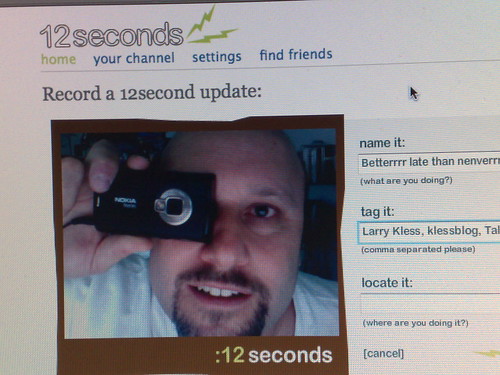
I just got my invitation to join 12econds.tv prior to taking a few days off with the family in Aptos and Santa Cruz. 12seconds is a new video messaging service that's currently in private alpha and like Twitter (which limits your messages to 140 characters) 12seconds limits your video messages to 12 seconds each. TechCrunch calls it "the real video Twitter" and offered 500 invites. Cordiva also offered 500 invites courtesy of ReadWriteWeb and you can read more on their about page or on this Stage Two Consulting blog post.
It's also similar to Seesmic and Phreadz (the UK Seesmic competitor that launched with threaded conversations) in that you are using video to share your thoughts and status and follow friends within a social network. It just so happens that 12seconds is based in Santa Cruz where I'm currently enjoying a few days vacation with my family. Founded by David Beach and Sol Lipman as a side project they are a small company of nerds and funded by burritos. 12 seconds works with mobile phones too and the time limit is real as the 12 second timer counts you down for every message.
"12seconds is the best place online for video status updates. It's a super easy way to share what you're doing with your friends and family using short video clips. You can use your web cam or mobile phone. Show your friends where you are, share your thoughts, or tell them how you're doing. We are building a video status platform that will help you keep up to date with your friends 12 seconds at a time." - About 12seconds
It's the middle of the summer and the heat is on. The live mobile broadcasting solutions, Kyte, Qik and Flixwagon, got some press in the tech blogs with two stories the last two days.
Beet.TV Associate Producer Kelsey Blodget, posted a new story "Kyte Blows in a Different Direction Than Qik, Flixwagon" that includes an interview with Kyte CEO Daniel Graf, who says that Kyte is really not in competition with with Qik and Flixwagon and has broader focus.
" Kyte is focused on a different market, partnering with entertainment companies including the four major record labels (Universal, Sony, EMI and Warner), MTV Europe and KROQ. It also will support any type of video content, whether online, mobile, live or recorded, while Qik and Flixwagon are primarily concerned with the live cell phone streaming of individual users. Kyte also lets users embed branded, automatically updating players on their websites and allows fans watching a channel on different sites to chat." - Kelsey Blodget, Beet.TV
I've covered Kyte before on this blog and listed the related links below. In particular, there's another interview with Daniel Graf on how Kyte is different from Seesmic, Qik and Flixwagon.
In a related story on TechCrunch Jason Kincaid posted, "Mobile Livecasting Faces Off: Qik vs Kyte vs Flixwagon" that compares the quality of three main mobile streaming platforms. They recruited Sarah Austin of Pop17.com to be the on-camera test subject for the quality tests and recorded a similar clip using each solution. The tests were more subjective than technical and didn't seem to have a set benchmark. Ratings issued on the video, audio and the player and Kyte edged out Qik on video and audio quality only with Flixwagon coming in third. Check out Jason's review to see all the videos.
There were some great comments on the post which listed other live mobile broadcasting applications and some pointing out that the test didn't delve into the technical specifics like this one from Ben:
"Technical comment regarding the comparison, that I think is somewhat wrong(!!!): You could clearly see the video shot on the Flixwagon video shot is much closer to the subject than Qik and Kyte. The surrounding are mostly white and compress better hence video quality of the picture will be better in this framing with all services. Another point not mentioned, I do know that both Qik and Flixwagon have quality settings - and I believe Qik goes up to 640×480 - what were the setting in each broadcast? how “live” was the broadcast? ignoring this is simply rating the default selection of each provider…"
Another comment from N95 was:
"nice comparison, but too simple, i’m afraid. i’m missing a more real-live set of tests using 3G using an adequate “no-delay” / medium resolution setting, which is more likely to be the normal setting for live-streaming, when someone is out and about. also i’m missing the technical details for each test, like resolution, bandwith used, delay, framerate, etc."
Livecast (formerly known as ComView) was also considered but they couldn't get the video to embed so it wasn't included. It supports Windows Mobile 5/6 and Symbian S60 phones, incorporates GPS and does have syndication capabilities for blog, YouTube and Twitter. It sounds like it should be great but formmy experience it actually performed poorly most likely not be a contender.
Regarding players Jason concluded that:
"Preference in the embeddable players will largely come down to a matter of taste. Qik’s player has the best styling, but it lacks the embedded chat features that are found on Kyte (Qik has a chat button in the player, but it doesn’t seem to do anything). Again, FlixWagon falls short in this area - it’s overly simplistic player is neither stylish nor feature-rich."
There are a number of other services available but none of them have had the amount of exposure and user adoption this past year as Kyte, Qik and Flixwagon. I'm currently testing all of these live mobile broadcasting platforms using a trial Nokia N95 compliments of WOM World/Nokia and so far Qik is my favorite. I plan to spend more time with mobile Kyte, Qik and Flixwagon during the next few weeks and publish my finding here on this blog.
Related posts from this blog on Live Mobile Streaming:




 of Santa Clara, Calif.-based Visivo Communications. It became a popular live mobile streaming application for a growing list of 130+ supported handsets (including Android, iPhones (original, 3G, and 3GS - previously jailbroken only), BlackBerry, Nokia Symbian, many Windows Mobile devices, and J2ME devices. Qik
 ![[wvff_header.jpg]](https://blogger.googleusercontent.com/img/b/R29vZ2xl/AVvXsEid0svakJzaRqtxNSL7nHO-8XvVBYcKkxlANMbOA3n4HkfrdVO_EUswKdEsX8Bnhf5ledfubPwMc6ieymY2ijfwKgR6Gr9naZiHUFi61YVfUEaj-YrOV4mc5Qw1lqLsaJIqpGLqbiKBtUCX/s1600/wvff_header.jpg)
 Today Andy Plesser, Executive Producer and Founder of the