Showing posts with label Video Marketing. Show all posts

Friday, May 8, 2015

Animoto Survey Says: Consumers Want More Video Marketing on Web, Social and Email [Infographic]

According to a new survey released today by Animoto, the leading cloud-based online video creation service, consumers are hungry for video and four times as many of them would rather watch a product video than read about it. In fact, of the 1,051 U.S. consumers surveyed, 1 in 4 actually lose interest in a company if it doesn’t have product video. The company issued a press release and infographic detailing the findings of its 2015 Video Marketing Cheat Sheet.

eMarketer estimates that US video advertising will climb to $7.8 billion this year and social media platforms like YouTube, Facebook and Twitter continue to attract and build content partnerships. Animoto CEO Brad Jefferson sees video as a huge opportunity for businesses to engage with consumers:
"The growth of online video marketing in recent years has been tremendous," said Jefferson. "Today, there are more than 7 billion videos watched every day on Facebook and YouTube. Historically, in order to create and distribute high-quality video to your customers it was cost-prohibitive for all but the largest brands. However, today's tools and platforms ensure that small and medium businesses can reach their audiences where they hang out online. This represents one of the biggest marketing opportunities for small businesses in a long time."
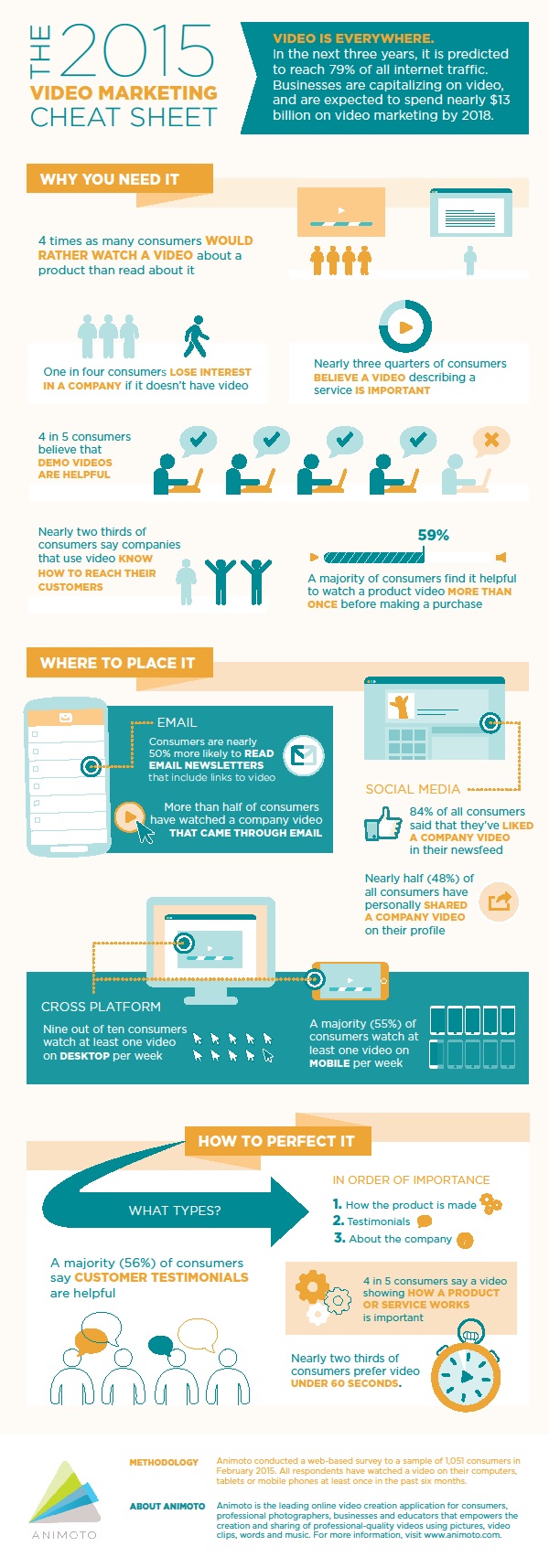
AnimotoSMBVideoInfographic
Three key themes emerged from the study, data presented below is directly from the press release:

1. Video Marketing Resonates With Consumers (Video drives brand lift)
  • 63 percent of consumers say companies that use video know how to reach their customers
  • One quarter of consumers lose interest in a company if it doesn't use video
  • 56 percent of consumers believe that if a company has a website, it should have video
2. Video Boosts Email Marketing and Social Media Engagement (Connect with consumers)
  • 84 percent of all consumers said that they have liked a company video that has appeared in their newsfeed
  • 43 percent of consumers are more likely to read email newsletters that include links to video
  • 56 percent of consumers have watched a company video that came through email
  • Nearly half of all consumers have shared a company video on their own social media profile
3. Video Boosts Email Marketing and Social Media Engagement (Tell your story)
  • 80 percent of consumers say a video showing how a product or service works is important when learning about the company
  • 56 percent of consumers says customer testimonials are helpful when purchasing a product/service
  • About half of customers say that 'about the company' videos are the most helpful when purchasing a product/service


About Animoto: Animoto makes it easy for businesses to create effective, professional videos within minutes with no video editing experience. Businesses use Animoto to enhance and promote their brands, drive website traffic, increase sales, and create dynamic email, social and online marketing campaigns.Founded in 2006, Animoto is based in New York City with an office in San Francisco.  For more information go to: http://animoto.com/business.

Monday, December 1, 2014

The Evolution of Video Marketing Part 2: An Illustrated History [Reel Summit]

This post is about five months old and goes back to the Reel Summit that was held at the Hotel Nikko in San Francisco on July 24-25, 2014. I meant to do a lot of blogging on this event, which was put on by good friend and ReelSEO rockstar and founder Mark Robertson and Dave Holland, ReelSEO Events and Commercial Director, but as you have noticed I've been way to busy to blog!

So, I share this video produced by BonFire Labs as the first post to wrap up the year, and the best of 2014!


Stay tuned for more to come... and visit ReelSEO to get everything you need to know about video marketing!

Thursday, July 24, 2014

The History of Video Marketing Part 1: Revolution [2014 ReelSummit] #reelsummit

The 2014 Reel Summit taking place today and tomorrow at the Hotel Nikko in San Francisco. This two-day conference is the only industry event devoted entirely to online video marketing for marketers and content creators who are serious about the (r)evolution of digital video marketing. The event is sponsored by ReelSEO and brings together inspiring brands, marketers and industry thought-leaders to share cutting-edge knowledge and advanced training and best practices on video production, online video advertising, brand management, e-Commerce and much more. ReelSEO welcomes video industry leaders YouTube, Vice, Vimeo, Cisco, Buzzfeed, Pixability, Brightcove, JW Player, Tubular, CinemaSins, and many others to learn from each other and celebrate the world of online video marketing.


As YouTube marketing expert Greg Jarboe says, this video, "An Illustrated History of Video Marketing Meet the Screens", produced by Bonfire Labs, illustrates that online video has grown, matured, and become mainstream.
"So has its audience", says Jarboe. "What was once the domain of the cutting-edge few has now become so common that it’s transformed how the world interacts with the web. Companies that never thought of using video now realize it’s the best way to communicate with their customers, build their brands, and educate and inform stakeholders both inside and outside of their organizations. With this new audience comes new challenges and new possibilities."
This year's keynotes include:

This Tubefilter article, 2014 Reel Video Summit Has A Stellar Lineup, Grilled Gurus, captures a great synopsis of the event and discusses a new and different format where attendees can "Grill the Gurus." Also, this Onlinevideo.net article written by YouTube marketing expert 


Several of the sessions will be streamed live on ReelSEO's YouTube, so stay tuned for updates.

More information - http://reelsummit.com

Wednesday, October 2, 2013

Video Marketing Tips from the 2013 Video Summit [ReelSEO Creator's Tip #105]

The 2013 Video Marketing Summit was held on July 25-26 in San Francisco and is the largest and only annual event devoted to all things video marketing and video commerce. The sold-out event drew over 300 attendees and was co-hosted by ReelSEO and Liveclicker, and was held in tandem with the Liveclicker's Video Commerce Summit. This year's combined summit was Liveclicker's 5th annual and an inaugural event for ReelSEO, and drew a cross section of over 300 retailers, brands, and agencies attending either summit.

Over the last few years, I've interviewed attendees and speakers at the Liveclicker video commerce summit, and this year the tables were turned, when Tim Schmoyer asked me to share a video marketing tip for his weekly ReelSEO Creator's tips. He included me in the following video, with video marketing tips from Suzie Reider (Marketing Director, YouTube), Jim Louderback (CEO, Revision3), Reed Lucas (Director of Channel Management, Channel Factory), Rob Sandie (CEO, vidIQ), Sofia Stefou (Video Strategist, Sofina Media), Jason Cesare (Account Executive, Unruly Media), Jay Nolan (Producer, Ecommerce), and Anthony Bucci (Founder, RevZilla).


See my tip is at 1:15, "Tell a story and capture your audience, whoever they may be--marketers, consumers, your customers." Don't sell the product, tell the story.

For a summary of all of the video marketing tips, see the related ReelSEO article here: Quick Video Tips from Experts at the ReelSEO Video Marketing Summit [Creator's Tip #105]

For a full look at the event, speakers, schedule and video summit links, visit reelsummit.com.

For a preview of last year's conference, watch this video with interviews I conducted at Liveclicker's Fourth Annual Video Commerce Summit.


2013 Video Commerce Summit — Advancing video in e-commerce

See you next year!

Tweet #vsummit


Monday, July 1, 2013

Check out my Google+ Hangout with Neil Davidson on, "The Core of a Successful Corporate Video"

Today, I had the pleasure of joining Neil Davidson, Founder and CEO at MyWebPresenters, in a Google+ Hangout to discuss, "The Core of a Successful Corporate Video", as part of his new Hangout series of talks with digital leaders. I was glad to join Neil's list Google+ Hangout guests, who've included: Conrad Weaver of Conjo StudiosTim Schmoyer of ReelSEOJustin Foster of Liveclicker, Tyrone Shum an expert on YouTube Video MarketingGideon Shalwick an online video marketing expert and Chris Savage of Wistia.

Google+ Hangouts have become a great way for people to "hang out" and have group video conversations and Google has added a lot of new features recently including: Remote Desktop, live rewind, and instant replay. The product has gained popularity over the last few years since its initial release in 2011 and relaunch as a standalone product at the Google i/o developers conference in May 2013. For more on the development of Google+ Hangouts and how it grew out of Google Talk, see this article: Exclusive: Inside Hangouts, Google's big fix for its messaging mess | The Verge.

I had a great conversation with Neil and you can see the topics we discussed in the interview questions below and watch our Google+ Hangout video for the full conversation.


Neil Davidson's interview questions:
  1. Larry - you must have seen (and made) a few corporate videos in your time; what would you say are the commonalities that all of the good ones share?
  2. How should a business go about fitting a video production into their marketing strategy? How can they decide what type of video to use and how to market it?
  3. Which businesses would you say are leading the way in using video as a marketing tool?
  4. I find that failures are normally good learning experiences. What is the biggest video failure you have had and what did you learn from the experience?
  5. What are the big opportunities that you see in the coming year for those using online video? Is it just more of YouTube or are there other good opportunities out there?
  6. What do you think of the short video format? i.e. Vine videos? Do you think that they will take off with businesses?
Watch all the Google+ Hangout interviews on Neil's YouTube channel at: Neil Davidson - YouTube.

Follow Neil Davidson (WEBPRESENTER) on Twitter.

Tuesday, September 27, 2011

Video is the Swiss Army Knife Of Internet Marketing - Mark Robertson, ReelSEO.com


According to ReelSEO.com's Mark Robertson, online video is the swiss army knife of online marketing, and social video can help eCommerce retailers move from conversions to conversations with their customers. I sat down with Mark following his keynote, "Welcome to the ‘REEL’ Web: Why Video Marketing has Evolved Beyond SEO" at Liveclicker’s 2011 Video Commerce Summit in San Francisco last month, to get a high level overview of how social media has changed search, the state of V-Commerce and what tactics and tools eCommerce marketers can harness to move beyond product videos.


Retailers Have Embraced Product Video

Mark says that SEO has evolved over the last 10 years, and now social media engagement enhances SEO rankings, a lot. Universal video search is becoming less effective for e-commerce transactional queries.
"I feel that eCommerce providers, for the most part, have done a fairly good job with online video, and they've embraced product video, specifically. So product videos on their landing pages, which makes sense. It's cost effective, highly measurable and they are there to sell products. But I believe as well, that online video is the swiss army knife of Internet marketing. It really can be used all over the customer life cycle. So, whether it's customer service, whether it's marketing, even recruitment, people are using video."
He included a few statistics in his presentation to illustrate his point:
73% of US retailers feature video on product pages in Q4 2010.   vs. 55% 2009.
# retailers > 1,000 videos on their websites 10% from Q4 2010 to Q1 2011.
⇑ 37% YOY growth in video views for LiveClicker retail sites live with video >1 year.

Source: eMarketer's "Video for Ecommerce" report | Sunday Sky’s “State of Video in Ecommerce Q1 2011” | MediaPost, Justin Foster 7/2011

Mark emphasized that while product videos are great, they don't lend themselves well to social sharing or universal video search. So while they're incredibly important, he says that marketers’ must embrace social video throughout the customer life cycle and produce video that lends itself to social. He cited a number of strategies and video types that can be applied to the video marketing purchase funnel, and a key ingredient to every application is to make all videos sharable.

StrategiesVideo Types
Video Advertising, Video SEO, Live Video Events, Social Video, Video DistributionVideo Commercials, Branded Video, Instructional (How-to) Videos, UGC Videos, Lifestyle Content
Video SEO, Social Video, Video Chat
Company profiles, Product Demos, Video Case Studies, Video Testimonials, Video Comparisons,
Website Video, Video Chat
Product Videos
Website Video
Training Videos, User Generated Videos, Video FAQs, Corporate Image/Culture, Customer Support, Thank you/rewards videos
Video Sharing/Social Video/UGC 
MAKE ALL VIDEOS SHAREABLE
Product Video Reviews/Testimonials

Examples of Retailers Going Beyond the Product Video

He presented a few examples of companies that were doing some innovative work that goes beyond the product video. 

Think Thin
ThinkThin, a health and wellness bar retailer, is providing comment value with its lifestyle web series that features the company’s CEO and Founder, Lizanne Falsetto, called Lizanne Naturally. It's highly produced branded entertainment in the form of a weekly web cooking show that is simultaneous released across all channels (YouTube, Facebook, Twitter), with outreach partnerships on relevant YouTube channels and niche target sites like diet.com.  It's a good example of an eCommerce company investing in online video outside of the product page.
"In challenging socio-economic times, people are searching for authenticity, even in the brands they buy. Consumers want to be given something more than forced advertising. They want community and trust. Producing original branded video content is one way to provide value back to the community and grow brand awareness and loyalty at the same time." - Stacy Bellew, ThinkProducts, Inc.
How does it tie back into sales?
• Carefully - Viewers want value, not a sales pitch
• Indirectly – Brand awareness, Loyalty = soft ROI
• Calls to action
  - “Download the recipe” – takes viewers to product website.
  - ASK: for email information, Facebook likes, etc...
  - Incentive: 20% coupon


Zappos.com
Zappos is embracing video like it's going out of style. The eCommerce retail giant sells over 300,000 different products, and began producing product videos in 2009 and soon found that the company could sell anywhere from 6-30% more merchandise when accompanied by videos. In its first year, Zappos exceeded its goal producing over 50,000 videos and is looking to double that in 2011. Zappos also has a YouTube it uses to expose its brand to the public and interact with the community. The channel offers fun behind the scenes looks at Zappos and has a number of blooper reels in its YouTube page. Zappos is a great example of a eCommerce retailer getting it right with video and has developed a broad and comprehensive video retail strategy. 

Zappos Video Strategy
• Product videos
• How-to videos
• Brand marketing
• Internal communications
• Corporate culture
• User-generated product reviews (planned)
• Video reviews
• Customer service videos
“What works the best is the fact that our videos are very real. There is value in being candid. There's an emotional connection that can’t be captured via photograph or text” – Laurie Williams, Zappos.com Video Product Manager
The results have been powerful with an increase in product page conversions and customer satisfaction and a decrease in product returns. Its success can be attributed to an honest, personal, informative approach to its video strategy and a diffusion to all its channels (Zappos website, YouTube, Facebook).

This video is from Zappos' insidezappos YouTube channel and explains how to properly package a return.


Moving from Conversions to Conversations
Mark concluded that eCommerce retailers must embrace social video as part of their overall marketing strategy throughout customer life cycle.
"I really think that product videos are a no brainer, and I honestly believe that every eCommerce retailer should be doing them. I can't think of any logical reasons now why they shouldn't. That being said, I think that there's many other opportunities around that and I think that if eCommerce retailers really want to embrace online video and really excel, they'll be doing video across the customer life cycle and that will lend itself better to social, that will lend itself better to search and helpfully we'll some interesting innovation there."

About Mark Robertson 
Mark Robertson is the Founder and Publisher of ReelSEO, an online information resource dedicated to the fusion of video, technology, social media, search, and internet marketing. In addition to running Reel SEO, Mark is a popular web video consultant and has worked on digital-video initiatives with several major brands, including, Zappos.com. He is considered a leading expert within the digital video and search marketing industries and has had the pleasure of speaking at many conferences including Search Engine Strategies, Streaming Media, SMX,  PubCon, Video Commerce Summit, Online Video Platform Summit, Online Video Summit, and more…
Twitter @markrrobertson | Google Plus | Facebook | Linkedin | YouTube


Related

Wednesday, June 22, 2011

Getting Online Video to Measure Up - Dan Piech, comScore


2010 was massive year of growth for online video, throughout the industry and the way consumers accessed video content. Analysts are seeing a sharp rise in online video viewing compared to traditional television, which has huge implications for online video advertising and marketing. Digital media measurement firm comScore noted in its “The 2010 U.S. Digital Year in Review” that eCommerce spending in 2010 grew 9% to $227 billion in sales. Social networking site continue to drive views as audiences build, share and engage on sites like YouTube, Facebook, Twitter, LinkedIn and Tumblr. For businesses, there's no other tool more important than online video analytics to capture how your video content is consumed on the web.

Dan Piech, Senior Product Management Analyst with comScore says, the best way online video publishers and marketers create and sustain value is through differentiation, and the way you do that is through your data.
"It's not just about understanding your audience," Piech says, "but then putting together a pitch that sells that audience to advertisers."


Piech says that online publishers will not have the reach of a television audience, and for small publishers it will be even harder. So he suggests that publishers find that niche audience, develop it and sell that niche based on what you've learned about it from your metrics, because the agencies are not going to do that for you. He says that digital market intelligence services like comScore help you better understand your audience.

comScore believes that they have the most accurate methodology for measuring digital media. Each month, the digital media measurement firm comScore releases its Online Video Rankings from its Video Metrix service, with the most recent comScore May 2011 U.S. Online Video Rankings, that showed 83.3 percent of the U.S. Internet audience (176 million) watched online video content in May for an average of 15.9 hours per viewer. Video ads accounted for 12.6 percent of all videos viewed and 1.2 percent of all minutes spent viewing video online.

How comScore gets at the data is a secret sauce merged from two sources. The first source is a panel of two million Internet users worldwide that they track their behavior. One aspect of that behavior is watching videos. So they're able to understand where they are watching videos, how long they're watching videos, get a good sense of unique viewers , and project that to the total populations. The second source is census-level data collection method, commonly referred to as unified digital measurement, and comScore works with all the top publishers in the video and media space to get that data. In the method, publishers send data every time a video is viewed.
"By that we're able to get a very census-level, total population look at the video activity on that site," Piech says. "and furthermore, break that video activity down to very granular levels."

As an example, for clients like NBC, CBS or MTV, comScore is able to break down how people are engaging with those shows on a a census level from that unified digital measurement, as well as on the panel. Like Nielsen, comScore tracks that activity across all screens and as Piech notes
"Obviously we're paying close attention to the cross-media space and the three screen developments that are taking place. Because at the end of the day, content is king, as you always hear and to the extent that that's the case, we have to follow that content wherever it goes."
Piech says, currently that's mostly online but we're at a turning point in the space where mobile and OTT are growing very fast. So comScore is working on developing the indicators to know where the space will be in five years, mostly through surveys that help forecast audience perceptions. In a recent survey, comScore was working to understand the level of ad loads that users would be willing to watch, or rather willing to endure. What they found was that online viewers are perfectly willing to watch twice as many ads for their content. Piech says that when it comes down to it, the numbers are people, and by putting a face to the numbers puts an emphasis not just on numbers, but attitudinal changes happening in the space which helps publishers better understand how their content is consumed so they can best monetize it moving forward.


As the current trends in online video continue to show massive growth, so does the opportunities for online video publishers and marketers. Many analysts say that for the last several years we've reached a tipping point for online video.
"We've reached a state in the online video space now where almost everyone online is watching video at some point in the month," says Piech, "so we've now got that reach. But what's interesting that we're finding out is that now that everyone is watching online video, people are starting to watch a lot more."
He says it's more than doubled in the last year and is fascinated by the trend, because online video is still a small part of the overall activity of any individual day as compared to television, but what's happening is that's growing incredibly fast. Engagement levels are up, number of videos views are up and that's across all demographics and all across the board, and it's happening at a very high rate.
"So if you do a simple extrapolation that, in the very near future where online video is a major, major player out there," Piech notes, "and that's what makes me really excited about the space. We're not a dying industry, we're in our birth and really high growth state which makes this a very exciting space and a space that changes quickly."
This interview in this post was conducted at the Online Video Platform Summit where Piech was a panelist on the session, Online Video by the Numbers: Analytics, Reporting, and Metrics. He was joined by an all-star panel that examined what type of important data you should be collecting and how to use that data to improve the effectiveness of your video and increase your ROI.

Piech also spoke earlier this year at OMMA Video on, The State of Online Video, where he provided a picture of today’s online video consumer which can be viewed in the video below.


Video streaming by Ustream
"Who is watching, how engaged are they and what has changed over time? Where are we seeing the biggest shifts – long-form or short-form videos? What impact is online video having on traditional TV viewing, and when it comes to online advertising how are consumers’ preferences shaping the market?"

About comScore
comScore, Inc. (NASDAQ: SCOR) is a global leader in measuring the digital world and preferred source of digital business analytics. For more information, please visit www.comscore.com/companyinfo. Follow comScore, Inc. (comscore) on Twitter

About Dan Piech

Dan is a Senior Product Management Analyst at comScore, Inc. and President and Founder at evoxio. At comScore, Dan manages comScore’s online video measurement products and is responsible for ensuring that measurement insights support the growth and development of the online video industry. Previously, he was anInteractive Strategy Intern at McKinney, Project Manager at HG Media, Inc and Advertising Intern at Success Communications Group. comScore is a marketing research company that provides marketing data and services to many of the Internet's largest businesses. Follow Dan Piech (danpiech) on Twitter

Related:

Monday, May 30, 2011

Brands Are Using Live Streaming Video to Engage Fans on Facebook - Max Haot, Livestream

Over the last several years live video streaming has become a powerful marketing tool for artists and brands. For Max Haot, CEO and Co-founder of Livestream, it's been interesting to watch the growing trend of brands adopt live streaming to market their products. I caught up Haot at NewTeeVee Live 2010 where Livestream announced its new Livestream For Facebook application that allows anyone with Facebook pages to launch a live broadcast within Facebook. Livestream launched this service based on the demand they were seeing from the market and developed an easy way to integrate live streaming into Facebook. Livestream and its competitors had previously provided this service for a fee, but Livestream decided to launch it in a DIY way so that anyone could launch a Livestream channel and embed it in their Facebook page.

Facebook launched its own channel, Facebook Live, in August 2010 powered by Livestream, and has hosted numerous live video and chat with Hollywood celebrities, musicians other high profile Livestream events. Most notable is a recent Town Hall meeting with President Barack Obama that was streamed live from the Facebook headquarters.

comScore noted in a September 2010 study, that the amount of time American audiences spent watching video for the major live video publishers (USTREAM, Livestream, Justin.tv, LiveVideo, and Stickam) had grown 648% since 2009 to more than 1.4 billion minutes. While that's just a fraction of the amount of time Americans spent overall watching online video content, comScore said that the sharp growth indicates viewers’ growing comfort with watching live content. Additionally, the comScore report indicated that live video sites have not only been successful in building audience, but also keeping them more engaged, with the average live streamed video view is 7% longer than the average on demand video view.


"What's interesting for brands to realize," Haot notes, "is the engagement time is on average twenty to thirty minutes, versus if you post a trailer, it's only two or three minutes… and then they have a chance of really creating a viral buzz on Twitter and Facebook, and get a lot of eyeballs coming to the live stream because it's trended on Twitter."
Content brands like movie studios, use Livestream to market the release of a new movie within social networks like Facebook and Twitter through a live broadcast of the red carpet premiere. TV networks like HBO are taking advantage of the Livestream's ability to host live video Q&A sessions with celebrities and show exclusive behind the scene previews. Other brands like Ford used Livestream to launch its 2011 Ford Explorer and hosts regular live events on its Facebook pages with Q&A sessions with customers and fans. Restaurant chain PF Chang hosts a live cooking show to market its Pei Wei Asian Diner brand and takes questions from the audience.

Haot says that working with brands and content owners drives content quality and revenue and is core to Livestream's mission to build a next-generation live cable operator. But the bigger goal of Livestream is to unlock every event around the world, from major events like red carpet interviews at the Oscars or the Royal Wedding, to prosumer events from a church, a small baseball game, or even a smaller conference.
"If you look at the world of events today," Haot says, "a very small percent of these events are being live streamed, so we offer the technology, the tools and promotion to hopefully increase the amount events owners that realize that they can use Livestream to extend their event online and connect with audiences on Facebook and Twitter."
Another goal Haot says, is to increase the production quality and reach across the various platforms by offering HD quality and enhancing the mobile offering by live streaming to the popular mobile devices, and on the web by enhancing it with multi-bit rate encoding and HD. Haot says that connected TVs are another growing platform that event owners can reach and that 80% of all TVs sold today are "connected" TVs.

In a related post on Beet.TV today, Andy Plesser spoke with Kevin Delaney, Managing Editor of the WSJ.com, about the value of live video streaming at the Wall Street Journal. The news organization is creating value in process and audience by connecting with viewers through daily webcasts. This is yet more evidence that live streaming has become a mainstream tool for publishers to extend their reach beyond traditional outlets. As more content creators, publishers and broadcasters develop their mobile and OTT offerings, and with YouTube finally getting into the live streaming business with selected YouTube partners, it's clear that live video streaming has become an integral tool for artists and brands to connect with fans and that demand will continue to grow.


About Livestream
Livestream offers brands a complete solution for your live streaming project on Facebook - Including : Custom Facebook application development with integrated live streaming that gives you everything you need to launch your own 24/7 television station (including Like to watch), Live video platform (including CDN bandwidth from Akamai, social enabled chat and player) and on-side production/encoding services if needed. Livestream streams more than one billion video minutes each month to a growing community of 20 million monthly viewers (with some 50,000 watching at any given time) to audiences on the web, mobile devices, and connected TVs. Notable content partners include Facebook, The New York Times, ABC News, CBS News, Associated Press, HBO, AT&T, IBM, Burger King, Nike, The Academy Awards, The Foo Fighters, Maroon 5, Ralph Lauren, and Diesel.

Livestream was cofounded in 2007 by Max Haot, Dayananda Nanjundappa, Phil Worthington, and Mark Kornfilt, and has received $13 million in funding from private angel investors & Gannett Co. It now operates with over 50 full-time staff members in 3 offices - in New York, Los Angeles and Bangalore (in addition to a globally-available production team). The service is available for free (advertising-supported) or as a feature-rich, monetizable, premium subscription for business. In May 2009, Mogulus re-branded as Livestream. Become a fan of Livestream on Facebook and follow Livestream (livestream) on Twitter.

About Max Haot
Max Haot is CEO and co-founder of video streaming company Livestream. Max is an expert in user generated content, broadcast technologies and workflow. He previously founded ICF a media asset management platform which was sold to Verizon Business in 2005. He held positions as VP of Digital Media at Verizon Business and Senior Vice President at IMG Media - the television and interactive arm of the sport marketing giant (www.imgworld.com). Max is a recognized digital content industry pioneer and is regularly invited to speak and contribute at industry events/forums for the broadcast, broadband and mobile industry. Max is a Belgian national and lived in London, UK between 1995 and 2005 before moving to New York. Follow Max Haot (maxhaot) on Twitter.


Related:

Sunday, December 12, 2010

Online Video Conversations: David Burch, Tubemogul - Part 1: Why Video? Marketing tips, Online Video Industry Trends

In this latest installment of Online Video Conversations, I caught up with David Burch, Director of Marketing at TubeMogul, Inc., to find out why video is important for all types of businesses – small, medium and large – and how video distribution, analytics and social media marketing helps build brand identity and viewer engagement. He also talks about trends and the current state of the online video industry. Burch is well-known within the industry and is frequently quoted as an expert in online video in leading media outlets like AdAge, NPR's Marketplace and Wired.

Burch leads media relations for the Emeryville, California-based online video ditsribution, analytics and advertising platform. He also is the author of all TubeMogul's data-driven research. Prior to joining TubeMogul, Burch was a Content Manager at Delivery Agent, and worked on digital strategy for many top media companies, including ABC and NBC. He received his BA in Political Economy from the University of California, Berkeley, which is where Tubemogul was born.


To start the conversation, I asked Burch one of those "what is the meaning of life?" questions by asking:
"Why video? What's so compelling about video that companies should get involved with it?"
According to Burch, there are a lot of good reasons, but the number one reason is that video is more engaging than any other media.
"Video is just a really powerful medium to convey branding messages. It's more effective than other formats, like banner ads or different mediums of advertisement. Why video? Why not video?"
Online video audiences continue to grow, with more and more people are watching more video across the board. According to Tubemogul research, people are more likely to click on a link if it's a video and on average audiences clicking on video links from Twitter watch a video 36.91% longer than viewers referred by Facebook and 49.98% longer than viewers referred by Digg. He says people love Tubemogul's feature that sends a Tweet when your video is uploaded.

In addition, Brightcove and Tubemogul's Online Video & Media Industry Quarterly Research Report, found that online video discovery is shifting from search to social media. Twitter and Facebook attract more engaged viewers than other sites and are growing faster than search engines, and while Google search is still king, social media marketing gaining ground fast.

Burch says that even though YouTube is the biggest online video entity – publishers, marketers and businesses of any size can benefit from distributing their videos to more than one site. Tubemogul provides a free video syndication service OneLoad, which is a single point for distributing videos to the top video and social networking sites. Tubemogul also provides InPlay, its free video analytics solution for publishers, online video platforms and video sharing sites. He says that publishers and marketers can learn a lot about their audience and their level of engagement from real-time analytics.

Burch says that if you're not using video, you should get started:
"A lot of small businesses get a lot of SEO benefit from video. Being in more places means – more people are watching. It's not like you're gaming anything, you're just becoming more popular."
In regards to the current state of the online video industry – and comparing the industry growth innings in a baseball game – Burch thinks we're in the forth or fifth inning.
"It's hard to remember, but YouTube's only been around for 5 years, so it is pretty young. I really think with the analytics space, we've got this technology that a lot of people are using – and I think the technology is getting there."
According to Burch the viewing experience is getting better and rebuffer rates (those annoying delays in the video loading) are going down. Fast load times are low rebuffer rates are crucial, as Tubemogul's research found that 81.19% of viewers choose to click away instead of waiting for a video to rebuffer.
"If you're willing to avoid that and want to pay to deliver professional quality video, there are solutions out there to do it. There's this while ecosystem of analytics built in, which is where we step in, advertising solutions which we recently launched, our PlayTime ad platform. It's a very developed ecosystem. HOw television will be viewed on the web and how mobile will fit in to that  – there's a lot of open questions – but I feel that it's evolved quit a bit." 
Stay tuned for Part 2 of my Online Video Conversation with David Burch coming soon.

About Tubemogul
TubeMogul is a video advertising and analytics platform that connects advertisers with highly targeted audiences. TubeMogul's advertising solution is powered by the company's unprecedented data platform that tracks billions of video streams every month from the Internet's top publishers. This unique technology enables TubeMogul to help advertisers find consumers who want to watch their videos - and watch them longer. Advertisers and marketers never again have to choose engagement and accountability over reach if they use TubeMogul's video advertising and analytics platform.

Follow tubemogul (tubemogul) on Twitter

Related posts:

Sunday, March 14, 2010

Have You Taken the 2010 Video Marketing Quiz? EyeView Tests Your Video Marketing Skills

According to EyeView, an effective video experience is the best way to increase conversion. Since it was founded in 2007, the Tel Aviv-based company has specialized in online video content creation, marketing and conversion as B2B solution for big name customers that include Google, Yahoo!, HP, and eBay. They've learned a lot about how video performs as marketing tool, and decided to share the data in a fun way using social media. This past week, EyeView launched its 2010 Video Marketing Quiz which follows up on the success of last years quiz, which you can still take here, and showcases some of the results of optimization tests that EyeView has performed for its clients.

VMQ10


The quiz is composed of five questions that challenges your video marketing instincts. Each question compares two videos side-by-side and asks you to choose which one had a higher conversion rate.
  1. Still image vs. video
  2. Dynamic Call-to-Action pointers
  3. Launch triggers
  4. Auto-play vs. Press-to-play
  5. British accent vs. American accent
All comparison data was collected during A/B tests where 50 percent of the incoming traffic would see one version of the page and the remaining 50 percent would see an alternative version. In each case EyeView's customers saw the conversion rate for particular landing pages increase by as much as 85 percent. The question that pitted two videos with voice-overs by British and American accents, was a way to discover whether the old adage about everything sounding smarter in an English accent translated into increased conversions – and the results were surprising.

According to Tal Riesenfeld, Co-Founder and VP Marketing for EyeView:
“The quiz is a fun way to expose marketers to the proven concept that video solutions increase conversion and generate greater profits. Etailers have already woken up to this idea with early adopters like Zappos.com committing resources to video, but we are also seeing companies from the financial, software, lead generation and gaming sectors benefiting from the improved performance video offers.”
Daniel Sevitt, EyeView’s Director of Corporate Communications, told me that people really love the quiz and while they're a B2B company, they love using social media to connect with peers and consumers. EyeView’s previous Video Marketing Quiz included a book giveaway of Chris Brogan's New York Times bestseller, Trust Agents, and EyeView returned to the microblogging network again for their 2010 quiz. Everyone who completes the quiz is invited to tweet their results with a simple in-game link. The quiz launched at 10 am ET on Wednesday May 10, 2010, and EyeView randomly gave away five Amazon.com vouchers ($20 each) every hour for the first eight hours to anyone tweeting their score and helping spread the word about the quiz.

You can also download the answer key once you've completed the quiz to see how well you scored.

[Disclaimer: I actually won a $20 voucher after Tweeting my score, but I have no financial interests in EyeView, nor is this a sponsored post.]

About EyeView
Founded in 2007, EyeView is the leading provider of video solutions for performance advertisers with offices in Boston and Tel Aviv. The company has assembled a dedicated team with a wealth experience from leading companies, such as Google, YouTube, 888.com and HP. Among EyeView’s clients are eBay, Yahoo!, LendingTree and many SMBs around the world.

Sunday, February 21, 2010

Online Video Gets Serious in 2010, and it's only the Beginning

With almost two months into 2010, the daily news feeds have been filled with updates on the online video space. From funding announcements, M&As, new product and service rollouts, broad market expansion, rapid innovation, and consolidation within the space — it's an industry that is maturing into a serious business, as both the consumption and production of video on the web transitions to mobile devices and broadband-enabled televisions. According to comScore, over a billion videos were consumed daily in December for whopping 33 billion views in the US, and there's no sign of it slowing down. Leading online video platform providers have expanded into new markets, and enhanced their cloud-based video SaaS offerings for delivery to all consumer electronics devices.

But with all the push, there's also been pull and with any market — startups rise and fall, and supply and demand dictate the terms of who survives in the changing environment. Advertisers are still not convinced that online video is the holy grail, and according to eMarketer, companies have yet to convert their spend of about $70 billion they're currently spending on TV advertising to online advertising.

More signs of compression within the space were seen last week, when we saw the first online video platform literally put itself on the auction block, with SesameVault selling itself on eBay (item 160405185640) with a starting bid of $500,000, with no takers so far. In addition, Ryan Lawler reported on the fall of Move Networks as Fox dropped Move Networks for Brightcove, Adobe Flash, and Dan Rayburn covered the news that Swarmcast laid off half of company, and changed focus to target CE devices.

On funding trends, Will Richmond has been tracking the money flowing into online video companies and he called February "a red-hot month" for online video financing. He noted financing rounds just in the last week for Clicker ($11M), YuMe ($25M), TidalTV ($16M) and Vook ($2.5M), adding to those previously announced: Encoding.com ($1.25M), IVT ($5.5M), Voddler ($3.5M), BrightRoll ($10M) and the big whopper of the month Ustream ($75M) though in two tranches. In 2009, he tracked 64 companies which raised close to $470 million, and so far in 2010, the total funding is just short of $150M.

The momentum is building for paid video content models and battles lines are drawn between HTML5, Flash, Silverlight and H.264, and as Brightcove CEO Jeremy Allaire said, the future of web content and mobile apps is really about the Internet’s dominant platform companies — Apple, Adobe, Google and Microsoft — trying to push their value proposition for broader adoption, and we've only seen the beginning.

Before the year marches on any further, here are some highlights of significant online video news stories so far in 2010.

Industry News, Online Video Advertising and Marketing
Online Video Platform and Related News
OTT
The State of Online Video
Update 2/22/10 - In an article today, Digital Marketing Guide: Video - Advertising Age - Digital, Michael Learmonth noted that spending on web video advertising may increase by 50%. eMarketer and Piper Jaffray are putting the online video advertising market at or around $1.5B, up from $1.1B in 2009.