Online video, online video publishing, streaming media, OVP, OTT, web television, video advertising, marketing, startups, gadgets, social media, videoconferencing, collaboration and related topics are discussed here. Thanks for stopping by the "Klessblog."
According to a new survey released today by Animoto, the leading cloud-based online video creation service, consumers are hungry for video and four times as many of them would rather watch a product video than read about it. In fact, of the 1,051 U.S. consumers surveyed, 1 in 4 actually lose interest in a company if it doesn’t have product video. The company issued a press release and infographic detailing the findings of its 2015 Video Marketing Cheat Sheet.
eMarketer estimates that US video advertising will climb to $7.8 billion this year and social media platforms like YouTube, Facebook and Twitter continue to attract and build content partnerships. Animoto CEO Brad Jefferson sees video as a huge opportunity for businesses to engage with consumers:
"The growth of online video marketing in recent years has been tremendous," said Jefferson. "Today, there are more than 7 billion videos watched every day on Facebook and YouTube. Historically, in order to create and distribute high-quality video to your customers it was cost-prohibitive for all but the largest brands. However, today's tools and platforms ensure that small and medium businesses can reach their audiences where they hang out online. This represents one of the biggest marketing opportunities for small businesses in a long time."
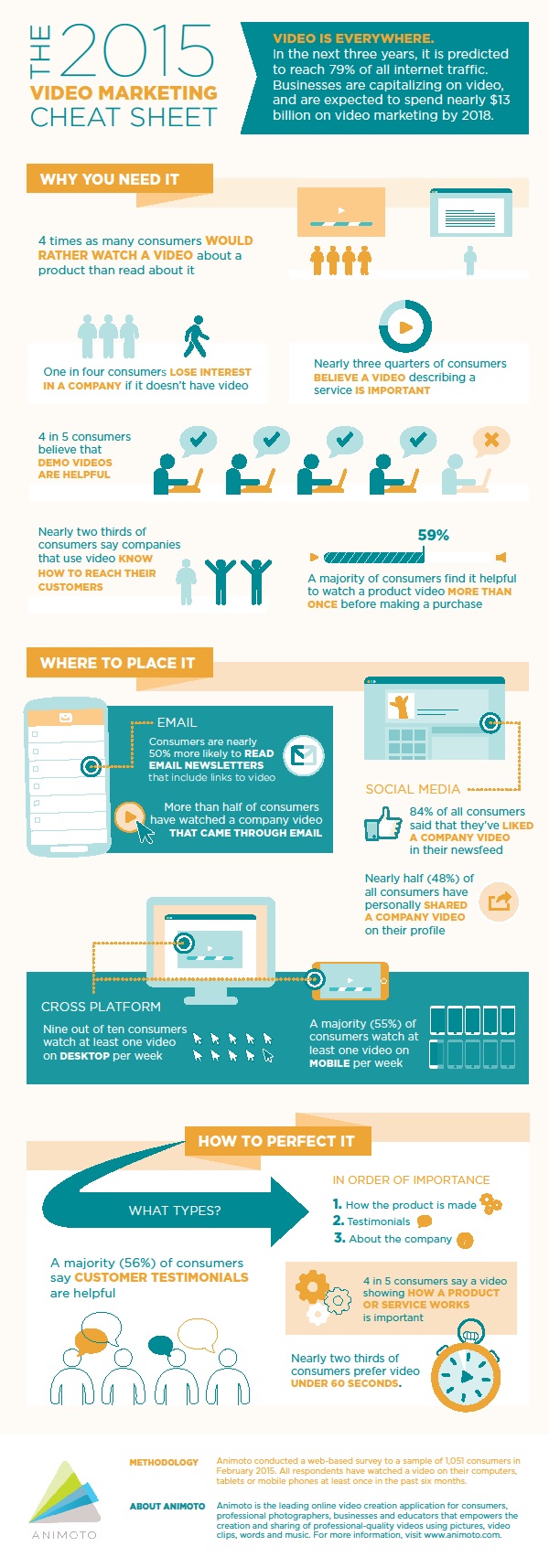
1. Video Marketing Resonates With Consumers (Video drives brand lift)
63 percent of consumers say companies that use video know how to reach their customers
One quarter of consumers lose interest in a company if it doesn't use video
56 percent of consumers believe that if a company has a website, it should have video
2. Video Boosts Email Marketing and Social Media Engagement (Connect with consumers)
84 percent of all consumers said that they have liked a company video that has appeared in their newsfeed
43 percent of consumers are more likely to read email newsletters that include links to video
56 percent of consumers have watched a company video that came through email
Nearly half of all consumers have shared a company video on their own social media profile
3. Video Boosts Email Marketing and Social Media Engagement (Tell your story)
80 percent of consumers say a video showing how a product or service works is important when learning about the company
56 percent of consumers says customer testimonials are helpful when purchasing a product/service
About half of customers say that 'about the company' videos are the most helpful when purchasing a product/service
About Animoto:
Animoto makes it easy for businesses to create effective, professional videos within minutes with no video editing experience. Businesses use Animoto to enhance and promote their brands, drive website traffic, increase sales, and create dynamic email, social and online marketing campaigns.Founded in 2006, Animoto is based in New York City with an office in San Francisco. For more information go to: http://animoto.com/business.
According to ReelSEO.com's Mark Robertson, online video is the swiss army knife of online marketing, and social video can help eCommerce retailers move from conversions to conversations with their customers. I sat down with Mark following his keynote, "Welcome to the ‘REEL’ Web: Why Video Marketing has Evolved Beyond SEO" at Liveclicker’s 2011 Video Commerce Summit in San Francisco last month, to get a high level overview of how social media has changed search, the state of V-Commerce and what tactics and tools eCommerce marketers can harness to move beyond product videos.
Retailers Have Embraced Product Video
Mark says that SEO has evolved over the last 10 years, and now social media engagement enhances SEO rankings, a lot. Universal video search is becoming less effective for e-commerce transactional queries.
"I feel that eCommerce providers, for the most part, have done a fairly good job with online video, and they've embraced product video, specifically. So product videos on their landing pages, which makes sense. It's cost effective, highly measurable and they are there to sell products. But I believe as well, that online video is the swiss army knife of Internet marketing. It really can be used all over the customer life cycle. So, whether it's customer service, whether it's marketing, even recruitment, people are using video."
He included a few statistics in his presentation to illustrate his point: •73% of US retailers feature video on product pages in Q4 2010. ⇑ vs. 55% 2009. •# retailers > 1,000 videos on their websites⇑10% from Q4 2010 to Q1 2011. •⇑ 37% YOY growth in video views for LiveClicker retail sites live with video >1 year.
Source: eMarketer's "Video for Ecommerce" report | Sunday Sky’s “State of Video in Ecommerce Q1 2011” | MediaPost, Justin Foster 7/2011
Mark emphasized that while product videos are great, they don't lend themselves well to social sharing or universal video search. So while they're incredibly important, he says that marketers’ must embrace social video throughout the customer life cycle and produce video that lends itself to social. He cited a number of strategies and video types that can be applied to the video marketing purchase funnel, and a key ingredient to every application is to make all videos sharable.
Strategies
Video Types
Video Advertising, Video SEO, Live Video Events, Social Video, Video Distribution
Video Commercials, Branded Video, Instructional (How-to) Videos, UGC Videos, Lifestyle Content
Video SEO, Social Video, Video Chat
Company profiles, Product Demos, Video Case Studies, Video Testimonials, Video Comparisons,
Website Video, Video Chat
Product Videos
Website Video
Training Videos, User Generated Videos, Video FAQs, Corporate Image/Culture, Customer Support, Thank you/rewards videos
Video Sharing/Social Video/UGC
MAKE ALL VIDEOS SHAREABLE
Product Video Reviews/Testimonials
Examples of Retailers Going Beyond the Product Video
He presented a few examples of companies that were doing some innovative work that goes beyond the product video.
Think Thin
ThinkThin, a health and wellness bar retailer, is providing comment value with its lifestyle web series that features the company’s CEO and Founder, Lizanne Falsetto, called Lizanne Naturally. It's highly produced branded entertainment in the form of a weekly web cooking show that is simultaneous released across all channels (YouTube, Facebook, Twitter), with outreach partnerships on relevant YouTube channels and niche target sites like diet.com. It's a good example of an eCommerce company investing in online video outside of the product page.
"In challenging socio-economic times, people are searching for authenticity, even in the brands they buy. Consumers want to be given something more than forced advertising. They want community and trust. Producing original branded video content is one way to provide value back to the community and grow brand awareness and loyalty at the same time." - Stacy Bellew, ThinkProducts, Inc.
How does it tie back into sales?
• Carefully - Viewers want value, not a sales pitch
• Indirectly – Brand awareness, Loyalty = soft ROI
• Calls to action
- “Download the recipe” – takes viewers to product website.
- ASK: for email information, Facebook likes, etc...
- Incentive: 20% coupon
Zappos.com
Zappos is embracing video like it's going out of style. The eCommerce retail giant sells over 300,000 different products, and began producing product videos in 2009 and soon found that the company could sell anywhere from 6-30% more merchandise when accompanied by videos. In its first year, Zappos exceeded its goal producing over 50,000 videos and is looking to double that in 2011. Zappos also has a YouTube it uses to expose its brand to the public and interact with the community. The channel offers fun behind the scenes looks at Zappos and has a number of blooper reels in its YouTube page. Zappos is a great example of a eCommerce retailer getting it right with video and has developed a broad and comprehensive video retail strategy.
“What works the best is the fact that our videos are very real. There is value in being candid. There's an emotional connection that can’t be captured via photograph or text” – Laurie Williams, Zappos.com Video Product Manager
The results have been powerful with an increase in product page conversions and customer satisfaction and a decrease in product returns. Its success can be attributed to an honest, personal, informative approach to its video strategy and a diffusion to all its channels (Zappos website, YouTube, Facebook).
This video is from Zappos' insidezappos YouTube channel and explains how to properly package a return.
Moving from Conversions to Conversations
Mark concluded that eCommerce retailers must embrace social video as part of their overall marketing strategy throughout customer life cycle.
"I really think that product videos are a no brainer, and I honestly believe that every eCommerce retailer should be doing them. I can't think of any logical reasons now why they shouldn't. That being said, I think that there's many other opportunities around that and I think that if eCommerce retailers really want to embrace online video and really excel, they'll be doing video across the customer life cycle and that will lend itself better to social, that will lend itself better to search and helpfully we'll some interesting innovation there."
About Mark Robertson
Mark Robertson is the Founder and Publisher of ReelSEO, an online information resource dedicated to the fusion of video, technology, social media, search, and internet marketing. In addition to running Reel SEO, Mark is a popular web video consultant and has worked on digital-video initiatives with several major brands, including, Zappos.com. He is considered a leading expert within the digital video and search marketing industries and has had the pleasure of speaking at many conferences including Search Engine Strategies, Streaming Media, SMX, PubCon, Video Commerce Summit, Online Video Platform Summit, Online Video Summit, and more… Twitter @markrrobertson | Google Plus | Facebook | Linkedin | YouTube
I caught up with Curt Van Inwegen, VP of Client Services at LEVEL Studios at last year's Online Video Platform Summit where he was part of a panel on the topic of how to choose the right online video platform for your business. Van Inwegen offered his insights on what you should consider for selecting the appropriate OVP for your business. LEVEL Studios is an independent digital agency based in San Luis Obispo, California with additional offices in San Jose and El Segundo, California that provides user experience, digital media, and application development solutions.
Van Inwegen suggests that when you're choosing an OVP you need to look at several things. You're not just looking at the technology, you're looking at the ability to gather data on who is looking at your content, what devices they are using, desktop or mobile and what type of mobile, iPhone, iPad, Android or Blackberry. The other piece of it is, looking at whether your content can actually play on those devices or can it be produced from those devices.
With everything going mobile, Van Inwegen, notes that the ability to ingest that content and view it on a variety of different platforms is really what's critical and an OVP will help you distribute your content to all those platforms and devices within the complex and fragmented video landscape. Those are but a few of the key factors he and his team at LEVEL look for in the solutions they provide to their clients.
Van Inwegen says:
"A lot of our clients aren't just looking to post their video up and generate a bunch of ad revenue, they're looking for what we call, branded experiences."
LEVEL's choosing of the Kyte platform was based on the idea that they can have complete control of customization of the video player. Everything that wraps around the video can represent the brand in way that he says isn't available in other platforms. This offers great flexibility in a white labeled solution for any viewing platform whether it's a TV, website or mobile device.
Van Inwegen spoke with Beet.TV last year about how on LEVEL has helped their client Monster Energy Drink create an interactive branded video experience for their loyal fans using the Kyte platform. He says that the flexibility of Kyte's 360° application is incredibly powerful for producing content, both professionally produced or user-generated, and distribution on platforms on mobile, desktop and the social web. Other key features that offer the brand more control and insight are with the moderation tools and analytics suite. Read more here: http://t.co/u3C9tS1
About Curt Van Inwegen
Curt Van Inwegen is the Vice President of Operations at LEVEL Studios, an independent digital agency headquartered in San Luis Obispo. With offices in San Luis Obispo, Los Angeles and San Jose, LEVEL has about 150 employees (more than 100 based in San Luis Obispo) and a client list that includes Apple, Disney, Cisco and Hewlett-Packard, among many others. Prior to joining LEVEL, Curt served as a member of the Orb Networks, Inc. executive team and managed strategic partnerships with companies such as Sprint, Intel, AMD, Hutchison 3 Group, Nokia, Vodafone and Virgin Digital. Curt earned his MBA degree from Loyola Marymount University and his Bachelor’s degree in Business and Accounting from the Loyola College, Maryland.
On a personal level, Curt, his wife Martha and daughter Cyprus live in Atascadero and enjoy all the region has to offer from outdoor activities to wine tasting to the various farmers markets. He’s an active cyclist and enjoys passing mountain bikers on 27-speed bikes uphill with his single speed. From a historical perspective, his Grandmother on his mother’s side was Melba Branch, of the long-standing Branch family in Arroyo Grande.
LEVEL Studios is an independent digital agency that amplifies global brands by innovating across desktop, web and mobile environments. LEVEL provides user experience, digital media, and application development solutions. Its solutions include user experience design and research, brand promotion strategy, and marketing research and planning; enterprise application design, Web services development and integration, content management implementation, technology architecture consulting, and hosting and managed services; J2EE, .NET, PHP, and ColdFusion-based systems engineering; and intranet, extranet, and portal solutions. The company’s services also include brand and campaign development, social media, information design, and search engine marketing; and 3D design and development, Web and application interface design, video and post production, Web production, and database engineering. LEVEL Studios was formerly known as Web Associates, Inc. The company was founded in 1995 and is based in San Luis Obispo, California with additional offices in San Jose and El Segundo, California. As of September 20, 2010, LEVEL Studios operates as a subsidiary of Rosetta Marketing Strategies Group, Inc.
KickApps was founded in 2005, and is a leading provider of customizable social software solutions consisting of a suite of hosted applications and services which are used by some of the world’s largest brands and recording artists including: NBC Universal, American Express, Live Nation, Scripps Network, Simon & Schuster, Viacom, The Washington Redskins, The Weather Channel, Madonna, U2, Kiss, Shakira and all the NHL teams. Its more than $12 million annual revenues are made almost entirely from recurring software license fees.
On January 28, 2011, KIT digital acquired the privately-held KickApps Corporation, based in New York City. Its more than $12 million in annual revenues are almost entirely from recurring software license fees. As part of the acquisition, KickApps' CEO Alex Blum, was appointed to the new position of global chief operating officer of KIT digital and will be responsible for the overall business operations of the company. Blum has had a long career as a pioneer and innovator in online video and interactive TV as vice president of products at AOL. Additionally, KickApps CFO David Lapter will assume the role of SVP of business administration at KIT.
KickApps adds significant technology and product synergies to KIT digital. KickApps’ Open Source Media Framework (OSMF) App Studio will help unify all publishing-layer technologies across KIT digital's family of products to deliver fully customized Flash and HTML5 experiences. KickApps' suite of self-serve deployable social solutions that are created using an intuitive drag-and drop interface, ranging from full social website experiences to simple social widgets. The platform also includes KickApps’ proprietary WidgeADs ad format, that can be served in any IAB-standard ad slot and shared across the web.
KIT digital's President Gavin Campion said:
“KickApps’ innovative and proprietary suite of social media applications are a perfect strategic fit for us, adding powerful social tools and player authoring capabilities to our software platform solutions. Its applications will also help us reduce our marginal cost of customized interface development and dramatically reduce the speed of our custom player deployments versus the competition. We see extensive and attractive cross-selling opportunities in our respective client bases, and plan to mine KickApps’ capabilities immediately in the global geographies we cover.”
Prior to the acquisition, I caught up with Mike Sommers, then VP of Product Management for KickApps, at the 2010 Online Video Platform Summit, who discussed the growing importance of curation, specifically social video curation. With the proliferation of video on the web, Sommers said, it's getting more and more difficult for consumers to find the good content they are looking for. He noted that a long time ago curation of content on the web was done by editors at AOL or Yahoo, and there would be a bunch of links to point the way to that content. Then Google came along with its bots that automated search, and its algorithm became the main curator of content through keyword searches.
But as Sommers noted, the problem with video is that Google's search engine bots can't understand what video content is about as well as humans can.
"So, what's happening today is that we're going from search engine optimization – which is a practice of building your website in a certain way that makes it understandable to search engines – to friend engine optimization – which is building your website in way that makes it sharable, that invites people to take our content, notify your friends about it and then drive traffic back to your website."
Sommer said that publishers building out their platforms with social media should pay close attention to to their brand, and that means where they host their content:
"I think the temptation right now is to leverage these social media platforms, like Twitter, Flickr, Facebook and YouTube, because they're free and there's a lot of eyeballs there. So the temptation is to put your content on these destination sites and try to figure out how to monetize it. But what's really important for these brands to understand is that the true experience is about more than just that little piece of content.
It's about the brand, and it's about what happens around that content and what happens to that content once it's been distributed – and when that content is distributed on platforms that you don't control, you don't have the ability to leverage that content and leverage the data that's created when that content is interacted with. So with a platform like KickApps, we provide a method for our customers to create completely branded social experiences at their domain or out on their Facebook tab, or on their iDevices or Android devices."
David Parker is the co-founder of a new startup in the online video ad space called Tadcast who's goal to shake up the online video industry by helping filmmakers finally earn some real cash for doing what they love, by bringing product placement to online video. As a former filmmaker David knows firsthand how difficult it is to make money in the industry. In New York he made a couple of movies including a documentary, "One Per Cent ," that won the Audience Award at the 2006 Vail Film Festival which more votes than other movies, including those with heavy hitters like Jon Stewart, Hugh Grant, and Janeane Garofalo and with budgets hundreds of times the size of his movie. But despite that success, David still had difficulty monetizing his film. So he went to Harvard Business School with the intent to build a company that would allow filmmakers a real way to earn significant money for their work. He and his classmate have been working full-time on top of their academic course-load to realize this vision.
A few weeks ago, they launched the Tadcast Contest to prove that online video product placement is safe and effective. Filmmakers can win $5,000 by incorporating one of three products into their next video productions (more details at www.tadcast.com) - one of those products is Honest Tea (a Coca-Cola minority owned brand). The contest is also sponsored by Adobe and IMDb. Their next goal is to create a market that allows filmmakers to easily find products that they can incorporate into their productions on a pay-per-view basis and they are currently finalizing deals with a bunch of consumer products brands to participate in this model.
David strongly believes that product placement will be the solution and that online video is great place to advertise because it would allow advertisers a way to more organically reach viewers, it would allow filmmakers a more substantial way to earn money, and it would allow viewers to watch videos without annoying overlays and pre-rolls.
I had an opportunity to speak with David recently about Tadcast and asked him how he came up with product placement. He said, "It was a couple of years ago when I was thinking about how Tivo was going to change television and that they were going to need to make up their revenue somewhere else, within the content, that viewers wouldn't be able to skip over."
Larry Kless: What is your goal with the contest and your ultimate goal for Tadcast?
David Parker: The contest is different form our ultimate vision that I just described. We are working with Honest Tea, Zildjian (the oldest family-owned US business), and sweetriot (an organic confectionery start-up) on a contest in order to demonstrate that product placement in UGC is safe and effective. The producers will place the products in as many videos that he or she chooses, according to the requirements stipulated by each advertiser, and the producer with the most total views wins the contest. IMDb and Adobe are offering contest winners prizes, and the producer with the most total views from videos he or she submits will win $5,000. The top 10 video winners will receive a 3-month subscription to IMDb and Adobe will be giving the second place winner an editing suite that retails for $1,700.
We have also been getting excellent reception from filmmakers, who are already rapidly signing up for the contest. One filmmaker, actually sent us a promo video that he made for Tadcast on his own time because he believes so strongly in our mission. That's the video on our site right now on the Contest Rules page: http://tadcast.com/c/index.php/details/
LK: Can you describe the launch and timeline of the contest?
DP: I think of what we're doing in distinct components. We launched the contest to filmmakers in December but they haven't been allowed to upload videos yet. They're allowed to start uploading videos February 22nd. The views that will count will be from Feb. 22 to May 25. In parallel to that we're speaking to advertisers and all different types of filmmakers ranging from Hollywood filmmakers to student filmmakers and with every strata we're trying to get them matched up to get the most appropriate deals done. Advertisers will pay on a pay-per-video-view basis. That's the ultimate vision and that's what we're beginning to work out deals for.
LK: So if your goal is to help filmmakers monetize their content, is the method CPM based? What type of ad share?
DP: Yes, it's going to be CPM based, but the CPM range will vary. Some will be between $10-50 depending on the advertiser, filmmaker, and level of product integration. We want this to work on a reputational system. The filmmakers who have performed the best and have built up a good reputation on our site, they've always fulfilled the advertisers requirements, they get great video views per video, they'll be able to not only command higher CPMs from advertisers and get better access to products, but they'll also get a higher percentage of the split. So it's going to heavily vary based on the filmmaker's reputation.
LK: What are your short terms and long term goals?
DP: Our goal basically is to really grow the market for product placement in online video and to show that it's a great place to advertise. To reach niche communities and reach people safely and effectively. Our ultimate vision for Tadcast is an automated marketplace between advertisers and producers for product placement in online video. If we can prove that online video can have a significant revenue stream, content producers will expect real money for their work and they'll in turn put in more production value. Soon our online video options will be better than cats on skateboards.
LK: How did you broker the current deals with advertisers Honest Tea, Zildjian, and sweetriot and contest sponsors IMDB and Adobe?
DP: My partner and I brainstormed for a while on what type of companies would be suited for this competition. What we wanted was one very big brand, so Honest Tea and Zildjian are those big brands and we wanted at least one startup which is sweetriot, another company started by a Harvard Business School Alum. We also wanted the products that we used to be able to be purchased nationally because we didn't know where these videos would be coming from. So if someone in Texas saw the product placement and wanted to get sweetriot we wanted them to be able to get it. So we put together a list of cool companies that we thought we'd like to to work with and got responses from these three. They are advertisers and the contest sponsors are IMBD and Adobe. For the sponsors we thought about who would be a good fit for this and since the people coming to our web site would be predominantly filmmakers, and having been a filmmaker myself I used IMDB Pro which is a really great service and they were the first sponsor we spoke to. They got on board. Adobe also supports student filmmakers so they're sponsoring the contest by donating their product too, a really great editing suite.
LK: What's your vision of maintaining brand integrity of the products being advertised rather than just wearing the T-shirt? Does it delve in that deep?
DP: One of the things we wanted to do with this contest was to show that product placement was safe for advertisers. Because it's user generated the advertisers don't know the filmmakers incorporating the products, so we wanted to show that there was some level of trust. Ultimately we're going to be very focused on maintaining quality controls and making sure that all of the requirements by the advertisers have been met by the filmmakers before anyone gets paid for any transaction. It's yet to be seen but I'm pretty confident that filmmakers will treat the brands nicely and live up to the advertisers demands in placing each product properly. Honest Tea, for instance, requires that its "bottle should appear cold or refreshing" in videos, while SweetRiot instructs that its chocolate-covered cacao nibs "be consumed in small portions (not all in one gulp)."
LK: How do you differentiate yourself from other companies like Storybids? What's your value proposition?
DP: We're completely different from Storybids, the way our process works is that advertisers will go up to the site, and for instance Honest Tea would say, "I want these requirements, no nudity, no profanity, the character has to drink the product in fixed gulps or whatever it is, we'll pay a CPM of "X" and then video makers go out and choose which products they can incorporate into their videos. Storybids has advertisers bidding for scripts or videos, I think. If you have advertisers bidding on stories there's going to be huge lead times, because you have to wait until the auction ends. It's a reverse process and our way is a more automated way of doing things. So the advertiser basically says that they have a budget of $200,000 and then we'll deplete that budget everytime a filmmaker's video, that meets the advertisers' requirements generates views. With Tadcast, once the advertiser sets the budget and lists the requirements, they can relax and know that we will take care of the rest.
LK: Where will the contest videos be uploaded? Will YouTube be the primary video site?
DP: They're not going to upload them to our site. they're definitely going to upload them to YouTube and as of now they're going to be able to upload them on any video site so long as they give us a link to the videos so we can monitor them. But I'm trying to work out a deal with one of the non-YouTube video portals like either Metacafe, Break, or Revver, and see if we can line up something exclusive with them so it could be YouTube and then just one of them. But that's yet to be determined. Tubemogul is a service that we're probably going to end up using once we launch the pay-per-video model of Tadcast.
LK: Where are you now in the process?
DP: We're promoting the contest and speaking with advertsiers and all different levels of content producers to get that pay-per-video view model launched. We're also working with engineers to build out the next phase of the web site which should be up in a couple of months. Everything is happening at once, we're also in our last semester of school and this is taking over our lives, which is good.
If Tadcast proves successful David and his associates will be building a bridge to their new business. With the countdown clock on the web site ticking away "Until the Revolutions Begins" for the opening of the contest on Feb. 22 he noted that the market in its early days and he is sure that it's going to be proven that online video is going to be an excellent place for advertisers and that in the next couple of years it's really going to catch on.
According to KillerStartups, Tadcast voted one of the three most awesome startups for the entire month of January and it might be a killer because, "The site will stand as a spot where advertisers and filmmakers can connect effectively, and come up with something that will benefit all concerned parties (including the public)."
Even with our dire economy, eMarketer predicts that online video will surge forward this year as a viable base for brand marketers with a +45% spend in 2009 to reach to reach $850 million. With the success of the UGC campaign by Dorritos with last weeks Super Bowl commercials it's clear that product placement can go viral with the right combination. Tadcast could be poised to help facilitate that growth and become a big player in product placement in online video.
About Tadcast: Today, there is no good way for filmmakers to earn real money making online videos. We plan to change that. And we think product placement will play a big role in getting us there. Product placement ads don’t take over your screen, they don’t annoyingly pop up, they don’t flash like a maniac on the side of your browser, and they don’t make you wait 30 seconds to watch a 2 minute video that you’re not even sure you want to watch. Hollywood is already catching on to this, and we plan to bring this high revenue potential to you. Ultimately, Tadcast will be a site where advertisers post products that they want to advertise through product placement. They will say what kind of product it is, all the requirements they have for the videos, and a price they are willing to pay for every video view. The filmmaker will then visit Tadcast, browse the list of campaigns posted by our advertisers, choose a product that can be organically incorporated into the video with highest pay per view, and then submit the video to Tadcast. But we need a bridge to get there. Before advertisers start shelling out the big bucks, we need to show them that online videomakers will comply with their requirements and help build their brands. We also need to show them that this kind of brand advertising works. This is why we are launching the Tadcast Contest. By participating in this contest, you are not only taking a shot at cash and prizes, but you are also helping to make this revolution a reality.
As Chris Brogan said in a recent blog post, "personal media, making conversations using internet video, seems to be on the rise. With tools like Seesmic and ooVoo and Skype Video, there are lots of ways to have conversations between interested people." This topic of personal brand, was the focus of a session led by the social media guru and featured a panel of video bloggers, authorities on social media and user-created media and an inside man from Pure Digital (the makers of the Flip video camera.) The Flip Ultra is the #1 selling camcorder having sold 1 million units in the US based on sales through June 2008. It's another tool that has helped foster quick and easy personal media creation. I produced this short Flip video myself of an exchange between Chris and Scott Kabat of Pure Digital prior their session about its durability along with excepts from the panel which also featured Irina Slutsky, JD Lasica and Schlomo Rabinowitz.
Let's unpack the mythology and reality of UGC: User-Generated Content. We all have cameras. We have free distribution. And, practically overnight, almost everyone can become an independent media producer. What are the stories being told? Who's delivering the excitement, the buzz, and anything resembling an engaging product? Hear a cast of characters bring this story to light, both from the individual perspective as well as the perspectives of the garage moguls, the kids just using new communication tools, and everyone in between.
Moderator:
Chris Brogan, VP, Strategy and Technology, CrossTechMedia & Co-Founder, PodCamp