Showing posts with label syndication. Show all posts

Monday, May 31, 2010

Ooyala Adds YouTube Video Management Tool to Backlot (Demo from Streaming Media East #smeast10)

A few weeks ago, at Streaming Media East in New York City, Bismarck Lepe, Ooyala Co-Founder and President of Products, demonstrated the new YouTube video management functionality within their Backlot video platform. Ooyala tapped into the YouTube APIs to give publishers the ability to search and discover YouTube video directly from Ooyala's Backlot interface and deliver them within the Ooyala player. This feature was unveiled in April 2010, free to all publishers until today (5/31/10).

What that means is that any publisher can now easily manage and publish any content from YouTube within an Ooyala player. It's easy to add content from YouTube, from the "Add New Content" menu within Backlot. You can either enter the URL for a single YouTube video or import multiple YouTube videos. The YouTube videos have access to the same Backlot functionality as videos uploaded directly to your account, including analytics, player branding, and set syndication rules.

Ooyala is targeting the video bloggers and newpapers sites that are creating a lot of text-based content but may not have a lot of video content. They noticed that a lot of their publishers were using YouTube videos to complement their content, which was no surprise to Ooyala as Lepe noted, "We all know video increases overall engagement."


In a blog post announcing the new feature, "The World's Videos at Your Fingertips" Lepe said:
"This will be great for any publisher looking to add rich media to a primarily text-based article. For example, if you're writing a story on electric cars and you'd like to include images or videos on the EV-1, GM's early 90s foray into the electric car business, you will easily be able to search, find and embed the video directly from Backlot."
Lepe further explained:
"We had noticed this behavior, but it wasn't until one of our publishers asked us to help them with their YouTube workflow that we decided to do something about it. By leveraging the YouTube APIs, we've added the ability to search and discover YouTube videos directly from Backlot and then deliver the videos in the Ooyala player. Because the video is hosted and delivered by YouTube, but in our player, videos are added to Backlot in seconds and the sophisticated management, syndication and analytics tools that you use every single day are supported for the YouTube videos."
He illustrated this by showing how Business Insider used Lady Gaga's video "Bad Romance" within the Ooyala player for their article,  Lady Gaga's Bad Romance Will Be YouTube's First Video To 200 Million Views.

As you can see below, I actually tried Ooyala's YouTube Video Management Tool myself using my Backlot account. It was easy to find my own YouTube video of Bismarck using the URL and display it within the Ooyala player:


The YouTube Management tool is one of 10 new products enhancements that Ooyala has launched in the last month, which are outlined by in an Ooyala blog post by Alex Holub: Product Enhancements 2019-05-29.

About Ooyala
Ooyala is the leader in online video technology, analytics and monetization. Ooyala's comprehensive online video platform gives content owners the deep insights that drive stronger viewer engagement and greater revenue from video content. Ooyala serves hundreds of global media companies and marketers including Telegraph Media Group, Fremantle Media, Dell, General Mills, Vans, Endemol, Vice Magazine, The Glam Network and Electronic Arts.

Monday, November 23, 2009

Streaming Media West 2009 Red Carpet Interview - Brett Wilson, TubeMogul

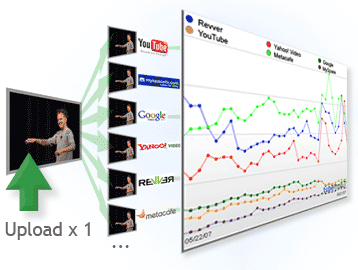
In this Streaming Media West 2009 Red Carpet Interview, Jose Castillo of thinkJose.com sits down with Brett Wilson, Co-Founder and CEO of TubeMogul. Brett leads the strategic direction for TubeMogul, a free online video distribution and analytics service that provides a single point for deploying uploads to the top video sharing sites, and powerful analytics on who, what, and how videos are being viewed. TubeMogul's free beta service has been live since November of 2006, and in January 2008, TubeMogul announced the launch of its Premium Products, which include a host of new professional features.


TubeMogul was founded in 2006 by Brett and a handful of online video buffs who met while in graduate school and won the UC Berkeley Business Plan Competition. TubeMogul's objective from the start has been to empower online video producers, advertisers and the online video industry by providing publishing tools and insightful, easy to interpret analytics.

Through its acquisition of Illumenix in October 2008, TubeMogul is also able to offer rich engagement and performance metrics to video sharing sites, content creators and advertisers. Earlier this year, TubeMogul launched TubeMogul 2.0 which offered video publishers for the first time, access to a single, standardized set of rich, census-based analytics measuring far beyond the metric of video “views,” including per-second audience dropoff, what sites and search terms are referring viewers, audience geography and much more.

Brett says TubeMogul has a few competitors on the syndication side that doesn't provide analytics and have a host of competitors on the analytics side but doesn't have the tools to help with campaigns. TubeMogul will soon be offering a feed-based solution that will launch later this year which will offer content owners greater hyper-syndication tools.

Brett was on two panels sessions at both Streaming Media West and the Online Video Platform Summit. The Streaming Media West session, Successful Content Syndication and Aggregation Strategies, was moderated by Jim Louderback, CEO, Revision3. Other panelists included Vanessa Pappas, Director, Audience and Strategic Partnerships, Next New Networks, Tom Gorke, VP, Digital Distribution, MTV Networks, Brandon White, Interactive Manager, FUNimation Entertainment who discussed the new ways content owners and site developers are aggregating content and distributing it on the web. They talked about the shift from super-syndication (shotgun approach to distribution) to hyper-syndication which is more of an audience play reaching out to social sites, blogs and other sites that will give you a niche audience for your content within a specific vertical.

Brett also spoke on the Measuring Success panel session at the Online Video Platform Summit which was moderated by Jan Ozer, Principal, Doceo Publishing and included Mike Newman, CEO, Accordent Technologies, Brian Shin, Founder & CEO, Visible Measures and Ben Weinberger, CEO & Co-Founder, Digitalsmiths.

Look for videos of both of those sessions coming soon as well more Red Carpet interviews on Streaming Media TV.

Wednesday, July 8, 2009

Veeple and TubeMogul Announce Distribution and Syndication Agreement

Iin another strategic partnership Veeple has announced an agreement with TubeMogul that will offer greater distribution and syndication choices for marketers, agencies and social media leaders using Veeple's Interactive Online Video (IOV) platform. The agreement allows Veeple customers the use of TubeMogul’s signature “Load and Track” service which gives users the capability to upload videos once and automatically deploy them with as many of the top video sharing sites as they want, within the users’ specified accounts. TubeMogul, in turn, will recommend Veeple as one of TubeMogul’s three primary online video platform providers. Veeple and TubeMogul expect to deliver the new capabilities by the end of July.

According to Brett Wilson, TubeMogul CEO and co-founder, “Veeple understands the needs of today’s marketer who is responsible for telling a compelling story while building a well-respected brand through the powerful tool of online video. TubeMogul is pleased to enhance Veeple’s service offering through the ability to help increase the distribution of the interactive videos that Veeple’s customers are creating.”


I asked Scott Broomfield, Veeple CEO and co-founder, about how the new partnership evolved and he said that TubeMogul found them first as their customers began to ask them about online video platforms. Veeple also saw the need for wider distribution and syndication is a key element, along with embed, url, RSS, and video SEO. Interactive works if the destination site allows embed, url or metadata tracking. This means for sites like Ning or Wordpress, but not for YouTube or Metacafe. Over time Veeple plans to add an 'onion skin' that will ride along with the InPlay API that will make everything interactive.

Broomfield added that, “Veeple is all about enhancing, engaging and measuring online video campaigns. Our customers expect not only simplicity in our service but also a platform that quickly evolves with their needs. As we evolve the Veeple service we knew that syndication was a top priority for our customers who are increasingly adding online video to their marketing mix.”

To see interactive video in action see Veeple's customer web sites

Follow Veeple and TubeMogul on Twitter
About Veeple
Veeple is the leader in simple, Interactive Online Video (IOV) solutions for marketers looking to deepen customer engagement through online video. With Veeple's cloud-computing solution people have easy access to use interactivity, full content management for multiple clients, branded player video delivery and full clickable analytics. Veeple has the solution for successful online video campaigns. Veeple is a private company headquartered in Palo Alto, California. For additional information go to www.veeple.com/solutions.php

About TubeMogul
TubeMogul is the first online video analytics and distribution company serving publishers
large and small who need independent information about video performance on the Internet and automated upload to the Web's top video sharing sites. TubeMogul's analytic technology aggregates video-viewing data from multiple sources to give publishers improved understanding of when, where and how often videos are watched. TubeMogul offers tracking far beyond the traditional metric of video "views." TubeMogul InPlay, which can be activated within minutes, tracks rich viewership metrics such as audience engagement, attention span and site performance -- all in real-time.

Wednesday, June 24, 2009

Qik joins Brightcove Alliance Bringing Mobile UGC Publishing to the Masses

In a move that extends the capabilities and reach of two leading online video and mobile platforms, Brightcove and Qik have announced a new partnership that brings Qik, the popular live mobile broadcasting platform, into the fold of the Brightcove Alliance, a global ecosystem of more than 160 technology, distribution and solution providers who have intergrated with Brightcove's global online video platform. What that means is that Qik users who have a Brightcove account can now distribute their pre-recorded mobile video content within the Brightcove player and existing Brightcove customers can now have mobile video as a new source of UGC content.

In a guest post on the Brightcove blog, Qik Co-founder Bhaskar Roy said, "We're excited to announce our new partnership with Brightcove, the world's number one online video platform. Brightcove's on-demand platform lets its customers publish and distribute video across websites, social networks and video portals. Brightcove also provides monetization options for customers through integration with advertising servers and networks. With today's partnership announcement, Qik's mobile video capabilities can now be easily integrated into Brightcove's online video publishing and distribution workflow."

"Brightcove, meanwhile, can now offer its customers the ability to upload videos from more than 130 mobile phones, including models from AT&T, BlackBerry, Motorola, Nokia, Sony Ericsson, Sprint, and Verizon," noted Bill Greenwood on Streamingmedia.com, "Currently, live mobile videos cannot be streamed through Brightcove, but that ability is expected to be added shortly, according to Roy."


This capability could open the floodgates for a new workflow for citizen journalism, as Andy Plesser pointed out, "This could be in important development in so called "citizen journalism," allowing users to upload directly from mobile devices to newspapers sites including The New York Times and the Washington Post, both which are powered by Brightcove."


To celebrate the launch of their partnership, a special offer of three months of free Qik integration with Brightcove is available to Brightcove customers (existing or new) when signing up for an annual account by July 15th. This is a savings of $450 per user, with the monthly license per user priced at $150. Send an email to brightcove@qik.com for the trial.

Mobile video continues to rise and both Qik and Brightcove continue to expand into new markets and devices. Bill Greenwood added that, "Brightcove is also reaching out to Apple iPhone and iPod Touch users with the Brightcove iPhone Video Site package. Those interested in the offer can contact Brightcove Professional Services, which will create a site optimized for the iPhone and iPod Touch that contains either a user’s full Brightcove video library or only selected playlists."

Qik has supported live streaming on jailbroken iPhones since last year. Currently though no live streaming app is available through the iPhone App Store and that's not likely to change for some time due as David Chartier pointed out last year that, Qik iPhone client may violate AT&T's terms of service.

Still, the video capabilities of the new iPhone 3GS with a million devices sold in first week and an early alpha of Qik on now available on Android, Pete Wylie says we're seeing the mobile video explosion is gearing up. With the forecast that 90% of the traffic on the web will be online video by 2013 it's clear that there will be a lot more integration of mobile video, online video platforms and content delivery.

Related:

Sunday, June 21, 2009

How to Upload Your Video to Multiple Sharing Sites

Hosting your videos on a free, video sharing website such as YouTube, Blip.tv, Vimeo, Dailymotion or even on a social networking site such as Facebook has many advantages for reach, higher visibility on search engine results (SEO) and of course, the fact that's it's free all the content delivery costs are paid for by the sharing site. This option for video hosting is one of three that Jan Ozer recently wrote about in his indepth article, Choosing an Online Video Platform. He referred to free video sharing sites as UGC sites and pointed out several pros and cons saying, "These UGC sites relieve you of the encoding and player-creation chores and assume the task of hosting and distributing the video for you. You can still embed the video on your own website, but by offering your video on a UGC site, you also expand the number of potential viewers, which can help from a marketing perspective. However, there are some negatives to consider, as well as some benefits..." (more)

For those interested in the "hyper-syndication" model of distributing your video to multiple video sharing sites there are a number of free and premium choices which are covered in two recent articles.

My friends at ReelSEO published this review, Upload Videos To Multiple Video-Sharing Sites - Tools & Software and highlighted the following services with short descriptions and pricing:
If you want to dig deeper you can also check out Best Tools To Upload Your Video To Multiple Video-Sharing Sites - Mini-Guide on MasterNewMedia with mini-reviews and a comparative table of 11 tools to automatically upload your clips to multiple video sharing sites.

Written by Robin Good, the guide used the following criteria to compare the services:

  • Distribution: Video-sharing sites where you can automatically upload your content
  • Analytics: Viewership information gathered from supported video-sharing sites
  • Upload: Publish to video-sharing sites accepting videos bigger than 300MB
  • Premium: Price and extra features of premium accounts for supported video-sharing sites
  • Migration: Export of your content from one video-sharing site to another site without download
Robin included this interactive map with links to all the services in the Mini-Guide. Full descriptions and comparative details on capabilities and cost are here.


The only service I use
to distribute my videos to multiple sharing sites is TubeMogul. You can read more about their new TubeMogul 2.0 capabilities which "democratizes video metrics" here. I haven't tried any of the other services but would be interested to hear from anyone who has.

A few other options that came up in the comments on these two articles worth checking out are:

Related:

Sunday, April 5, 2009

TubeMogul Looks to Grow and Standardize its Online Video Analytics with $3 Million in Series A Funding from Trinity Ventures

TubeMogul, online video's most popular distribution and analytics service, announced last week it has received $3 million in Series A funding from Trinity Ventures. "We invested in TubeMogul because we saw the potential of a viable business model, a solid product with a growing customer base at this early phase. However, it is my relationship with the executive team that that reminds me why I love what I do, helping passionate entrepreneurs fundamentally change an industry,” said General Partner from Trinity Ventures Ajay Chopra, who will join TubeMogul’s board. "TubeMogul has the team, vision and product to drive a fundamental change in the way online video is monetized.”

The funding will be used to fast-forward growth of TubeMogul's video distribution platform and accelerate standardization of its online video analytics. With over 75,000 users and hundreds of millions of streams tracked, TubeMogul solidifies its position at the nexus of online video.

Last week at the Future of Television conference Tim Street got an on camera interview with Brett Wilson, TubeMogul CEO and co-founder about the investment and some new features coming down the pike.


"We are thrilled to be partnering with a world-class venture firm like Trinity Ventures whose reputation as a value added partner is well known among entrepreneurs,.” Brett said, "To have Ajay on our board who was also a successful entrepreneur and passionate about winning this is space is invaluable."

With TubeMogul, users upload videos once and TubeMogul deploys them to as many of the top video sharing sites the producer chooses. TubeMogul's integrated analytics then provide a single source of metrics on where, when, and how often the videos are viewed. TubeMogul's free beta service has been live since November of 2006. In January 2008, TubeMogul announced the launch of its Premium Products, which include a host of new professional features.

Through its acquisition of Illumenix in October 2008, TubeMogul is also able to offer rich engagement and performance metrics through InPlay, its Flash-based analytics service. Integrating within minutes with any Flash video player, InPlay tracks audience statistics and user interaction in real time. TubeMogul also offers a marketplace to connect online video producers and advertisers and a promotion service for new viral campaigns, video ads or web series.

TubeMogul is on track to be cash-flow positive by the fourth quarter of 2009. "Since the company’s founding, TubeMogul has hit every single one of its revenue targets, and this one should be no different," said Dave Toth, co-founder of NetRatings and a TubeMogul board member and early investor. Other early investors include Knight's Bridge Capital Partners.

I recently visited the TubeMogul headquarters in Emeryville, California and met with Brett and the TubeMogul team. I had a great conversation with Mark Rotblat, VP of Business Development about online video distribution, analytics, TubeMogul’s InPlay technology and more. Look for that video later in the week.

Congratulations to Brett, John, Mark, David, Eugene and everyone at TubeMogul!

About Trinity Ventures
Founded in 1986, Trinity Ventures, a boutique firm, partners with passionate entrepreneurs to transform revolutionary ideas into reality. With over $1.5 billion under management, Trinity Ventures was founded on the principle of personal engagement and mutual respect with the entrepreneurs we fund. Trinity Ventures focuses on early stage technology ventures with a particular emphasis on digital media, Internet services, mobility, security and software markets.

About TubeMogul
TubeMogul is the first online video analytics and distribution company serving publishers large and small who need independent information about video performance on the Internet and automated upload to the Web's top video sharing sites. TubeMogul's analytic technology aggregates video-viewing data from multiple sources to give publishers improved understanding of when, where and how often videos are watched. TubeMogul offers tracking far beyond the traditional metric of video "views." TubeMogul InPlay, which can be activated within minutes, tracks rich viewership metrics such as audience engagement, attention span and site performance -- all in real-time.

For more information about TubeMogul, contact:
David Burch
david@tubemogul.com
+1 510 653 0501

Related:

Thursday, March 12, 2009

Graspr Unleashes Experiential Knowledge Through Online Video, Extends Brand through Innovation and Syndication on Glam Media Network

In a crowded field of How-to video sites Graspr has been innovating and expanding beyond its reach as a video destination site. In December 2008, Graspr joined the Glam Media network as a video content provider. I had the opportunity to speak with Graspr CEO Teresa Phillips before the new year about the recent Glam Media syndication deal, their innovative gCard™ and how Graspr differentiates itself from other How-to sites as an instructional video network. The Grapsr web site emphasises community sharing and this past week Grapsr integrated Facebook Connect to allow video producers to login using their Facebook accounts, and invite friends to share the wealth of knowledge available on the site.

Launched in September 2007 by Teresa Phillips, a former executive at both Yahoo and Time Warner, Graspr raised $2.5 million in Series A funding from Draper Fisher Jurvetson and angel investors and is a privately-held company based in Mountain View, California. Graspr is the world's leading instructional video network with over 30,000 videos under 17 different categories from producers and experts across major lifestyle markets, Graspr defines itself as the only site where learners, users, and creators of videos can edit, watch, collaborate on, and syndicate to make money from instructional videos.

Previously, in October 2008 Grapsr released an advanced video player widget called the “gCard” that carries the identity of a video creator wherever his or her video gets embedded across the net. The gCard is available for free to every producer who uploads their videos to Graspr or any user who creates a collection of videos on Graspr.

According to Teresa Phillips, "Graspr's gCard" uniquely enables producers of instructional videos to promote themselves within the videos they produce. The gCard is seamlessly embedded within every video a producer publishes, and is available to viewers via an on-screen icon that, when clicked, displays the producer's contact details and specialties, and showcases the producer's entire video gallery. The gCard creates a persistent presence for the producer in that it accompanies all videos at all times, whether a producer or user shares individual videos themselves or the videos are distributed through Graspr's syndication network of several thousand sites. The gCard allows producers to interact with their community at all times, promote their brand and expertise across the Internet and monetize their video content. Click here to see an example.

In my conversation with Teresa Phillips, she spoke at length about her passion in creating new markets and product categories
for experiential knowledge and that Grapr's purpose is to purpose is to help deliver that knowledge to the people who seek it. The following interview took place following their big announcement that Graspr had joined Glam Media network.

Larry Kless: It's real exciting news has it hit the airwaves Graspr Goes Glam, The How-to space for video has gotten really big in the last year.

Teresa Phillips: Yes, really exciting. It's certainly been validated over the last year or so. There are companies with a lot of traction and we're all taking a different approach and I think we're reaching critical mass, especially in terms of producers and people who are creating. If you look at the top uses of online video where people are spending their time on the consumption side, still instructional doesn't make it to the Top 10 but we're moving up in the ranks. If you look in the economy, I read this morning the number of new unemployment applications file last month were the most in 26 years, 2 millions people have lost their jobs this year. So people are looking ways to moonlight, make money from their expertise as well as do things themselves to save money. we've increased our traffic in the last couple of months and I think it's from the economy. It's just a natural direct result.

LK: Congratulations on your partnership with Glam and also with Diet.com. Can you talk about Grapr's syndication model?

TP: Our strategy has always been about syndication. I think it's difficult to build a big destination site and I'm not sure that the future of the Internet. everything is more about componentization, widgetization and so we've always sought to help content creators develop high impact videos and package those videos so that they're more easily discoverable through search engines and distribute them across the tens of thousands of sites who have text only and are looking for video by either lack the content or the technical infrastructure. So from day one we've always been about syndication.

The nice thing about instructional video is that learning pertains to all of what we do in life and it's very relevant to any type of site whether it's a community site in how people come together an learn or a retail site in merchants teaching their customers about products, how to use products, hot to fix products to sell more products, so it's very relevant. We've targeted lists in each content category of 1000s of web sites who have community, who have very targeted audiences where there's a lot of customer participation and interactivity and we approach them to offer them instructional high quality videos.

After I launched the company I spent about six months talking to producers trying to understand what they were doing with their businesses. And out of that work came four unmet needs that I heard. One of them was, "Help me build a brand online." So we have a lot of people who have brick and mortar businesses or side jobs or hobbies of passion but they don't know how to build a brand online. The second one was they said, "Help me stay connected to my audience." Because if they upload their video to YouTube or any other site they completely become disconnected from their content and don't even know who's watching their content and they can't build a relationship with their viewers. The third thing they said was, "Take me into deep rich vertical audiences where people are gathered talking about something I know something about so we can have meaningful rich discussions." And the last one was, "Help me monetize my content." So Grapsr's entire platform which we launched in July 2008 was built to satisfy those four unmet needs.

LK: How did you launch Graspr?

TP: We launched our beta product at Demo Fall 2007 and that's where I said I went out and talked to producers. We kind of stayed quiet and we didn't do a single press release for probably seven or eight months. That's when I spent the time holding bi-weekly and monthly conference calls with all these producers and kind of mini-focus groups to develop our syndication platform and our content creation tools.

We also are a big SEO shop. We've invested a lot in creating meta data within and around the video. That allows us to make our videos more searchable. We add the meta data as scenes so learners or viewers can jump to the part of the video that interests them without having to watch it in a linear way.

So we launched, then went quiet and relaunched our syndication platform and whole package in July 2008.

LK: Graspr uses an algorithm and human search to find videos. Is that how you initially launched and reached out to the producers?

TP: Yes we did, we built what we call a feed manager application that listens for RSS feeds and we also have crawlers that find instructional video and in the beginning we just aggregated and then reached out in parallel and after that fact. Now that we've gotten the word out and are a lot more popular through word of mouth we're only accepting 30-40% of the videos that we get. So all of our producers are actually registered members now before we have seen their videos. That's how we seeded the service with content.

LK: Had you been developing gCard for sometime?

TP: We're actually working on the commerce. I showed the commerce component today in a demo to some people. We filed a patent on it earlier this year. We have been thinking about and working on it. There's a lot of stuff we've already done that's not available yet. As you can see the gCard™ really went to the heard of help me stay connected to my audience where ever my video is embedded across the Internet and let them reach out to me directly as well as let me show what else I've been doing, give me credit for my work. Then finally it's about the viral distribution of it and ultimately commerce.

LK: And it allows for the hyper-syndication especially though Glam Media's network. So in terms of distributing on Glam, will we see the gCard™?

TP: In the beginning you won't see the gCard™ on Glam because it doesn't fit their model but we're in discussions with then about applying the gCard™ on a broader scale beyond Graspr content. In fact we're in discussions with some other video sites that interested in licensing the gCard™ for their own videos that are outside the instructional genre. So I just think it has universal appeal for producers and the hosted providers to help monetize some of the video. While you won't see it today I hope to work the gCard™ into our partnership with Glam.

LK: What differentiates Graspr from the competition? What's your value proposition for the producers, for the distribution networks, advertisers and viewers?

TP: Our direct competitors are the How-to video sites (Howcast, 5min, eHow, WonderHowTo, ExpertVillage, Videojug) and there's a number of different dimensions that we differentiate Graspr. One of them is how we source content. Whether you produce content in house or source it through your users. Videojug, Howcast and Expert Village to a large degree produce their content in house. You're familiar with that model, while you have high quality content and you can templatize there's still the vertical increase in acquisition costs when you're talking about production fees. They have two challenges that we don't have. One of them is operational costs in terms of production costs and scalability and the second one is, what I call perspective or context. So because they content production costs they can't have 25 videos on how to write a resume but I can. They check a box and move on. The nice thing about learning is that we learn from other people and we learn from people we whom we can relate to. Whether it's socially or demographically, or something we have in common, or the teaching style. What we find is that learners appreciate that we have a broad mix of teachers and experts and they can always find someone they can relate to and better learn from. So that's how we differentiate ourselves from the competition.

5min also sources content from its users but the big differentiators there is that we filter our content. Like I said, we accept 30-40% of content and it's appropriate for all audiences of all ages. Regarding SEO and SEM, if you look at some of the analytic sites and look at the top key words that are driving traffic to some of those sites, you won't find those keywords on Grapsr.

That's from a content perspective, but even further we are different from our syndication strategy and our commerce model and really our relationship with these experts. So none of these sites have real people behind them, these are just content repositories and they different strategies in terms of distribution. I love markets where there's competition because it validates the space and we've got a lot of great competitors who are doing great things and we're all trying to help make this market bigger. We believe that the end game is about helping monetize knowledge-based services.

So for me, this isn't just about how-to content which is most of our competitors have only How-to content. If you look at the big vision of Graspr and take a step back and look at what's going on in the world in that 79% of the U.S. GDP is fueled by services and 62% worldwide and half of all workers are "Knowledge workers", meaning people get hired for what they know as opposed of their ability to perform manual labor and we all know these guys. Whether they are our teacher, our kids piano instructor, golf instructor, veterinarian, we all know them. Now imagine if these knowledge workers everywhere could extend their services beyond their local neighborhoods to the world and with Graspr they can do that.

The other piece is that it's about the products backing up the services. My first goal is to unleash experiential knowledge and we chose video as the medium for its high impact value. The impact of the medium is amazing in terms of motion, emotion and connectedness and learning. And so the first goal is to give people the tools and education to help them tell their story, to help unleash this experiential know-how and help them package it in a form that can be easily consumed.

The second thing really is to build a product business around it because these experts have developed affinity toward branded products. So if you listen to our videos we did this random sample and about 60% or so of our videos the producers were recommending products and brands within the video. For example, one of our producers Mark Donovan says, "When you're doing drywall use Sherman Williams paint. It goes on easy, it doesn't fade, etc..." So when the learner is learning how to hang drywall they don't hear just how to do it they also hear, "Go buy Sherman Williams paint."

LK: So the product placement is baked right into the video.

TP: Totally, it's part of the message. It's the whole nirvana of broadcast video which is product placement. Tie those brands as close as you can to the plot of the story and products are at he heart and soul of learning and doing. So what we're doing in terms of algorithm from a product perspective is we're deciphering and we're going to be mapping these products to what these producers are recommending within their videos and creating a commerce model around it.

LK: How do you see this new syndication through Glam? How did it start, where do you see it going and how will it benefit your producers and the Grapsr community?

TP: Glam has a TV section, video section and they primarily source professional content. They don't accept UGC, they like branded content. And what they liked about Grapsr is that it really enables them to obtain what I call "indie artists" so it's high quality content from people who are trying to create a business and care about the quality of their video and message, without having to accept user generated content. So with our kind of producers it was just a nice fit. It was something that Glam did not have. They did not access to these real people. Because if you think about it their publisher network is mostly long tail content, small mom and pop businesses, and so they don't want content that's overcooked or with mass appeal and they having the content from real people. So that's what we bring to the table; real people, real stories without the compromise in quality.

LK: It seems like a good fit in that helps them extend their existing brands into the video space.

TP: Absolutely, and it's content that they can still think about advertising against. There are different types of syndication and distribution deals and levels. Sometimes you do deals for brand awareness and reach other times you do deals for longer term strategic relationships or even for monetization. This for us is about reach and brand. Glam is redistributing our videos and our producers have the opportunity to get in front of their extended global network in these communities that have really targeted audiences where there's a lot of conversation and discussion going on which his exactly what are producers are trying to do.

Graspr/Glam Press Release:

GRASPR GOES GLAM
Instructional Video Leader Joins as Content Provider For Glam TV , Will Provide 700+ Sites in the Glam Media Publisher Network

MOUNTAIN VIEW, CA December 11, 2008 – Today, Graspr (www.graspr.com), the world’s leading instructional video site, announced that it has been selected as a video provider for Glam Media’s GlamTV/BrashTV platform. The GlamTV/BrashTV platform is an innovative video application that allows for the distribution of premium content across Glam Media’s network of 700+ sites with a reach of over 98 million uniques globally.

Graspr videos will now be available to publishers in the Glam Media Publisher Network, pairing high-quality video content for visitors with relevant monetization opportunities for advertisers. Graspr’s content is complementary to that of the Glam Media Publisher Network, with its channels including style, living, family, health and wellness. Graspr’s video content about consumer electronics, sports and recreation, cars, computers and Internet will be featured on BrashTV, part of Glam Media’s newly launched Brash.com, a vertical content network targeting men.

This partnership allows Glam Media publishers access to an increased quantity of quality video content across its network and provides new compelling content opportunities for brand advertisers. For Graspr, the partnership is further proof of its syndication model which provides video creators and producers with additional opportunities to increase the distribution of their content and to monetize it.

“Glam Media publishers are focused on providing the highest-quality content relevant to their readers’ interests and passions,” said Christina Cece, Senior Product Manager for GlamTV “Graspr gives our publishers access to videos that will further engage their audience on an instructional level.”

“This partnership with Glam Media opens the door to exciting new distribution opportunities for our producers who can take advantage of the additional reach. At the same time they can attract premium advertisers for their high-quality video content,” said Teresa Phillips, founder and CEO of Graspr.

About Graspr
With over 25,000 high-quality videos from producers and experts across major lifestyle markets, Graspr is the world’s leading instructional video network. Graspr is the only site where learners, users, and creators of videos can edit, watch, collaborate on, and syndicate to make money from instructional videos.

Graspr is a privately-held company based in Mountain View, California and can be found at: www.graspr.com. Graspr was launched in September 2007 by Teresa Phillips, a former executive at both Yahoo and Time Warner. Teresa founded Graspr to enable people to discover the answers they seek from either experts or from those who have shared a similar experience. Through the broad reach of the Internet, and more specifically the power of video, people all over the world are able to share their wealth of knowledge more freely through Graspr.

Media Inquiries
Dominic Johnson, Consort Partners
dominic@consortpartners.com

Related:

Sunday, February 15, 2009

Blip.tv Online Video Distribution Model Featured on USA Today

Blip.tv was the subject of a major news story this past week in a feature article, Blip.tv gives videomakers a chance to be a star, by Jefferson Graham in USATODAY.com. The article focused on Blip's successful business model for online video distribution. Graham has covered Blip in the past and last July he wrote an article, Why Blip is better than YouTube, which compared the two video sharing sites.

Blip.tv is the online video distribution platform for new "up-and-coming" independent shows where you can watch videos in higher quality and resolution. Like YouTube, producers can create a channel, post videos and syndicate content all for free. It's not the anything goes viral video site like YouTube but a more focused approach.

In a blog post reporting on the story, Blip.tv Demonstrates its Value, Jamison Tilsner of Tilzy.tv wrote,"In a feature article in USA Today, Blip.tv’s function in the ecosystem of video content (on and off the computer screen) is set straight. The company that, in early 2005, set out to build an organization that would exploit economies of scale to market, monetize and serve videos, giving creators the freedom to focus on their crafts, has become the standard-bearer of the new medium. Perhaps most importantly, the article shows that Blip.tv’s business model seems to have proven itself."

This video was featured in the story:


In the article Graham writes, "It's actually a video-distribution service. People upload their video shows to Blip, which syndicates them to video sites such as AOL, Yahoo, MSN and elsewhere on the Web. About 1 million "episodes" have been uploaded to Blip."

"We target anyone who wants to make quality content and doesn't want to pitch the show to a network TV exec," says Kaplan, Blip's chief operating officer. "There's a lot of great content a network exec might say no to that could be an excellent and profitable Web show."

For many online video publishers Blip is the main vehicle for content delivery and all the CDN costs are borned by Blip and not individual producers or web studios. The recognizable Blip player is seen on Beet.TV, web shows by For Your Imagination and "some 38,000 homegrown shows across the Web, which Blip splits ad revenue 50/50 with the producers."


Mike Hudak, Blip's CEO says on the Blip.tv blog that it's not that easy to make five figures on Blip and that it takes a lot work to get there,

"There are two quick notes I wanted to make about the USA Today piece. First, the story somewhat understates our traffic because it relies on the third-party measurement service Quantcast. Quantcast reports that we reach 13.2 million viewers and do about 32 million video views, but it only counts about half of our traffic so far (this is due to a number of factors, including the difficulty in tracking iTunes downloads). The actual numbers are roughly double that. We are working with audience measurement companies like Quantcast and ComScore to properly recognize that traffic.

Second, I think it’s easy to read the article and think that making money with blip is easy. It’s not. We’re very proud that DavidJr has pulled in almost $40,000 from us and that we sent a roughly $26,000 check to the folks at Nostalgia Critic. We’ve sent a lot of money to a lot of other people, too. All of it earned from advertisers in exchange for hard work, dedication and a little bit of luck."


Andy Plesser also published this story Beet.TV: Blip.tv Pays Emerging Video Producers Well in to Five Figures, USA Today. He says, "Here at Beet.TV, we use Blip.tv as our primary video publishing platform and as our non-exclusive advertising representative. Blip landed marquis sponsors for us including Adobe, Holiday Inn Express and Akamai. The Akamai program went live today. Through Blip's efforts, and keeping our costs low, Beet.TV is breaking even. Yeah!"

He also I've republished an interview with co-founder/COO Dina Kaplan from late last year.

In October 2008, Blip.tv secured its second institutional round of capital, led by Bain Capital Ventures. From the press release, "Blip.tv joins other exciting companies in Bain's venture portfolio, including LinkedIn, Thumbplay, The Find, Tokbox and LaLa Media. Blip.tv closed its first round of institutional funding in June 2007 with Ambient Sound Investments, the venture capital vehicle of the four founding engineers of Skype."

"In conjunction with this funding round, blip.tv announced that it served more than 51 million video views in September 2008, a more than 250% increase over September 2007. Blip.tv measures video views by counting only one view per IP address per video per session. 'Blip.tv is the leading distributor of niche video programming on the Web, and we're proud to add them to our portfolio,' said Jeffrey Glass, a partner at Bain Capital Ventures. 'Blip leads its industry in the number and quality of content creators, in video views and in monetization. We're thrilled to be joining the blip.tv team and we're looking forward to exciting growth and innovation in the future.'"

Congratulations to everyone at Blip for proving their business model and being a leader in the online video community.

About Blip
We've got a great service for great shows.
A new class of entertainment is emerging that is being made by the people without the support of billion-dollar multinationals. Our mission is to support these people by taking care of all the problems a budding videoblogger, podcaster or Internet TV producer tends to run into. We'll take care of the servers, the software, the workflow, the advertising and the distribution. We leave you free to focus on creativity.

Related:

Wednesday, February 4, 2009

Ooyala Co-founders Featured in the Mercury News, "Sons of migrant farmworkers co-found promising Silicon Valley tech startup"

Yesterday I spent the afternoon at the Silicon Valley headquarters of online video technology startup Ooyala. I had the opportunity to meet with the people behind the scenes from the software engineering team, computer vision, sales, marketing and the founders of the company.

Ooyala was founded in the spring of 2007 by Google alumni Bismarck Lepe, CEO, his younger brother Belsasar Lepe, Lead Engineer and former Stanford dorm mate and CTO, Sean Knapp.

During visit I noticed right away that their office was alive with bright vibrant colors and activity, engineers were playing ping pong and miniature basketball, a puppy was seen playing in a nearby workspace, Apple computers at every workstation with software engineers busy writing code for the new soon-to-be-released player, marketing, sales and account managers busy working on business development and of course the electric scooters parked in the front entrance charged up and ready for take off.

I want to thank Alexa Lee, Ooyala Field Marketing Manager for hosting my visit. I'll be following up with a more detailed series of posts on my visit at a later date since the intent of this post is to highlight the big front page new story about Ooyala, Sons of migrant farmworkers co-found promising Silicon Valley tech startup - San Jose Mercury News. It's great human interest story about how Bismarck and Belsasar Lepe's humble beginnings as the sons of strawberry farmers to Silicon Valley tech executives and it speaks to the diversity of the American dream. I also found it refreshing to get some back story on the people and not just the technology.

Here's an excerpt of the news article written by Scott Duke Harris, Mercury News:
"His parents were migrant farmworkers who worked the harvests of California and Washington state before wintering in their small hometown in rural Mexico. Bismarck Lepe, now 29, remembers how at age 5 he helped out in the strawberry fields.

"I was good at planting," he recalled. "I was very close to the ground."

"He brags about that all the time," muttered his 21-year-old brother Belsasar, known as Bel.

Today, Bismarck and Bel Lepe work marathon hours in the bright, clean quarters of their own Silicon Valley startup, with its own little fleet of electric-powered Razor scooters for zipping around Mountain View. Educated at Stanford University, seasoned at Google, these overachieving sons of the Latino laboring class are among the valley's more demographically improbable entrepreneurs. They are two of the three founders of Ooyala, a fast-growing company that in less than two years has built an impressive list of customers — Warner Bros., TV Guide, Armani — with its infrastructure technology for the booming trend in online video.

Ooyala means "cradle'' in the South Indian language of Telugu. The name reflects the founders' ambition for the company to cradle innovation in delivering and syndicating video content while leveraging the interactive nature of the Web to enhance advertising revenue.

Silicon Valley prides itself as a meritocracy — a place where people are judged less by ancestry than by ability. It boasts companies founded by people from all over the world. But tech entrepreneurs of humble Mexican roots are a distinct rarity." (continue reading here...)

As Bismarck tells the Ooyala story, it began one night in January 2007, when he got an idea for enhancing the commercial potential of online video. Soon after, he pitched his idea to his brother Bel and friend Sean. “Our goal in building our company was very similar to the way that Google has done AdWords, build a very sophisticated, scalable and extensible platform and make it accessible to all businesses of all sizes," said Bismarck in speaking with Bambi Francisco of Vator.tv in this recent video interview which they offer some advise to entrepreneurs and share a team hug.


Ooyala is backed with more than $10 million in venture funding and provides a seamless platform for distribution, syndication, and monetization of high-quality video content over the web. Their solutions power large scale, high quality video for hundreds of content owners including Warner Bros, Bebo, National Geographic, EA and Glam. Ooyala is committed to providing the most comprehensive video solutions to companies worldwide. Ooyala is headquartered in Mountain View, Ca with sales operations in New York, NY and London, UK.

Related:

Saturday, January 24, 2009

VatorNews - Ooyala To Launch Pay-Per-Play Transaction Model For Video

Ooyala has been working on making the viewing experience more meaningful for online video consumers and more lucrative for online video publishers. The online video technology company recently integrated with a number of different ad servers and networks from YuMe Networks , Tremor Media , DoubleClick Inc. , AOL LLC 's Lightningcast, and Google's AdSense for Video that has support for both overlay as well as in-streaming companion ads, including pre-roll, post-roll, and mid-roll. Content owners can use their own ad networks or tap into Ooyala's integrated offering. Ooyala has also recently integrated Nirvanix, the premier "Cloud Storage" platform provider and its Storage Delivery Network(TM) (SDN) into their Backlot video management platform.

Meliza Solan of Vator.tv posted this
entrepreneur interview with Ooyala founders, Bismarck Lepe, Sean Knapp, and Belsasar Lepe, Bambi Francisco which she says, "dives into the future of online advertising. In the interview, Bismarck Lepe talks about how Ooyala plans to launch in the first quarter, a subscription capability for its clients."


In 2008, with about a billion dollars spent in online video advertising Ooyala sees the opportunities in 2009 moving more to a transactional "pay-per-play" subscription model which puts the control back in the hands of the online video consumer and gives online video publishers greater margins to monetize their content. In addition Ooyala is rolling out new ad serving platform with advanced planning, analysis, and management options which will enable another tier of networks, distributors, and content creators to operate more effectively.

Their tools give dynamic control over the content and how the ads are served which helps content owners better learn about the end users. Co-founder and CEO Bizmarck Lepe defines that Ooyala is primarily in the enablement business and said, "
"Everyone talks about behavioral targeting. Well I don't necessarily think behavioral targeting works very well in terms of creating a dynamic learning system if you can actually learn from what is causing a certain behavior. So what we do is we actually analyze the video as the video is going through and we extract meta information and then based on behavior we tie it back to what was actually happening on the screen. So if we notice that someone is always fast forwarding through ads whenever there are car ads and whenever they're watching a soap opera then we'll make sure that that mapping of ads to that type of content never happens again."

About going beyond the pre-roll and post-roll and where online advertising is going in 2009 Bismarck Lepe has this to say,
"So when we think about advertising, I think people have it all wrong. It should be about monetization. It's about figuring out what monetization model works best for content A and person B. If we know that an individual is actually very willing to purchase a piece of content, why should we bore them with that? They should have the ability to pay for that individual stream and pay 5 cents or pay 10 cents.

If you think about it. If you build a very simple, transactional model, where they click once and it's tied to their PayPal account, and they only pay 10 cents, over a thousand people that's a $100 CPM. So that's what we're exploring. Obviously, we're continuing to do the pre-roll and the post-roll and the overlays. And what we've found there is you need to make sure that the ad is compelling to the end user, the ad complements the content, but in a lot of cases it's actually better that you directly give the opportunity for the end user to pay for that piece of content."
Read the full transcript from the video here:
VatorNews - Ooyala to launch transaction model for video
Online video monetization isn't just about ads, but pay-for-play

Related Vator News

From entrepreneur by Bambi Francisco
December 30, 2008

Ooyala founders: Sprint in the same direction

Lepe brothers and Sean Knapp share team hug and advice to entrepreneurs

Entrepreneur interview by Bambi Francisco
December 19, 2008

About Ooyala
Ooyala is a video technology company that provides an integrated platform enabling the delivery, management, and monetization of high quality video content. Focused on innovation and scalability, Ooyala is committed to providing the most comprehensive video solutions to companies worldwide.Ooyala is headquartered in Mountain View, Ca with sales operations in New York, NY and London, UK.

Ooyala was founded in early 2007 by Sean Knapp, Belsasar Lepe and Bismarck Lepe - all former Google employees. While at Google, they worked on the development and launch of various monetization and content distribution products such as AdSense, AdWords and Google Web Search. After four years of engineering and product development at the biggest Internet company in the world, the three left Google to start Ooyala. Ooyala has raised over 10 million dollars in funding and has in excess of 5000 publishers using its syndication platform - Backlot. Ooyala's goal is to build a successful technology company that focuses on delivering the best video experience to video content providers, advertisers and most importantly consumers.