Saturday, July 4, 2026

Dangerous Stage Collapse Incident Nearly Kills Performers at Freedom 250 Celebration #StageBlunders

In another example of #StageBlunders, a dangerous stage mishap occurred during rehearsals for President Donald Trump’s Freedom 250 Great American State Fair in Washington, D.C., on July 2, nearly resulted in fatal injuries for performers. A short 14-second video shared by Aaron Parnas shows a large object falling to the stage from above the performers, narrowly missing them as they were practicing their routine. According to reports, a piece of the overhead structure fell and came dangerously close to striking one of the performers.

Following the incident, a Freedom 250 representative released a statement to PEOPLE, confirming that the accident occurred on the Salute to America stage and that no one was injured. 

The statement continued:

“The work underway was taking place on the backside of the stage, separate from the front thrust where performers were rehearsing. Additional safeguards and senior technical oversight are now in place as preparations continue.” 

The incident has fueled additional criticism of the Freedom 250 celebration, which has already faced controversy over logistical problems, allegations of fraud, and other safety hazards.

In his latest video, BREAKING! THEY ALMOST DIED... , YouTuber Willie D discusses the stage mishap, broader controversies, and political division surrounding the event. He describes the celebration as "disastrous" and criticizes the lack of professional oversight pointing to the dangerous near-miss as evidence of inadequate stage safety procedures. His discussion of the stage incident is from (0:30-1:30). 

Luckily, no one was injured despite the apparent lapse in safety protocols and alleged cost-cutting measures by the even organizers. Meanwhile, current extreme heat conditions in Washington, D.C., have resulted in low attendance at the event, and the cancellation of the July 4th parade may keep people safe by keeping them away other potential dangers and future #StageBlunders. 

UPDATE (7:44 PM) via Reddit: National Mall is closed due to coming storm system. People are being told to evacuate and seek shelter immediately

Friday, February 14, 2025

Happy birthday YouTube!

Today marks the 20-year anniversary of YouTube—a platform that has defined online video, reshaped digital culture, and empowered millions of creators worldwide. What began on February 14, 2005, as an online video dating site founded by ex-PayPal employees Steve Chen, Chad Hurley, and Jawed Karim, has since transformed into the world’s largest video-sharing platform and the second-largest search engine after Google. Just a year after its launch, Google acquired YouTube for $1.65 billion in 2006—a move that cemented its dominance as the #1 video sharing site with over 5.1 billion videos. 

With its massive reach, YouTube has cultivated an entirely new industry of YouTube Creators, giving rise to web series, podcasts, music videos, personal vlogs, with over 360 hours of content uploaded to YouTube every minute. It has become a launchpad for influencers, musicians, educators, and entrepreneurs—turning everyday people into global sensations with 83 million people watching 1 billion hours of video content daily.

For a closer look at YouTube’s impact, SEO.AI’s content team has broken down key statistics in comprehensive detail, highlighting the biggest YouTube channels and most-watched videos of all time, and a lot more interesting YouTube statistics are here. The platform’s massive success has shaped the online video industry, making it the default destination for video creators and viewers alike. 

NPR’s Taylor Haney pointed out that YouTube’s role in viral moments, such as the iconic “Lazy Sunday” video, helped define the early days of viral content and brought online video into the mainstream and finally gave the power to independent online video publishers.


YouTube CEO Neal Mohan shares four big bets for YouTube in 2025 in this video from the YouTube Creator Liaison. As Mohan states, TV is the primary device for viewing YouTube in the U.S. surpassing mobile by watch time.

According to Mohan:

  1. YouTube will remain the epicenter of culture
  2. YouTubers are becoming the startups of Hollywood
  3. YouTube is the new television
  4. AI will make it easier to create and enhance the YouTube experience for everyone
 

Over the past two decades, YouTube has evolved from an online video dating site to global media giant for digital entertainment, reshaping the way we consume content and engage with creators worldwide. It all started on April 23, 2005, when co-founder Jawed Karim uploaded the first-ever video to the site, “Me at the Zoo”—a simple 19-second clip video that unknowingly ignited a revolution of user-generated content. This democratization of online video transformed YouTube into a global hub for content creators, offering anyone with an internet connection the chance to self-publish videos and reach millions without the need for expensive equipment, professional video skills, or traditional media networks.

As YouTube celebrates its 20-year anniversary, its influence continues to grow—shaping culture, empowering content creators, and revolutionizing how we experience video content. 

Happy 20th birthday, YouTube! 🎉

Monday, December 9, 2024

A TikTok Moment Reveals a Major Production Failure #StageBlunders

One of the most important aspects of production is safety. Careless mistakes can get people hurt. 

In my experience, nearly every production team I've worked with over the years has been dedicated to ensuring the safety and well-being of everyone involved. Much like a doctor’s pledge to "first, do no harm," the event managers, producers, and production teams I know and trust always take their responsibility seriously—not just to put on a great show for the audience, but to make sure the performers on stage and the production crew are protected too.

So, when I saw this Tik Tok video by @lexdawgie in my Instagram feed reposted by @popcravenow on Threads, I had to call out the event producer and stage crew involved in this production failure.

While no one was hurt and those on stage laughed it off, the outcome could have been very different. 

As industry professionals, it’s on us to use our experience and common sense to keep things safe and make sure everyone on stage is out of harm’s way.

What are your thoughts?

Tuesday, July 9, 2024

Tune up your Internet

Source: Copilot Designer
How long has it been since you've had an Internet tune up? Are you using the same Internet router that you've been using for years? Are you getting the biggest bang for your buck on your Internet service package? In our online world where network services and work are interconnected, I recently did a tune up of my home network, and after numerous complaints of dropped Zoom calls and low network speeds, let's just say, it's been life changing.

It's faster and more stable and reduced the FOMO related to not being able to get online. For so many students who moved to online learning there has to be a solid stable Internet connection. For remote workers who’ve been working at home for years now quality of service is a must to get the job done. After tuning up my home network, I was able to get a significant boost in service. If you haven’t done a tuneup in a while, I highly recommend that you do this for yourself. Why put up with terrible service? Your family, your coworkers, your colleagues and managers will all be appreciate your initiative and your online video and live streaming experience will be better. 

As I was researching the subject based on my own experience, I found some helpful and practical tips in Nelson Aguilar’s article, “Boost Your Internet for Free: My Secrets to High-Speed at Home”. He talks about planning when you move do some research before you relocate and upgrade or shop around for The best service. 

For streaming, you may not know it, but you might be sacrificing quality for convenience if you’re using Wi-Fi rather than a wired, ethernet connection directly to your router. See this article from Hailee Seltzer’s article, “What I Discovered Testing Wi-Fi vs. Ethernet Performance in My New Place” for an in-depth review on why you should be using an Ethernet connection for video streaming. She found extremely higher rates and quality of service than Wi-Fi by using a wired Ethernet connection. 

Speed test by Ookla 
My home office Internet speed vastly improved with a new Xfinity XFi Gateway and upgraded service. My old router couldn’t even handle the amount of data throughput that I had been paying for which was just a big waste of money each month. I’m now getting download speeds over 900 Mbps and upload 40 Mbps on the wired connection. AT&T fiber is available in my service area with speeds up to 5 Gbps at the introductory cost which is more than my Xfinity triple play monthly service cost. So, I’m not ready to make that jump and switch services at this time. The one gigabit per second AT&T fiber service is the same monthly cost as my Xfinity package, which includes television and a landline service. This recent Forbes article compares the cost and services of broadband service providers, “ Best Internet providers of July 2024.”

While searching for a good thumbnail for this blog post I used copilot to search this topic which generated the following tips.

When it comes to tuning up your home network, think of it like giving your Wi-Fi a thorough checkup. Here are some practical steps you can take to speed up, stabilize, and secure your Wi-Fi:

  1. Router Placement: First, consider the location of your router. Avoid hiding it in a closet or placing it in a far corner of your house. Instead, position it out in the open, as high as possible, with minimal walls obstructing its signal. If your router has external antennas, try pointing one vertically and one horizontally for better coverage1.

  2. Upgrade Your Router: If your router is more than a couple of years old, consider upgrading to a newer model. Look for routers with 802.11ac support, which delivers faster speeds. Even budget-friendly 802.11ac routers can provide excellent performance1.

  3. Check Wi-Fi Channels: Ensure that you and your neighbors are not all using the same Wi-Fi channel. Overlapping channels can cause interference. Use tools like Wi-Fi analyzer apps to find the least congested channel and adjust your router settings accordingly.

  4. Optimize Wi-Fi Settings: Explore your router’s settings. Adjust the channel width (20 MHz for less interference, 40 MHz for more speed), enable Quality of Service (QoS) to prioritize certain devices or applications, and update firmware for security and performance improvements.

  5. Secure Your Network: Change the default Wi-Fi password to a strong, unique one. Also, consider enabling WPA3 encryption for better security.

  6. Position Access Points (APs): If you have multiple access points (APs), strategically place them to ensure strong coverage throughout your home. Measure signal strength where you’ll be using your devices to find the optimal spots2.

Remember, a well-tuned home network ensures smoother streaming, faster downloads, and reliable connectivity. Happy Wi-Fi tuning! 😃🛠️🛜

Sources:

Digitaltrends https://www.digitaltrends.com/home/how-to-make-your-wi-fi-faster/

Tuesday, May 10, 2022

Zoom Presenter AV Tech Checks – Are you ready for your close-up?

Virtual events aren't going anywhere any time soon and as companies have shifted to a full-time remote workforce over the last two years, most people have figured out how to join and participate in virtual meetings. While most meetings don't require you to turn on your camera, which can save you from a bad hair day or even getting dressed for your work day, there are many occasions when you have to start your video and smile at the camera. So, when the time comes for you to turn on camera, unmute your mic and share your big presentation in a virtual meeting on Zoom or Teams or any virtual event platform, are you ready for your close up? 

As follow up to my last two posts, Build your own Micro Studio and Your Virtual Production Home Studio – There's No Place Like Home, this post shares a checklist my team and I created for our Zoom presenters to help prepare them for virtual stage. We usually schedule a day or more of tech checks with each our presenters before the virtual events that we produce. The tech checks usually take only 15-minutes depending on the level of knowledge and comfort our presenters have with Zoom.  


Zoom Presenter AV Tech Check List


Internet Connection

 Use Zoom app not web browser (keep app updated)
 VPN off (it consumes too much bandwidth)
 Wired Internet preferred vs. Wifi (tether to mobile as last resort)


Communications

 Zoom controls (video, audio, chat)
 Host will ask to unmute/turn on camera (Host can’t turn on their cameras and need to ask)
 Intercom for communication with production team behind the scenes


Clock

 Timer counting down amount of time to present (available for produced events)


Audio & Video

 Video - controls, on/off
 Audio – sound check, use computer audio, USB mic or built-in mic vs. telephone


Content

 Share content using Zoom share or with video capture card 
 Pin “slide” window to see any Zoom video full screen for your local view


Background

 Virtual or physical background


Lighting

 Natural or artificial lighting (even lighting)


Camera framing

 Camera angle and eye contact (head and shoulders in view with camera at eye line)


Saturday, April 30, 2022

Your Virtual Production Home Studio – There's No Place Like Home

Rate my Skype Room
Photo credit: Room Rater @ratemyskyperoom
As follow up to my last post, these pro tips come by way of @NewscastStudio from an April 2020 column There’s no place like home – your home studio simplified by Angry Badger Productions. While we've all been doing non-stop virtual meetings now for over two years – and most of us have our office or home  virtual production studio set up – there's always room for improvement. In this blog post, Angry Badgers' Director of Photography shares his Pro Tips for setting up your virtual production home studio or "at least to make improvements in your current set up."

The top ten topics are:

  1. Color Temp - keep lights the same color temperature
  2. Illumination Level - you should be the brightest part of the picture, use soft light, watch out for backlights
  3. Camera Sensitivity/Dynamic Range - make sure you have enough light so your picture isn't too grainy
  4. Contrast Ratios - don't over light, keep lights at medium brightness
  5. Manual Controls - use manual controls, don't just use auto settings 
  6. Camera Support and Placement - get camera a few degrees above eye line, that's the most flattering, stack books, boxes or anything you have to get the right angle
  7. Monitoring - keep an eye on your stream, monitor on an iPad or other device
  8. Framing and Composition - stay centered in the frame, use rule of thirds, keep background simple
  9. Connectivity - use a wired ethernet cable directly to your router so you don’t have to rely of Wi-Fi, it's a more stable connections
  10. Prompter - use an iPad or another laptop below the camera, printed scripts and index cards work too

Gear tips:


@NewscastStudio The trade publication for broadcast production, including broadcast technology, engineering, production tools, set design, gfx, augmented reality and virtual.


Sunday, February 13, 2022

Build your own Micro Studio

Over the last two years the rise in mini or “micro” studios around the world grew as the new economy of virtual meetings hit an all-time high. I don't mean micro-studio apartments, what I'm talking about is transforming small office spaces into a personal video production studio with enhanced audio and video technology that provide professional studio quality in a safe environment. 

As it's said, necessity is the mother of invention. COVID created challenges and opportunities for the video industry, and it forced us all to work differently and adapt, and regardless of what happened the need to communicate was our driving force and the show must go on. 

So, early in the pandemic my team and I created a series of micro studios within our regional headquarters by converting empty offices into small studio spaces we call micro studios. We did it by necessity, as we had to socially distance our studio presenters and talent since they couldn't be in the same space due to COVID restrictions. But in our micro studios, they could safely meet with each other over a video call from their own mini studios.

But why go to all the trouble of building your own micro studio if the built-in webcam and microphone on your laptop and just regular ambient light works fine for most meetings? 

Because production quality matters, and high-quality video content increases engagement. So, if you’re presenting important information, teaching a class, public speaking or if you're appearing on any virtual event or broadcast TV, and you want to stand out and look and sound the best you can, then this blog post is for you. 

As we built our micro studios, we tested a lot of different equipment and set ups and developed an affordable solution that we could replicate. We've successfully connected them to Zoom, Teams, WebEx, Vmix call, OBS, Restream, and many other virtual event platforms. Several of our regional leaders use our micro studios on a regular basis for their important board meetings and high-profile external events. I'd also add that we instituted and follow COVID workplace safety procedures to keep our staff and guests safe by wearing masks and disinfecting workspaces and equipment.

Here are the main components of our micro studios:

1. Computer - The Apple Mac mini M1 model 16 GB RAM, keyboard, mouse, is great if you’re using it primarily for virtual meetings and lighter streaming applications this model works great and runs, Zoom, Teams OBS, and all productivity apps with ease. 

2. Monitor - This is a real subjective choice, depending on what other work you do an inexpensive LCD monitor with HDMI inputs will work. We use the LG 29WN600-W 29" 21:9 UltraWide and the Acer B277 27" LED LCD Monitor.

3. Speakers The Yamaha NX-50 Premium Computer Speakers were recommended by my audio engineers for their great sound at an affordable price. They work well and sound great although for most applications we prefer the in-ear monitors for very conversational sessions. This helps avoid any sort of audio slap back that isn’t eliminated by the echo cancellation in the video call software. 

4. Webcam - Logitech Brio 4K Webcam is the industry standard to get HD quality and look really great on camera. There are plenty of other options for higher quality with DSLR‘s, Blackmagic Pocket cinema cameras, but the Brio is a workhorse for your business meetings and webinars. Logitech has the Logi Tune app you can download that controls the settings from the Brio like your zoom ratio, white balance, focus, brightness and contrast. Logitech Capture app is also a content creation tool you can use with your webcam.

5. Audio interface - We handle audio differently than regular meetings, which usually are fine with just an inexpensive USB headset or Bluetooth earbuds. We use professional studio sound equipment that includes an audio interface, an omnidirectional lavalier microphone and an in ear monitor. In the micro studios we use the Focusrite Scarlett Solo 2x2 USB Audio Interface, and for our travel audio kits we’ve developed for our senior leaders we use the Shure X2U XLR-to-USB Signal Adapter. Both devices have professional XLR inputs and headphone jacks to monitor your audio input and output and a USB port to connect to your computer. The Scarlet has quarter inch 6.35 mm (1⁄4 in) outs which helps integration with other professional audio equipment. 

6. Microphone & in ear monitor - While more inexpensive options are available, we go DPA all the way. We use the 4060 Series Miniature Omnidirectional lavalier microphones and DPA Microphones d:fine In-Ear Broadcast Headset. We use DPA microphones in studio and these amazing mics have withstood the rigors of space travel and exploring the sounds of Mars. More inexpensive options are available like the  Sennheiser XS Lav USB-C Lapel Mic or any of these USB Lavalier Microphones.

7. Lighting - Depending on the room and size of the space, we use a similar approach but have several different lighting instruments with both ring lights and soft light panels. We don't use three-point lighting in our micro studios since that would be too dramatic and overkill. The key is to have flat even lighting on your subject so that there are no shadows. Soft incident light helps create that look and a simple way to achieve this look is to bounce your lights off your office walls. You can also position your lights to avoid those round ring light circles or lighting reflections in glasses. We use a few different lights in our spaces, like the VL-200T Portable LED Video Ultra-Thin Dimmable Lighting Panel with the Neewer Mini Set of Two Aluminum Photography Back Light Stands. We also use the more expensive Litepanels Astra 6X Bi-Color LED Panels. For ring lights, we use the CLAR Luminous Pro 19" Bi-Color Ringlight Plus which has actually been discontinued, so a good alternative is the CLAR LF-Y500 Double Arm 3000-6500K LED Light or the VidPro RL-18 LED 18" Ring Light

8. Green screen - Using a green screen with your virtual backgrounds on Zoom calls will enhance your quality with a professional looking chroma key. We use the FUDESY Collapsible Chromakey Panel Green Screen-77 x74 Backdrop with great results.

There are so many other equipment options out there as the market shifted to remote work and home studios over the last two years. We've tried out many solutions and found this collection of products work best in our environment. I'll be sharing more detail on some of the individual components and devices in future posts.

I'd love to hear what technology and solutions you're using in your own micro studios. Let me know if you have any recommendations or what you're doing to get the best audio and video quality for your virtual events.

Sunday, February 6, 2022

I'm Baaack! The Return of Klessblog

I'm happy to announce that after a long hiatus, Klessblog is back! 

It's been years since I've published on this blog, and I've been wanting to do so for some time. So much has changed over the last two years and in the many years since I was active on this blog. Online video is now everywhere, streaming is a household word, and Zoom is the most common way we meet with each other these days. 

There's no going back to the way things were before Covid. Our lives have changed in so many ways and the distance between who we are now and who we were then, and how we live our lives in the world today, with our faces covered by masks most of the time, is the new normal we've adapted to during the pandemic. 

Business models have evolved, new markets have emerged and every one of us have learned so much along the way that our old lives seem a distant memory. Offices full of workers packed and stacked in high-rises in the dense cityscape are all but empty, with the remote workforce now in non-stop Zoom and Teams meetings, instant messages, screen sharing, muting, unmuting, virtual backgrounds are all part of our everyday work lives. 

Many of us had to shelter-in-place for months on end and continue to maintain social distance from each other, and as time went by so many businesses both big and small, restaurants, bars, music and entertainment venues closed up their doors, workers were furloughed, supply chains disrupted and our economy and mental health took a downward spiral. But many of us took up new hobbies and art forms, worked on projects that we had long put on hold, started new business ventures, and innovated in ways we we never had before. As movie theaters closed, online video subscription services we called OTT (over-the-top) television, now just streaming services, are ubiquitous and available as apps on our all our various devices and Smart TVs. 

With all the changes in our lives, the most serious impact of Covid has been on our healthcare system which has been staggering for our medical professionals. In one of the most politicized public health issues in generations with over 900,000 lives lost from the virus, an ambivalent America struggles with an uncertain future. We've called our healthcare workers heroes time and time again to be there to save the day, but the truth is they are not asking for praise... but for just kindness, masks and vaccines. so they can sustain themselves and keep up their fight against the deadly coronavirus. 

I've spent the last two years of my 32 years as a healthcare technology professional innovating in new ways to support the many physicians, nurses, staff and leadership whom I worked with everyday. In this new way of working, my team and I pivoted from producing live in-person events to 100% virtual events. We're no longer setting up extensive AV systems in hotel ballrooms with lights, cameras and the action we all knew so well,  and now simply log on to Zoom and Vmix and broadcast to any platform. And for many of us videoconferencing and  streaming isn't new at all.

I'm hoping to find more time to share what I've learned over the last several years in the online video and meeting space, new technology solutions and innovative ways my team and I have adapted our production environment and workflows today. My thanks to you all for still reading this blog and I wish you all well. 

It's good to be back and look for more posts here soon!

Saturday, April 18, 2020

Original Video Bloggers Reunion, 4/18/2020

The coronavirus global pandemic of 2020 has had a worldwide affect on video communications and entertainment that harkens back to the early days of video blogging. Newsrooms, TV talk shows and other entertainment outlets have stayed on the air through makeshift DIY production sets outside their regular broadcast television studios using laptops with webcams, mobile devices and videoconferencing applications like Zoom , WebEx, Skype and other platforms that have powered business communications for years. The production quality mirrors the early days of video blogging with low-cost production tools and genuine and honest delivery on camera. Viewers have excepted lower quality audio visual standards for the immediacy and need for normalcy during these challenging times with millions ordered to stay at home to help reduce the spread of COVID-19.

Pioneer video blogger Steve Garfield organized an original video bloggers reunion on Zoom today to catch up with other "OG" video bloggers who helped shape the online video industry, including Dina KaplanEnric TellerDrew OlanoffNiko RantalaChuck Olsen, Bill Streeter, Josh Wolf, Rupert Howe, just to name a few.

Watch the conversation here:


Starting in 2004, Garfield was one of the first video bloggers. He helped spark a revolution of user-generated content (UGC) on the Internet which still influences television today. Reflecting back on that time, he says that 2020 is the Year of Live Videoblogging,
"16 years ago I was one of the first video bloggers. I figured out how to combine the ease of use of blogging with the power of video, to help people easily share stories. Now, when many people are self-quarantined at home, to help flatten the spread of COVID-19, they are looking towards video to feel connected. It makes sense. Video has the power to help people connect through storytelling. A lot has changed since 2005, when I made my first videoblog post. Five years later, I wrote the book on videoblogging for Wiley, Get Seen. Now, a good portion of that book is history. It's a history book. ;-) Containing many cameras, video making tools, and software that aren't around any more." 

Friday, May 8, 2015

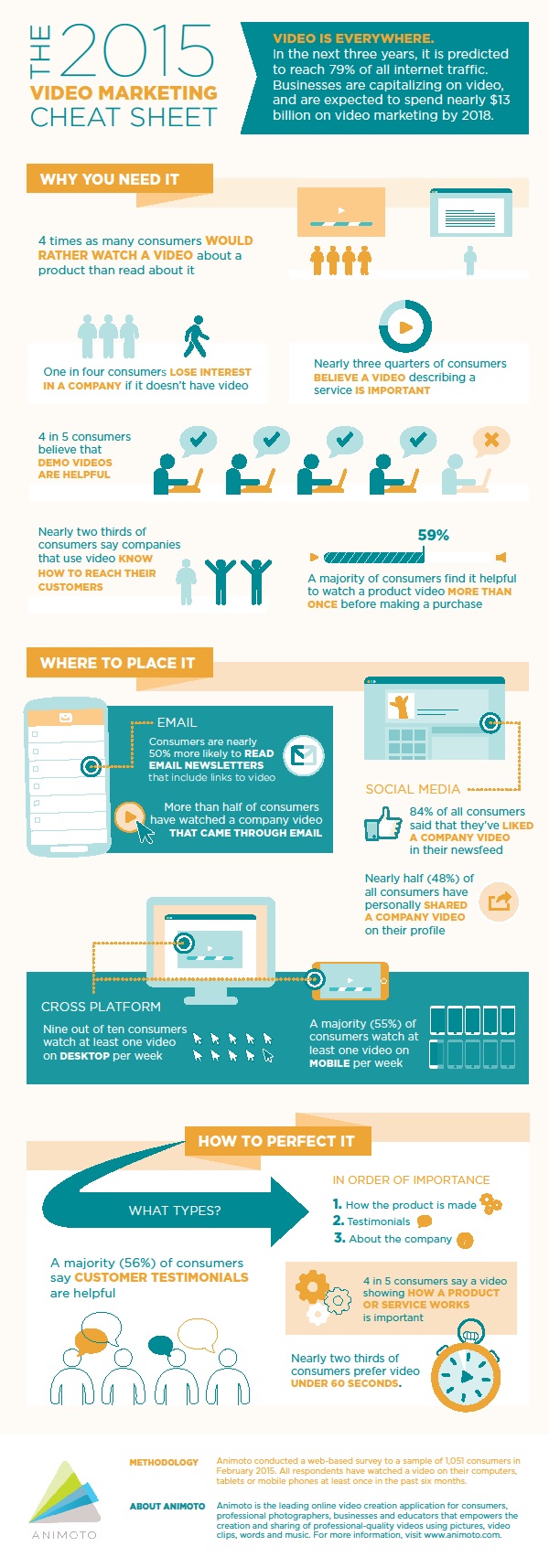
Animoto Survey Says: Consumers Want More Video Marketing on Web, Social and Email [Infographic]

According to a new survey released today by Animoto, the leading cloud-based online video creation service, consumers are hungry for video and four times as many of them would rather watch a product video than read about it. In fact, of the 1,051 U.S. consumers surveyed, 1 in 4 actually lose interest in a company if it doesn’t have product video. The company issued a press release and infographic detailing the findings of its 2015 Video Marketing Cheat Sheet.

eMarketer estimates that US video advertising will climb to $7.8 billion this year and social media platforms like YouTube, Facebook and Twitter continue to attract and build content partnerships. Animoto CEO Brad Jefferson sees video as a huge opportunity for businesses to engage with consumers:
"The growth of online video marketing in recent years has been tremendous," said Jefferson. "Today, there are more than 7 billion videos watched every day on Facebook and YouTube. Historically, in order to create and distribute high-quality video to your customers it was cost-prohibitive for all but the largest brands. However, today's tools and platforms ensure that small and medium businesses can reach their audiences where they hang out online. This represents one of the biggest marketing opportunities for small businesses in a long time."
AnimotoSMBVideoInfographic
Three key themes emerged from the study, data presented below is directly from the press release:

1. Video Marketing Resonates With Consumers (Video drives brand lift)
  • 63 percent of consumers say companies that use video know how to reach their customers
  • One quarter of consumers lose interest in a company if it doesn't use video
  • 56 percent of consumers believe that if a company has a website, it should have video
2. Video Boosts Email Marketing and Social Media Engagement (Connect with consumers)
  • 84 percent of all consumers said that they have liked a company video that has appeared in their newsfeed
  • 43 percent of consumers are more likely to read email newsletters that include links to video
  • 56 percent of consumers have watched a company video that came through email
  • Nearly half of all consumers have shared a company video on their own social media profile
3. Video Boosts Email Marketing and Social Media Engagement (Tell your story)
  • 80 percent of consumers say a video showing how a product or service works is important when learning about the company
  • 56 percent of consumers says customer testimonials are helpful when purchasing a product/service
  • About half of customers say that 'about the company' videos are the most helpful when purchasing a product/service


About Animoto: Animoto makes it easy for businesses to create effective, professional videos within minutes with no video editing experience. Businesses use Animoto to enhance and promote their brands, drive website traffic, increase sales, and create dynamic email, social and online marketing campaigns.Founded in 2006, Animoto is based in New York City with an office in San Francisco.  For more information go to: http://animoto.com/business.

Monday, December 1, 2014

The Evolution of Video Marketing Part 2: An Illustrated History [Reel Summit]

This post is about five months old and goes back to the Reel Summit that was held at the Hotel Nikko in San Francisco on July 24-25, 2014. I meant to do a lot of blogging on this event, which was put on by good friend and ReelSEO rockstar and founder Mark Robertson and Dave Holland, ReelSEO Events and Commercial Director, but as you have noticed I've been way to busy to blog!

So, I share this video produced by BonFire Labs as the first post to wrap up the year, and the best of 2014!


Stay tuned for more to come... and visit ReelSEO to get everything you need to know about video marketing!

Thursday, July 24, 2014

The History of Video Marketing Part 1: Revolution [2014 ReelSummit] #reelsummit

The 2014 Reel Summit taking place today and tomorrow at the Hotel Nikko in San Francisco. This two-day conference is the only industry event devoted entirely to online video marketing for marketers and content creators who are serious about the (r)evolution of digital video marketing. The event is sponsored by ReelSEO and brings together inspiring brands, marketers and industry thought-leaders to share cutting-edge knowledge and advanced training and best practices on video production, online video advertising, brand management, e-Commerce and much more. ReelSEO welcomes video industry leaders YouTube, Vice, Vimeo, Cisco, Buzzfeed, Pixability, Brightcove, JW Player, Tubular, CinemaSins, and many others to learn from each other and celebrate the world of online video marketing.


As YouTube marketing expert Greg Jarboe says, this video, "An Illustrated History of Video Marketing Meet the Screens", produced by Bonfire Labs, illustrates that online video has grown, matured, and become mainstream.
"So has its audience", says Jarboe. "What was once the domain of the cutting-edge few has now become so common that it’s transformed how the world interacts with the web. Companies that never thought of using video now realize it’s the best way to communicate with their customers, build their brands, and educate and inform stakeholders both inside and outside of their organizations. With this new audience comes new challenges and new possibilities."
This year's keynotes include:

This Tubefilter article, 2014 Reel Video Summit Has A Stellar Lineup, Grilled Gurus, captures a great synopsis of the event and discusses a new and different format where attendees can "Grill the Gurus." Also, this Onlinevideo.net article written by YouTube marketing expert 


Several of the sessions will be streamed live on ReelSEO's YouTube, so stay tuned for updates.

More information - http://reelsummit.com

Wednesday, February 26, 2014

Online Video Conversations: Tom Morgan, Net2TV

At OTTCON 2013, I caught up with television industry veteran Tom Morgan, Founder and CEO of Net2TV, to discuss the evolution of traditional television programming and how it's changed with the rise of broadband Internet television. Net2TV is a free, advertising-supported long-form television programming platform for smart TVs and connected devices. Net2TV was established in May 2012 and launched its Portico TV service in December 2012, which delivers niche content channels in food, tech, news and entertainment and looks and feels like a normal "lean-back" TV viewing experience. Content partners included like Discovery's Revision 3, CBS Interactive's CHOW, Popular Science, CNET and other branded content.


Morgan is passionate about Net2TV because it provides him an opportunity to solve the '500 channels and there's nothing on' problem. It's an opportunity to create great TV based on a great business model for program developers and advertisers. Before founding Net2TV in 2012, Morgan spent the last 30 years in the digital media space on business development, focused on advertising models for DVRs, video on demand (VOD), and broadband TV.

According to Morgan, we're in the third phase in the evolution of television, with the two most important dates preceding on, August 28, 1948 and September 7, 1979. In 1948, CBS President Frank Stanton lured big name entertainers like, Lucille Ball, George Burns and Gracie Allen, Jack Benny and Milton Berle away from NBC radio and signed them to TV, which marked the beginning of a whole new medium of programming with "I Love Lucy" and other new shows defined the golden age of television.

On September 1979, a double header softball game was broadcast live for the first time on a little cable TV start-up called ESPN, and launched the first 24/7 Sports channel which brought niche content including live and recorded telecasts, sports talk shows, and other original programming. A year later in 1980, CNN would launch as the first channel to provide 24-hour television news coverage and other special-interest channels and niche content would follow.

"I think where most people talk about this being a new generation of television technology and everything else, what I think is the answer is, these were the emergence of the new networks of television," says Morgan. "So, like you had ESPN and MTV emerge in the 70's and early 80's, you're going to see whole new forms of programming here. Is it radically different? I don't think so. I think people in a television setting, which are sitting on a couch looking at a screen on the wall, regardless of the technology, want to be entertained, they want to be informed, be engrossed and engaged. That's our job in the industry."
Morgan says that we've reached the tipping point for original Internet television programming, with the plethora of original content available from  Netflix, Crackle, Machinima, Revision3, The Makers, Bedrocket, YouTube creators and more and more choices everyday. The greatest opportunity, he says, is that television is being reinvented by this whole new class of programming.
"That's the biggest upside, ever, and that's why I'm in this business. That's the fun part," Morgan acknowledges.

This interview was recorded at OTTCON May 19-20, 2013.

Saturday, January 18, 2014

Online Video Conversations: AJ McGowan, Unicorn Media (now Brightcove)

The online video platform leader Brightcove acquired Unicorn Media on January 6, 2014 for $49 million, consisting of approximately 2.9 million shares of Brightcove stock and approximately $9 million in cash. Unicorn Media is a leading video technology platform company specializing in dynamic ad insertion in the cloud. Unicorn Media's key technology is a product called Unicorn Once, that enables dynamic optimization of video content, either live or VOD, across any Internet-connected device through a single URL, and monetize video content by dynamically inserting and analyzing targeted ads through its patented video cloud technology. Unicorn Media was founded in 2007 and made a name for itself within the online video platform space with more than 50 customers in the broadcast TV sector and $5 million in revenue in 2013. Boston-based Brightcove established itself as the first online video platform (OVP), founded by Jeremy Allaire in June 2005, and went public (NASDAQ: BCOV) in February 2012.

I spoke with AJ McGowan, Chief Technical Officer of Unicorn Media at OTTCON 2013, where he discussed Unicorn's product roadmap and customer experience, its perspective on the state of the online video industry, the challenges within the fragmented market, and where Unicorn would be in 2014. With the acquisition,  McGowan will assume of the role of CTO at Brightcove, and Unicorn's video team and its Once technology joins Brightcove's Video Cloud and App Cloud platforms, and Zencoder, a cloud-based encoding platform and open-source HTML5 video player Video.js, acquired by Brightcove on July 26, 2012 for $30 million.


According to McGowan, the online video industry is at a tipping point. "If you were to compare this, for instance, to the conversion from terrestrial broadcast to cable broadcast, we're probably roughly 1978 or maybe the early 80's, so we're definitely in the early days," says McGowan. "There's massive opportunity that's still in front of us and people are experimenting. There's a lot of fragmentation in the marketplace. There's a lot of complex problems, and we solve a lot of those problems."

McGowan admits that all the complexity is actually great for business, and that throughout 2013 we'll continue to see growth. "Particularly now that we're allowing our customers to monetize their content effectively on all platforms," says McGowan. "That spurs those folks forward to actually putting that content on more platforms. I think we'll continue to see lots and lots of organic growth, and I think we're going to see a lot of different models being applied and we're really excited as a back-end technology vendor, because we make it a lot easier for people to experiment and try different things as they build those audiences."

Some of the challenges facing the industry as a whole, as McGowan points out, is in the friction of the monetization process on the business side. A lot of the hard technical problems have been solved, but one of the biggest problems yet to be solved is how to make an optimal experience, from the brands buying the ad all the way out to the consumer and all constituencies in that value chain. But a lot of smart people are working on solutions now that there's real money flowing into the space.

"I think that a big theme that you're going to see in the next 12-18 months, is as more dollars are being added to this business, as it starts to scale up, how do you make it dial tone? There's this expectation from users whether they're paying for content or whether they're consuming it in an ad-supported way, in either case when we're talking about premium content delivered out to massive audiences, it's go to just work," says McGowan.

So looking into the future, it's going to be all about scale. "Scale, scale, scale," McGowan emphasizes. "How do I get to more users in more places in a consistent high-quality broadcast experience."

This interview was recorded at OTTCON March 19-20, 2013.

Sunday, January 12, 2014

Klessblog's Top 10 of 2013 (Part 2)

Well, the hangover has finally worn off and with the new year in full swing, I can continue this top 10 Klessblog countdown. I picked this top 10 list based on my best experiences of 2013. The last four covered the first part of the year and these top six will bring things up to date. It was a busy year for everyone, with some upheaval,  lots of change and a lot of things stayed the same.

Online video growth continues to skyrocket, as we've seen more brands shift their advertising dollars into online video, a new wave of short-form video creators arose from people are uploading their Vines and Instagram videos, the majority of marketers are jumping into the waters of online video en masse to tell their stories and sell their brands. According to comScore's most recent data of online video rankings, 188.2 million Americans, watched 52.4 billion online videos in December 2013, and video ad views totaled 35.2 billion. That's means 86.9% of Americans who accessed the Internet last month watched online videos, and the average video duration was 4.2 minutes. The average video ads viewed were 15 seconds and they accounted for 40.2% of all the videos viewed and about 5.7% of all the minutes spent viewing online video.

In addition, according to Pew Research, the percent of online American adult who have either created their own original content for viewing or download has doubled from 14% in 2009 to 31% in 2013, with many hoping their videos will go viral. Additionally, the number of adults who watch or download videos has grown almost 10% since in 2009, from 69% to 78% today, with the growth fueled mainly by rapid increase in the use of mobile devices and the growing popularity of social media sites.

But this isn't news to those of us who've been following these trends over the years. We all knew online video would grow and prosper. I could go on and cite countless sources that covered the trends, but again, I refer you to all the great sources I listed in my last post, on the side bar of this blog, including ReelSEOBeet.TVFierce Online VideoOnlineVideo.netDan Rayburn's The Business Of Online VideoStreamingMedia.comVideoNuze, and many more.

I started this blog in November 2007, to join the voices of the streaming media community as a way to share my knowledge, ideas and analysis of the online video industry. As I said in my 100th blog post and my 600th blog post,  I'm grateful for the support of my family, friends, followers, readers, supporters, community members, colleagues, and to the many of you who have contributed to this blog by sharing your time with me to meet and be interviewed by me, sent me press releases and kept me up to date on the latest news and information. I look forward to an even bigger year in 2014 and look back one more time to wrap up Klessblog's Top 10 of 2013.


6. My Google+ Hangout with Neil Davidson on, "The Core of a Successful Corporate Video"
As I said in my from July 1st,  had the pleasure of joining Neil Davidson, Founder and CEO at MyWebPresenters, in a Google+ Hangout to discuss, "The Core of a Successful Corporate Video". I had a great conversation with Neil and you can see the topics we discussed were focused on what are the commonalities that all of the good corporate videos share (hint: tell a story!), how should a business go about fitting a video production into their marketing strategy (hint: start with a good story and shoot video with what you have, either a prosumer camcorder or mobile phone, and try to get good video and audio quality), which businesses are leading the way in using video as a marketing tool (Zappos), what was the biggest video failure and what did I learn from the experience (always have a back up plan), and what are other opportunities for corporate video in 2013 (shoot live action video and don't rely motion graphics with a witty voice over to tell your story). My thanks again, to Neil Davidson for the great conversation. Watch our Google+ Hangout video here.


5. The Strategic Video Awards and Content Marketing Awards
Over the past four years, I've had both the privilege and honor of being as a judge for the Strategic Video Awards, a video competition "created for everyone who uses video to communicate for corporations, associations, non-profits, public institutions, colleges and universities, PR firms and ad agencies, and custom publishers. The Strategic Video Awards differ from other programs in that we judge the effectiveness of the message versus the technical aspects of the video." The Strategic Video Awards entries range from Flip-cam videos to highly-produced corporate documentaries, lighthearted executive vlogs and serious video news programs. Each year the entires get better and better and the 2013 winners will be announced this month. You can view entries from 2010-2012 on the Strategic Video Awards YouTube Channel and watch my favorite entry from 2010, Nationwide - The Musical, which was also the Grand Prize Winner.

Prior to judging this year's Strategic Video Awards, I was asked to be a judge for the Content Marketing Marketing Awards, presented by the Content Marketing Institute and sponsored by McMurry/TMG. According to Content Marketing founder Joe Pulizzi, "content marketing has gone from hot buzzword to a needed universal strategy for enterprise marketers. The Content Marketing Awards are a combination of two esteemed awards programs, the Magnum Opus Awards, honoring the very best in content projects, and CMI’s Orange Awards, honoring the best people and agencies in the business." Open to all companies, organizations, and institutions, this year's Content Marketing Awards had over 800 entries from all the best content marketers in the business in print, digital, publications, strategy, social media, mobile and of course, video.

My category was "Best Topic Specific Video" which had over 40 entries with a variety of styles and techniques. After viewing all the entries the ones that really stood out for me were real stories with real people shot as live action video productions. Many marketers rely just on animated, motion graphics and voice-overs which end up looking like boring animated Infographics that just leave viewers uninspired. So my advise is to actually shoot video to tell your story. See the winners of the 2013 Content Marketing Awards here. Thanks to Program Chairman David Murray and also Benjamine Knight from McMurry/TMG who did an incredible job organizing the competitions.


4. Streaming Media Magazine articles Part 1 and Part 2, "Best Practices for Live Events"
Thanks to the encouragement of my friend and Streaming Media Magazine, StreamingMedia.com, and OnlineVideo.net editor Eric Schumacher-Rasmussen, I wrote a two-part article for Streaming Media Magazine titled, "No Second Chances: Get Live Events Right the First Time".  Earlier in the year, Eric asked me to write a 2500 to 3000-word overview of production, lighting, audio, stage, talent, capture, and delivery, and by the time I completed my first draft I was well over 5000 words. So Eric suggested I turn it into a two part article for the June/July and August/September 2013 issues. The first part looked at the five core elements of a successful live event in the enterprise setting. It's a culmination of key learnings from years of producing live events and offers battle-tested advice to ensure live enterprise events come off without a hitch. The second installment looked at different ways to make the overall webcast experience engaging for your online audience using a variety of different video production techniques interactive tools.

Thanks again to Eric Schumacher-Rasmussen for the opportunity to write for Streaming Media Magazine, and contributions from Nick Balletta, Harvey Louie, Donn Kanagaki, Casey Wilms, Harvey Woo, Steve Dung and to the many people who I have worked with over the years to help me learn what works best for live events, and what doesn't work so well.


3. The 2013 ReelSEO/Liveclicker Video Summit
In July 2013, my good friend and online video superstar Mark Robertson, founder of  ReelSEO, joined forces with Liveclicker to co-host the first ever video marketing summit, held in tandem with Liveclicker's annual Video Commerce Summit. The sold-out event was Liveclicker's 5th annual and an inaugural event for ReelSEO and drew a cross section of over 300 retailers, brands, and agencies attending either summit. Over the last few years, I've interviewed attendees and speakers at the Liveclicker Video Commerce Summit, and I was there again this catching interviews but this year the tables were turned, when Tim Schmoyer asked me to share a video marketing tip for his weekly ReelSEO Creator's tips. The event was largest and only annual event devoted to all things video marketing and video commerce and it was a huge success and according to @JuliePerry, it's game on for #vsummit in 2014, so stay tuned for more awesomeness! A big thanks to Mark Robertson, Jen Fahey, Justin Foster and Dave Holland for putting on a great show and to Kevin Edwards for the video production support!


2. Online Video Conversations
I've been producing and posting short video interviews with online video publishers, producers, entrepreneurs, industry executives and innovators on this blog over the last number of years. But in November of 2013, I launched Onlinevideoconversations.com, as a new home to my many online video conversations. Over the years, I've shot my videos using the Flip Camera, Kodak Zi8, Canon Vixia FH30, with variety of microphones and edited them with Windows Movie Maker, iMovie and Final Cut 7. But just last month, I took the plunge and bought a new MacBook Pro and Final Cut Pro X (which takes some getting used to after years of editing in Final Cut 7) and I'm settling into a workflow. I already have a handful of new videos there, including Mike Folgner, SnappyTVTom Morgan of Net2TV and AJ McGowan, Unicorn Media (now Brightcove), and I'll be be cross-posting the videos there and here on this blog with more in-depth coverage. Look for more online video conversations soon and throughout the year.


1. Don't be Afraid to Let Them See You Dance!
I sometimes joke that when I write my memoirs, it will be titled, "Don't Be Afraid to Let Them See You Dance", which is my metaphor for believing in yourself without worrying about being embarrassed. I work with so many people at so many levels on a daily basis and it's always come easy for me, because I'm such a people person and I have honed my communication and customer services skills for the last 20 years. My daughter once asked me, how do I meet new people all the time and not be awkward. I told her that even if you're nervous, you can't worry about it and you have to work right through it and be yourself. Even though you may dance like Elaine from Senfield, don't be afraid to let them see you dance. So, thanks to my good friend and ever-faithful video director Dominic "Baby Dom" Bonavolonta, I'm now the star of my own Gangnam Style JibJab music video and you can see me in my natural habitat, working and having fun and of course, dancing... (or not!)


Thanks again to all my loyal readers, followers and supporters. Many thanks as well to Kris Drey at Vidcompare for the years of advertising and all the best to him in this ever-changing industry. As we move into a new year, we'll see continued growth and experimentation as standards and distribution models mature. I know I'll be busy as ever and even more so at both my day job and my own business venture with new clients, new challenges and always new adventures.

My best to everyone all in the new year!


(Editor's note: Sorry for the delay, but the year got away from me. Stay tuned for much more to come)